- Plants
- ›Vascular Plants
- ›flowering plants
- ›monocots
- ›grasses, sedges, cattails, and allies
- ›Rushes and Allies
- ›Juncus
- ›Agathryon
- ›Juncotypus
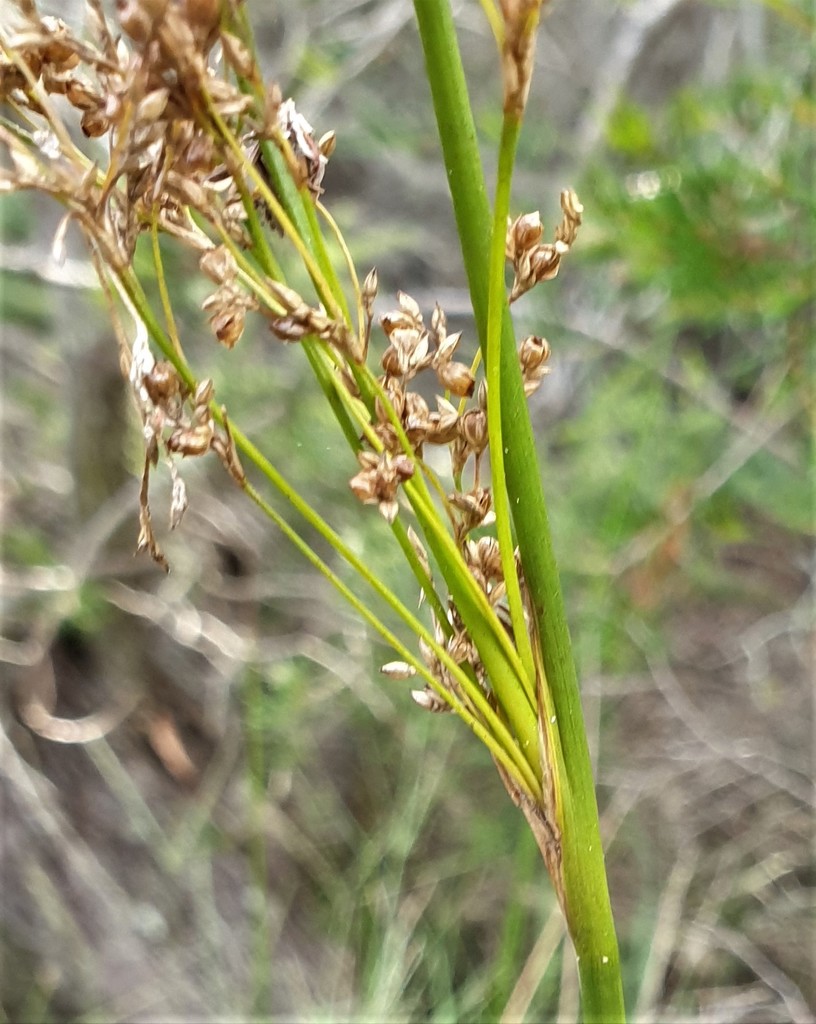
Juncus continuus
Juncus continuus is a perennial plant found in many parts of Australia; namely the regions of Queensland and New South Wales. Juncus continuus has also been introduced in Great Britain and New Zealand, and invasive in Texas. Often growing on sandy, moist soils, near fresh water. The specific epithet refers to the continuous pith within the stems. Basal leaves are reduced to sheaths, colored yellow/brown and split at the base.
While the Juncus continuus is a fairly new discovery, its plant family has been documented for many years. First beginning in a journal published by Johann Friedrich Gmelin titled, "Systema Naturae" between 1788 and 1793. The Juncus Continuus, like its many cousins, is a flowering plant, sporting clusters of small brown flowers on the ends of leaf-like stems.
From the article Juncus continuus on Wikipedia (CC BY-SA), quoted section by section
Description
This plant is described as having the following characteristics:
35–115 cm long culms 1.2-3.0 mm in diameter Cataphylls are 8–14 cm long Numerous flowers that are solitary or loosely clustered Straw-brown tepals The ellipsoid capsule of the flower is longer than, or equaling the length of outer tepals The Juncaceous family is generally perennial and known as a compact rush
Wikipedia: “Characteristics”
Where it lives
Recorded sightings
—
geo-referenced records in GBIF, from museums, herbaria and field observers.
Drag the globe to turn it. Dots are where records exist, not a range map; darker means more records.
In the stacks
Searching the stacks…
Every page naming Juncus continuus in the Biodiversity Heritage Library →
This page is assembled live from iNaturalist, GBIF, Wikipedia, the Source Library and the Internet Archive. It is not yet part of the hand-edited codex. iNaturalist taxon 402858.