- Plants
- ›Vascular Plants
- ›flowering plants
- ›Dicots
- ›nightshades, bindweeds, gooseweeds, and allies
- ›bindweed family
- ›Bindweeds, Morning-glories and Allies
- ›Bindweed Tribe
- ›Convolvulus
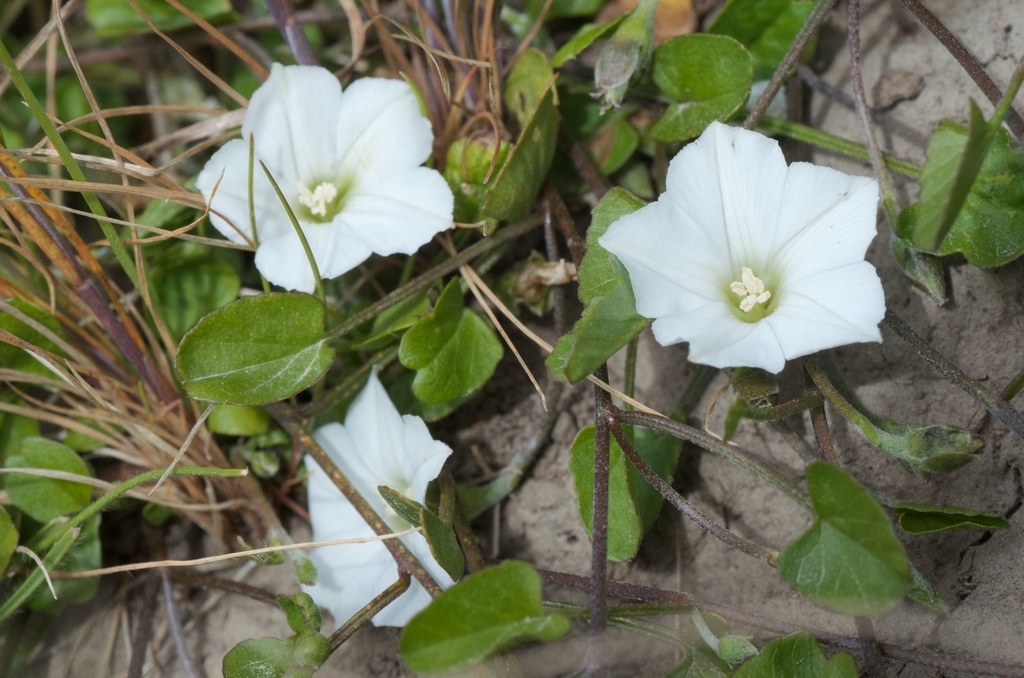
Convolvulus waitaha
Convolvulus waitaha, commonly known as grassland convolvulus, is a species of flowering plant in the family Convolvulaceae. A perennial herb, it is endemic to New Zealand. Its range mainly covers the South Island, but it is also sporadically present in the North Island. It is found in various habitats, such as tussock grasslands and pastures. It was first described in a 2003 article in the New Zealand Journal of Botany. Its 2023 assessment in the New Zealand Threat Classification System was "Not Threatened".
From the article Convolvulus waitaha on Wikipedia (CC BY-SA), quoted section by section
Description
Convolvulus waitaha is a perennial herb in the family Convolvulaceae. The stems can reach a length of up to 800 millimetres (31 inches), which may be covered with hairs. Leaves are found in a rosette arrangement. Leaves are arranged alternately on the stems and measure 6–17 × 5–12 mm long. They range from triangular to oval or broadly oblong in shape and are green in colour. The leaf surface is usually smooth. Leaf edges are smooth to slightly wavy. The pedecils are 8–18 mm long. The sepals are 3.6–4 × 2.1–2.6 mm long. The flowers are white, about 10–16 mm wide when open. The centre of the petals is pale green. The fruits are found in seed capsules which are 5–6 × 5–6.5 mm long, and contain two to four seeds. The seeds are 3.1–3.9 × 2.3–3.3 mm long, and brown to greyish in colour. C. waitaha has a diploid chromosome count of 22.
Range & habitat
Convolvulus waitaha is endemic to New Zealand. Its range sporadically covers the eastern North Island and South Island. There is a historical record of the plant being present in Hawke's Bay. C. waitaha is found in numerous localities along the Cook Strait. In the South Island, C. waitaha is found from the Marlborough Region south to Otago. Its 2023 assessment in the New Zealand Threat Classification System was "Not Threatened".
Habitat. Convolvulus waitaha is found in coastal to lowland environments, reaching 500 m (1,600 ft) above sea level at maximum elevation. It is found in various habitats, including tussock grasslands, browsed pastures, banks, rocky slopes, and gravelly areas.
Wikipedia: “Distribution”
What it does
The members of the Convolvulaceae are primarily pollinated by insects. The seeds of C. waitaha are dispersed by the wind.
Wikipedia: “Ecology”
In human culture
The etymology (word origin) of C. waitaha's genus name, Convolvulus, comes from the Latin convolvere, meaning "to twine around". The specific epithet (second part of the scientific name), waitaha, is a Māori language word meaning 'backwater'. It comes from wai, meaning 'water', and 'taha', meaning "to pass to one side". The species is commonly known as grass convolvulus.
Wikipedia: “Etymology”
Where it lives
Recorded sightings
—
geo-referenced records in GBIF, from museums, herbaria and field observers.
Drag the globe to turn it. Dots are where records exist, not a range map; darker means more records.
In the stacks
Searching the stacks…
Every page naming Convolvulus waitaha in the Biodiversity Heritage Library →
This page is assembled live from iNaturalist, GBIF, Wikipedia, the Source Library and the Internet Archive. It is not yet part of the hand-edited codex. iNaturalist taxon 400997.