- Plants
- ›Vascular Plants
- ›flowering plants
- ›Dicots
- ›Legumes, Milkworts, and Allies
- ›Legumes
- ›Faboideae
- ›Mirbelieae
- ›Callistachys
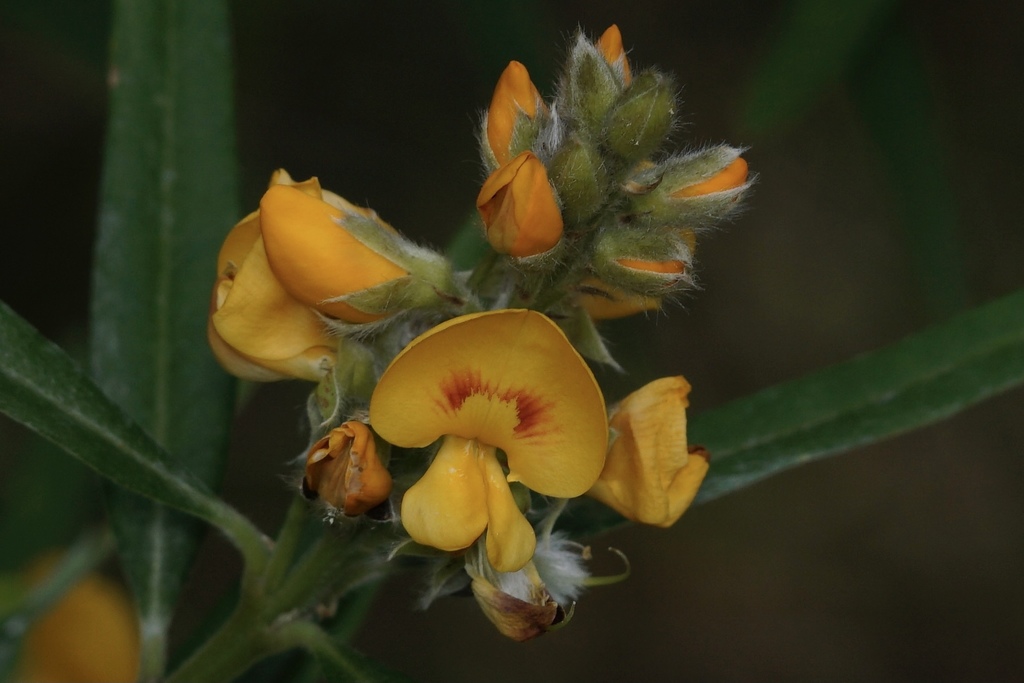
Native Willow
Callistachys lanceolata
Callistachys lanceolata, commonly known as the wonnich, native willow, or greenbush is the sole species in the genus Callistachys. It is a species of erect shrub or small tree that is native to the south-west of Western Australia and is naturalised in some other Australian states.
From the article Callistachys on Wikipedia (CC BY-SA), quoted section by section
Description
Callistachys lanceolata is an erect evergreen tree or shrub that typically grows to a height of 1.5–7 m (4 ft 11 in – 23 ft 0 in) and has silky-hairy young stems. The plant has conspicuous and attractive inflorescence composed of racemes with yellow flowers. The plant flowers from September to January. The leaves of the plant are leathery and are arranged in whorls, most typically with three leaves per whorl. The leaves are generally regular in shape between 40 mm (1.6 in) to 170 mm (6.7 in) in length and 4 mm (0.16 in) to 30 mm (1.2 in) in width and have pointed tips.
Range & habitat
Callistachys lanceolata occurs in the South West corner and South Coast of Western Australia. It grows well in sandy soils in areas that are damp, particularly along watercourses, swamps and culverts.
Wikipedia: “Distribution and habitat”
How it is grown
Seeds can be collected from the plant but the pods the seeds are found in should be left to dry on the plant before they are broken open. The seeds should be scarified before sowing.
== References ==
Wikipedia: “Use in horticulture”
Where it lives
Recorded sightings
—
geo-referenced records in GBIF, from museums, herbaria and field observers.
Drag the globe to turn it. Dots are where records exist, not a range map; darker means more records.
In the stacks
Searching the stacks…
Every page naming Callistachys lanceolata in the Biodiversity Heritage Library →
This page is assembled live from iNaturalist, GBIF, Wikipedia, the Source Library and the Internet Archive. It is not yet part of the hand-edited codex. iNaturalist taxon 400274.