- Plants
- ›Vascular Plants
- ›flowering plants
- ›monocots
- ›Agaves, Orchids, Irises, and Allies
- ›Aloe family
- ›Aloes and allies
- ›Bulbinella
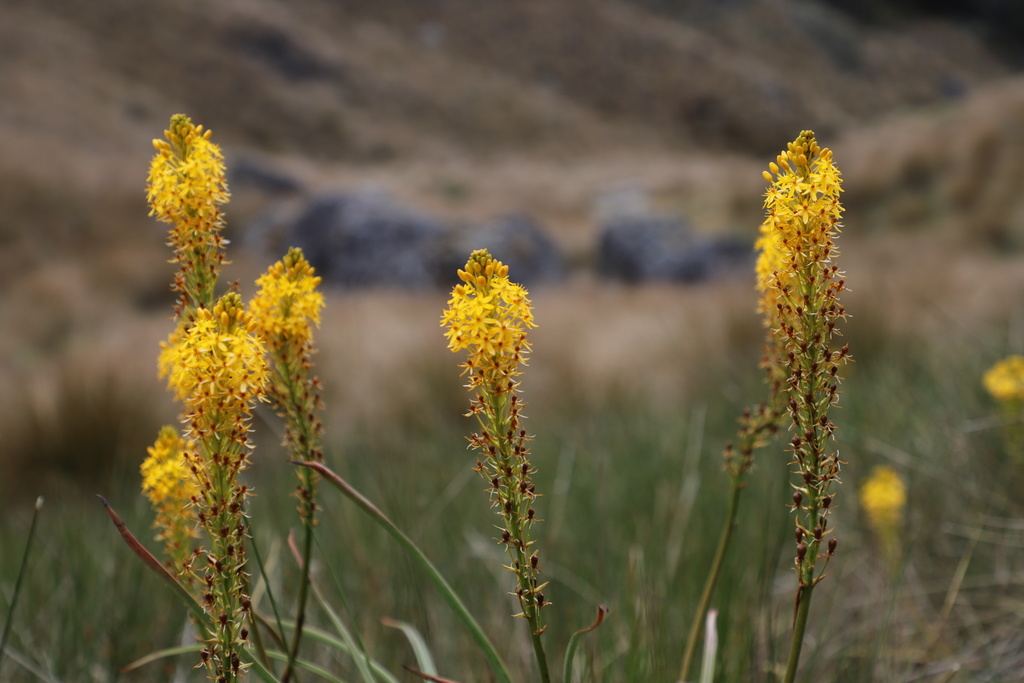
Bulbinella angustifolia
Bulbinella angustifolia, commonly known as the Māori onion, is a species of flowering plant in the family Asphodelaceae. It is endemic to the South Island of New Zealand, mostly found in Canterbury and Otago. It is commonly found in tussock grasslands in areas with moderate moisture contents. B. angustifolia reaches a height of up to 100 cm (40 in) tall. B. angustifolia was first described in 1911 by the New Zealand botanist Leonard Cockayne. It gets its specific epithet, angustifolia, derived from the Latin angustus and folius, meaning 'narrow-leaved'.
From the article Bulbinella angustifolia on Wikipedia (CC BY-SA), quoted section by section
Description
Bulbinella angustifolia is a species of perennial herb in the family Asphodelaceae and the subfamily Asphodeloideae. It reaches 100 cm (40 in) in height. Its leaves are usually smooth and narrow to a tip, the longest and widest leaves were measured at 60 cm (20 in) long and 15 cm (6 in), respectively. B. angustifolia's perianths are small, and the flowers are yellow in colour. Its peduncles are 5–55 mm × 1–10 mm long, the racemes are 2.5–20 × 1.5–2.5 cm long, its pedicels are usually about 15 mm long, but can be 20 mm long. Its capsules are 5–7 × 4 mm long. Its infructescences (fruit clusters) are usually arranged above the leaves. Its seeds are approximately 4–4.5 mm long.
Range & habitat
Bulbinella angustifolia is endemic to the South Island of New Zealand, ranging from approximately the Hurunui River, in the Canterbury Region, southwards through the Canterbury Plains, Otago, and the Southland Region. It is not found west of the Southern Alps. B. angustifolia's 2023 assessment in the New Zealand Threat Classification System was "Not Threatened".
Habitat. New Zealand's Bulbinella species prefer colder habitats and soils with high water content. B. angustifolia is typically found in damp environments such as boglands, seepages, and steep shaded slopes, predominantly in tussock grasslands where it is often locally abundant. It is common in areas with a moderate moisture status, and it commonly coincides with Chionochloa rubra.
Wikipedia: “Distribution”
What it does
A 1996 study reported B. angustifolia was grazed by rabbits (Oryctolagus cuniculus), although in low quantities when compared to other species at the studied site in Central Otago. B. angustifolia is likely pollinated by insects, such as bees and flies, and its seeds are later dispersed by the wind.
Wikipedia: “Ecology”
In human culture
The etymology (word origin) of B. angustifolia's genus name, Bulbinella, derives from the Greek βολβός, simply meaning 'bulb' (an underground plant storage structure). Both words Bulbine and Bulbinella translate to English as 'little bulb'. The specific epithet (second part of the scientific name), angustifolia, derives from the Latin angustus meaning 'constricted' or 'narrow', and folius meaning 'leaf', together meaning narrow-leaved. It is commonly known as the Māori onion.
Wikipedia: “Etymology”
Where it lives
Recorded sightings
—
geo-referenced records in GBIF, from museums, herbaria and field observers.
Drag the globe to turn it. Dots are where records exist, not a range map; darker means more records.
In the stacks
Searching the stacks…
Every page naming Bulbinella angustifolia in the Biodiversity Heritage Library →
This page is assembled live from iNaturalist, GBIF, Wikipedia, the Source Library and the Internet Archive. It is not yet part of the hand-edited codex. iNaturalist taxon 400216.