- Plants
- ›Vascular Plants
- ›flowering plants
- ›monocots
- ›Agaves, Orchids, Irises, and Allies
- ›Asteliaceae
- ›Astelia
- ›Asteliopsis
- ›Desmoneuron
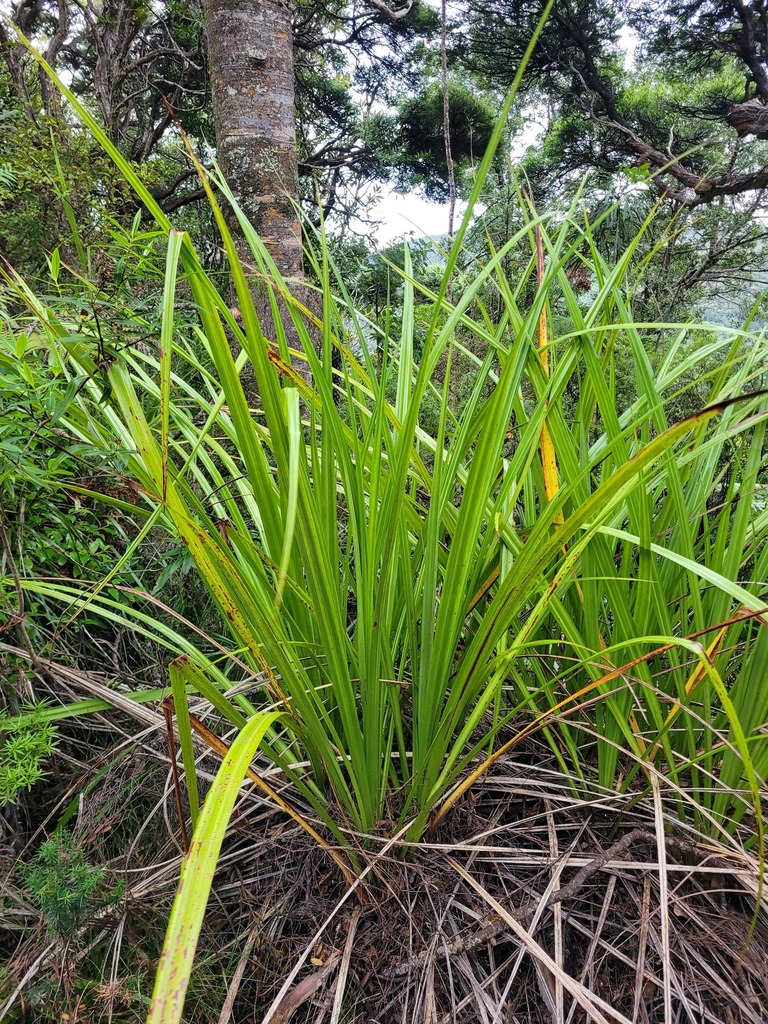
Kauri Grass
Astelia trinervia
Astelia trinervia is a species of rhizomatous tufted perennials which is native to New Zealand. An example occurrence of this species is in the North Island's Hamilton Ecological District where A. trinervia occurs in the understory associated with Crown Fern, Blechnum discolor and overstory forest elements of rimu and nothofagus trees.
From the article Astelia trinervia on Wikipedia (CC BY-SA), quoted section by section
Description
Astelia trinerva has glossy orange-red berries and glossy black seeds. It usually grows 40 to 80 centimetres tall. It has clumps of arching foliage and looks a bit like harakeke. The leaves are olive-grey-green. Distinctive to this species there is a 'prominent central rib flanked by two parallel lateral nerves.' The name 'astelia' is from Greek, "lacking a stem", a flowering plant, monocotyledon. Astelia are a tufted plant that look like grasses or flax. They are mostly a Pacific genus, with many, 15, in New Zealand, including the more common astelia banksii. The preferred habitat for astelia trinerva is places with 'high ambient humidity and consistent oceanic influences'. An example occurrence of this species is in the North Island's Hamilton Ecological District, where it occurs in the understory associated with Blechnum discolor (crown fern) and overstory forest elements of rimu and Nothofagus trees. It is a dioecious plant, it has female and male plants. The pale or white flowers are panicles. It flowers in late spring and berries are present through winter. It thrives in the acidic soil of kauri forests. It is used in landscaping including architectural foliage planting, and has adaptability to shaded gardens.
In human culture
The cultural significance to Māori of the plant astelia trinervia includes customary use of the berries and seeds that were eaten and also used as a dye. Other customary uses included hat making, thatching and candle wicks.
Wikipedia: “Cultural significance”
Where it lives
Recorded sightings
—
geo-referenced records in GBIF, from museums, herbaria and field observers.
Drag the globe to turn it. Dots are where records exist, not a range map; darker means more records.
In the stacks
Searching the stacks…
Every page naming Astelia trinervia in the Biodiversity Heritage Library →
This page is assembled live from iNaturalist, GBIF, Wikipedia, the Source Library and the Internet Archive. It is not yet part of the hand-edited codex. iNaturalist taxon 399808.