- Animals
- ›Arthropods
- ›Hexapods
- ›Insects
- ›Winged and Once-winged Insects
- ›Grasshoppers, Crickets, and Katydids
- ›Katydids, Crickets, and Allies
- ›Crickets
- ›True Crickets and Allies
- ›True Crickets
- ›Field Crickets
- ›Gryllini
- ›Teleogryllus
- ›Brachyteleogryllus
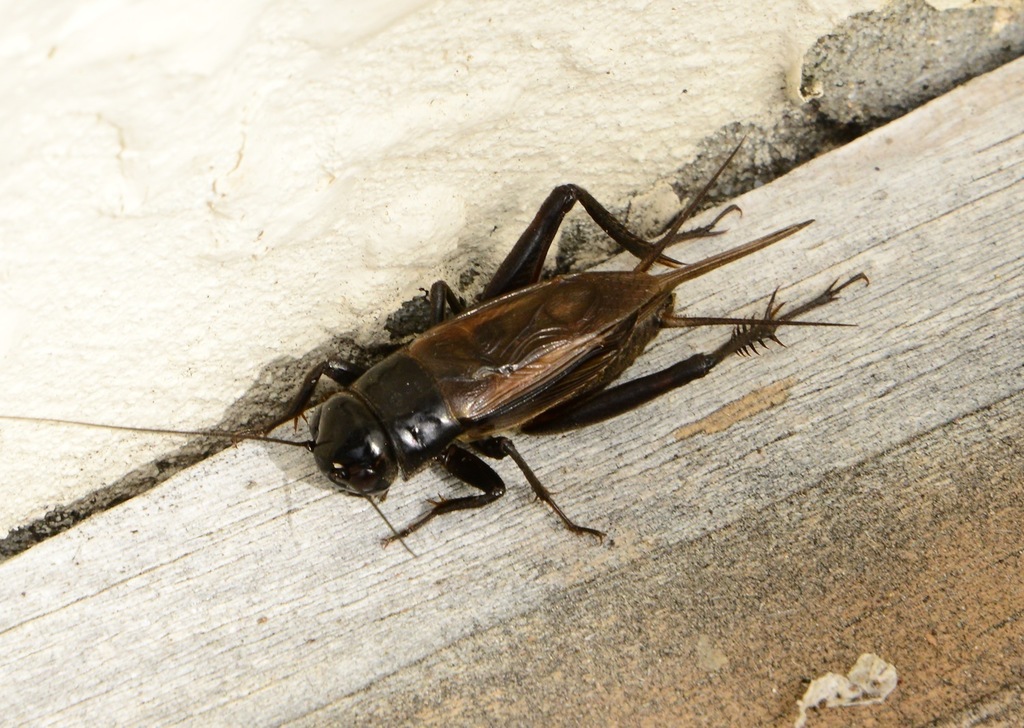
Australian Black Field Cricket
Teleogryllus commodus
Teleogryllus commodus, commonly known as the black field cricket, is a cricket species native to Australia. They are significant pests to most plants in Australia and New Zealand. T. commodus belongs to the order Orthoptera, the family Gryllidae which are characterized by wings that are folded on the side of the body, chewing mouthparts and long, thin antennae. T. commodus has the ability to learn via the recognition of rewards. They are also capable of odour recognition and thus can be taught via odour pairing.
From the article Teleogryllus commodus on Wikipedia (CC BY-SA), quoted section by section
Description
T. commodus can grow up to 30 mm long, with long antennas and legs adapted for jumping. Their coloration is usually black or brown. Nymphs can be recognized by a white stripe on the abdomen. Adult females are characterized by ovipositors which are long structures used for laying eggs. In contrast, males have modified veins in forewings with hard pegs that play a role in song production. Another fact about black field crickets is that their tegmina (leathery forewing) is asymmetrical. T. commodus undergo hemimetabolous (the lack of pupal stage from larva to adult) development with 3 main stages: egg, nymph (multiple stages~8), and adulthood Females age faster than males do. Furthermore, virgin males have a shorter life expectancy than mated males, most likely due to high calling efforts in attracting mates. However, high quality males may still die sooner if they call very intensely.
Wikipedia: “Morphology”
Range & habitat
T. commodus can be located throughout Australia and New Zealand. The species originated in Australia but with time they were introduced to New Zealand. They are known to cause significant damage to pastures and gardens. The habitat of T. commodus consists of rocky surfaces or ground with large amounts of cracks as it gives them shelter from the sun, and is most active at night. Moreover, T. commodus live in clusters and thus seek living quarters that are already occupied by others. The adult males usually change burrows every two days as a consequence of scarce mates or frequent attacks from other males.
Wikipedia: “Habitat”
What it does
Males attract females to burrows through production of advertisement calls, wherein females will mount the males should they be interested - therefore, song production is a key determinant for fitness of the male. Once a female have chosen a mate, they undergo multiple matings to increases the males’ probability of paternity. Successful mating leads to oogenesis (production of egg), ovulation (release of egg into oviduct), fertilization, and oviposition (deposition of eggs using ovipositor). Once the eggs are laid they need to absorb water required for development. The duration of water absorption is dependent on the temperature of the environment; in higher temperatures, faster water absorption is required. By absorbing water, the size of the egg shell increases thereby increasing the odds of the progeny hatching.
Wikipedia: “Reproduction”
Listen
Looking for field recordings…
Where it lives
Recorded sightings
—
geo-referenced records in GBIF, from museums, herbaria and field observers.
Drag the globe to turn it. Dots are where records exist, not a range map; darker means more records.
In the stacks
Searching the stacks…
Every page naming Teleogryllus commodus in the Biodiversity Heritage Library →
This page is assembled live from iNaturalist, GBIF, Wikipedia, the Source Library and the Internet Archive. It is not yet part of the hand-edited codex. iNaturalist taxon 397920.