- Animals
- ›Arthropods
- ›Hexapods
- ›Insects
- ›Winged and Once-winged Insects
- ›Butterflies and Moths
- ›Mandibulate Archaic Moths
- ›Micropterigidae
- ›Sabatinca
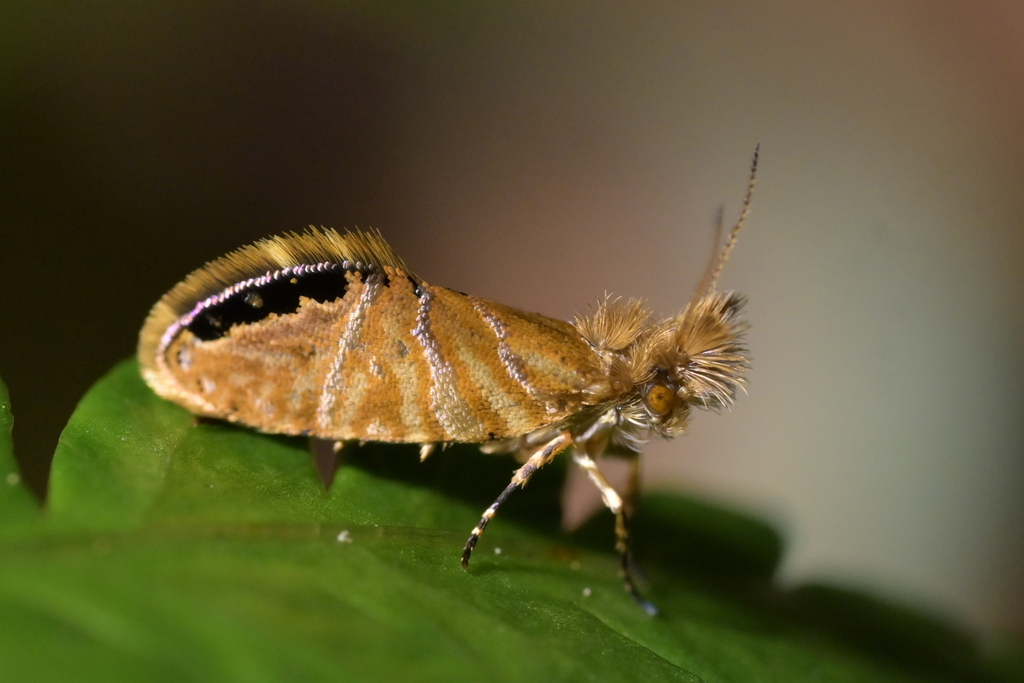
Sabatinca calliarcha
Sabatinca calliarcha is a species of moth belonging to the family Micropterigidae. It was described by Edward Meyrick in 1912. It is endemic to New Zealand. It is found in two separate areas of New Zealand - the first in the northern parts of the North Island including Great Barrier Island and the second population can be found from the top of the South Island down to Southland. The adults of the species are on the wing from the end of September until the middle of January. The species prefers to inhabit damp forests and larvae likely feed on leafy liverwort species. Adult moths likely feed on the spores of ferns or the pollen of sedge grasses.
From the article Sabatinca calliarcha on Wikipedia (CC BY-SA), quoted section by section
Description
Meyrick described the adults of this species as follows:
♂. 12 mm. Head light bronzy-ochreous, hairs extremely long. with long bronzy-ochreous hairs, beneath which is a white bent stripe on each side of back. Abdomen blackish, apex ochreous-whitish. Forewings elongate-ovate, costa moderately arched, apex obtuse, termen very obliquely rounded; yellow; dorsum suffused with ferruginous-brown, with a few black scales on edge; four golden-whitish streaks from costa between base and f converging towards posterior half of dorsum, first edged posteriorly with ferruginous-brown mixed with indigo-black, hardly reaching dorsum, other three margined on both sides with ferruginous-brown streaks and on costa with black, second and fourth reaching dorsum, third reaching about half across wing; posterior area ferruginous-brownish somewhat mixed with pale yellowish, with an irregular black dot in disc at 3⁄4, and four black dots on costa edged beneath with golden-whitish; a thick black streak lying along termen from near apex to tornus, edged with ochreous-yellowish and interrupted to form a long upper and short lower portion, upper portion including two golden-metallic terminal dots : cilia light ochreous-yellowish, with a violet-coppery basal line edged externally with grey. …
Range & habitat
This species is endemic to New Zealand. This species is very wide spread being found in the northern parts of the North Island, that is the Waitākere and Coromandel ranges as well as Great Barrier Island, and in the South Island from Nelson down to the Southland and Fiordland. It has been hypothesised that these two populations have been separated for a long period of time.
Wikipedia: “Distribution”
What it does
Adults are on the wing from the end of September until the middle of January. Adult moths have been seen resting on algae covered stones where its wing colouration ensures it is well camouflaged. When disturbed it takes flight and comes to rest a short distance away. It is very difficult to see when on the wing.
Wikipedia: “Behaviour”
Listen
Looking for field recordings…
Where it lives
Recorded sightings
—
geo-referenced records in GBIF, from museums, herbaria and field observers.
Drag the globe to turn it. Dots are where records exist, not a range map; darker means more records.
In the stacks
Searching the stacks…
Every page naming Sabatinca calliarcha in the Biodiversity Heritage Library →
This page is assembled live from iNaturalist, GBIF, Wikipedia, the Source Library and the Internet Archive. It is not yet part of the hand-edited codex. iNaturalist taxon 396491.