- Animals
- ›Arthropods
- ›Hexapods
- ›Insects
- ›Winged and Once-winged Insects
- ›Butterflies and Moths
- ›Bagworms, Clothes Moths, and Allies
- ›Bagworm Moths
- ›Rhathamictis
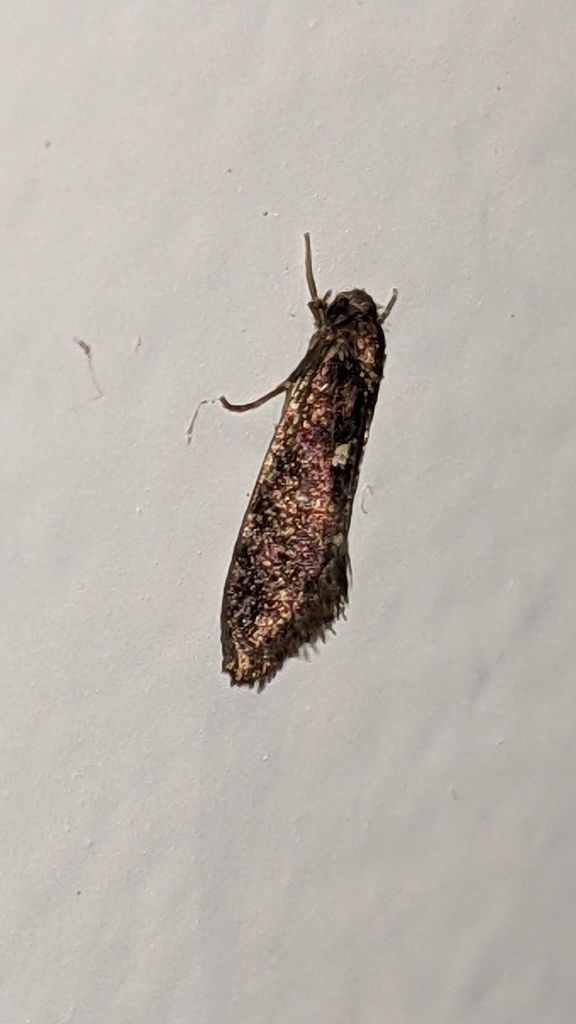
Rhathamictis perspersa
Rhathamictis perspersa is a moth of the family Psychidae. This species was described by Edward Meyrick in 1924. It is endemic to New Zealand and has been observed in the Wellington region. Larvae of this species build small protective cases in which they hide and feed. The cases are brown and are neat in construction. The larvae live under the loose bark of trees and feed on inert animal matter. The adults have been observed on the wing in February and March.
From the article Rhathamictis perspersa on Wikipedia (CC BY-SA), quoted section by section
Description
Meyrick described the male of this species as follows:
♂. 14 mm. Head, palpi, and thorax grey. Forewings elongate, apex rounded-obtuse, termen obliquely rounded; dark purple-grey; scattered whitish-ochreous dots and strigulae—viz., about 7 transverse strigulae from costa, several in disc, a dot at apex, and about 15 small irregular dots in dorsal area: cilia purplish-coppery. Hindwings dark purple; cilia grey. Hudson described the female of this species from a specimen collected at Gollan's Valley in February, a month earlier than the holotype. His description is as follows:
It is darker and blacker in colour than the male specimen from which the original figure and descriptions were taken. It also has definite, clear whitish-ochreous marks on the dorsum of forewings at 1⁄3and 2⁄3. The pale whitish-ochreous dots on the other portions of the wing are rather obscure, and some of them are only visible in certain lights. Hudson goes on to hypothesise that, as a result of the dates of capture, the holotype specimen may be worn or faded.
Range & habitat
This species is endemic to New Zealand. It has been collected in the Wellington region. This species is said to be associated with the species Olearia hectorii which is endemic to the South Island.
Wikipedia: “Distribution”
What it does
Larvae of this species build small protective cases in which they hide and from which they feed. Adults of this species have been recorded on the wing in February and March. Little is known of its habits, but according to a study the case-bearing larvae live largely under the loose bark of trees and feed on inert animal matter, either live, such as pupae and the eggs of invertebrates, or animal detritus, such as dead moths. Under such trees the abandoned cases may be numerous, and indicate that the adult eclosion season is late summer and that the species is univoltine. The cases are brown and are neat in construction; the case of the mature larva is about 8 mm in length.
== References ==
Wikipedia: “Behaviour and life cycle”
Listen
Looking for field recordings…
Where it lives
Recorded sightings
—
geo-referenced records in GBIF, from museums, herbaria and field observers.
Drag the globe to turn it. Dots are where records exist, not a range map; darker means more records.
In the stacks
Searching the stacks…
Every page naming Rhathamictis perspersa in the Biodiversity Heritage Library →
This page is assembled live from iNaturalist, GBIF, Wikipedia, the Source Library and the Internet Archive. It is not yet part of the hand-edited codex. iNaturalist taxon 396353.