- Animals
- ›Arthropods
- ›Hexapods
- ›Insects
- ›Winged and Once-winged Insects
- ›Beetles
- ›Water, Rove, Scarab, Long-horned, Leaf, and Snout Beetles
- ›Bostrichiform Beetles
- ›Carpet, Powderpost, and Deathwatch Beetles
- ›Deathwatch, Spider, and Wood-borer Beetles
- ›Spider Beetles
- ›Ptinini
- ›Ptinus
- ›Tectoptinus
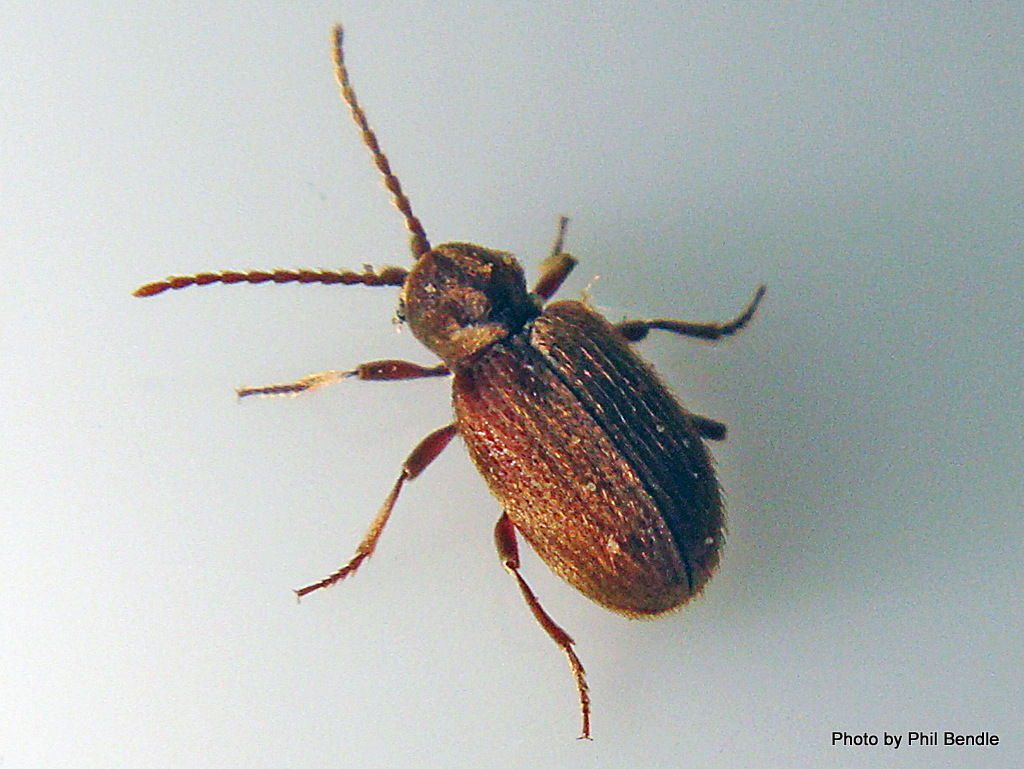
Australian Spider Beetle
Ptinus tectus
Ptinus tectus, often called the Australian spider beetle, is a species of beetle in the family Ptinidae, or family Anobiidae, subfamily Ptininae. It is a cosmopolitan species (arrived in Europe and the UK from Australia in 1900). It is a pest of stored foods and museum specimens.
P. tectus Boieldieu, 1856 is the name most often used for this species. Some works still state Ptinus ocellus Brown, 1929.
From the article Ptinus tectus on Wikipedia (CC BY-SA), quoted section by section
Description
The Australian spider beetle (Pictus tectus) measures 2.5–4 mm in length and is coloured dark brown. The adults have biting mouthparts, a well developed thorax and 11-segmented antennae. Characteristics which give them a spider-like appearance include a stout body, pronounced constriction of the neck shield and 6 long thin legs with 5-segmented tarsi.
What it does
The female Australian spider beetle lays 100–120 sticky eggs over a period of 4–5 weeks in early summer, either singly or in small batches. At 20–25 °C the eggs hatch in 3–16 days, producing larvae which are fleshy, curved, covered with fine hairs and relatively immobile. Larval development takes at least 6 weeks, during which time the larvae moult 4 or 5 times. When mature, they wander in search of a pupation site where they spin a cocoon cell in which to pupate. Adults emerge after 20 to 30 days and will live for as long 12 months. At 70% R.H. development of Ptinus tectus from egg laying to emergence from the cocoon takes an average of about 62 days at 23–25 °C; at 15 °C the time taken is about 130 days. The minimum temperature at which complete development can occur is 10 °C and the maximum is between 28 and 30 °C. Considerable mortality occurs in eggs and larvae at 28 °C.
Wikipedia: “Life cycle”
Listen
Looking for field recordings…
Where it lives
Recorded sightings
—
geo-referenced records in GBIF, from museums, herbaria and field observers.
Drag the globe to turn it. Dots are where records exist, not a range map; darker means more records.
In the stacks
Searching the stacks…
Every page naming Ptinus tectus in the Biodiversity Heritage Library →
This page is assembled live from iNaturalist, GBIF, Wikipedia, the Source Library and the Internet Archive. It is not yet part of the hand-edited codex. iNaturalist taxon 396021.