- Animals
- ›Arthropods
- ›Hexapods
- ›Insects
- ›Winged and Once-winged Insects
- ›Butterflies and Moths
- ›Geometrid and Swallowtail Moths
- ›Geometer Moths
- ›Carpet Moths
- ›Pug Moths & Allies
- ›Pasiphila
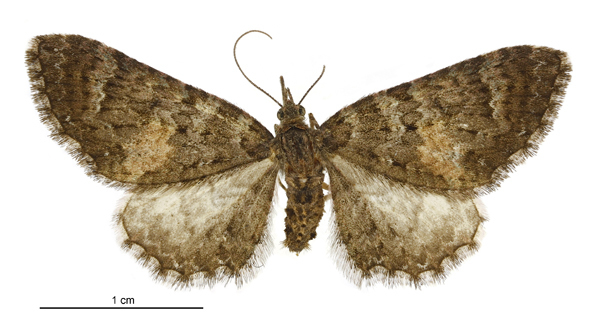
Pasiphila rubella
Pasiphila rubella is a moth of the family Geometridae. This species was first described by Alfred Philpott in 1915. It is endemic to New Zealand and has been observed in the South Island. P. rubella inhabit the upper edges of native forest at elevations of up to 4000 ft. Adults are commonly on the wing in December and January and have an affinity for Veronica odora. They are attracted to light. Larvae feed on the flowers of Veronica species.
From the article Pasiphila rubella on Wikipedia (CC BY-SA), quoted section by section
Description
Philpott described the adults of this species as follows:
♂♀. 28-29 mm. Head, palpi, thorax, and abdomen dark greenish- fuscous with some admixture of greyisb-pink and white scales. Palpi 2. Antennae in ♂ ciliate-fasciculate, ciliations 4. Forewings triangular, broad, costa in ♂ rather strongly arched on apical fourth, termen obliquely bowed ; dark greenish-fuscous mixed with black and tinted, especially round tornus, with pink ; veins interruptedly marked with black ; lines very obscure : a double, outwardly somewhat dentate, line at 1⁄4 ; a hardly traceable similar basal line ; median band moderate, inward margin curved, subdentate ; outer margin irregular, followed by 4 or 5 alternate lighter and darker lines, most distinct on costal half ; subterminal line bluish-green, serrate : cilia, basal half and suffused bars fuscous-greenish, apical half grey, flushed with pink. Hindwings, termen rounded ; fuscous grey, darker and flushed with pink towards dorsum and termen ; numerous obscure lighter and darker waved lines : cilia as in forewings.
Range & habitat
This species is endemic to New Zealand. This species has been observed in the South Island.
Wikipedia: “Distribution”
What it does
Adults of this species are commonly on the wing in December and January and have an affinity for Veronica odora. They are attracted to light.
== References ==
Wikipedia: “Behaviour”
Listen
Looking for field recordings…
Where it lives
Recorded sightings
—
geo-referenced records in GBIF, from museums, herbaria and field observers.
Drag the globe to turn it. Dots are where records exist, not a range map; darker means more records.
In the stacks
Searching the stacks…
Every page naming Pasiphila rubella in the Biodiversity Heritage Library →
This page is assembled live from iNaturalist, GBIF, Wikipedia, the Source Library and the Internet Archive. It is not yet part of the hand-edited codex. iNaturalist taxon 394666.