- Animals
- ›Arthropods
- ›Hexapods
- ›Insects
- ›Winged and Once-winged Insects
- ›Butterflies and Moths
- ›Geometrid and Swallowtail Moths
- ›Geometer Moths
- ›Carpet Moths
- ›Pug Moths & Allies
- ›Pasiphila
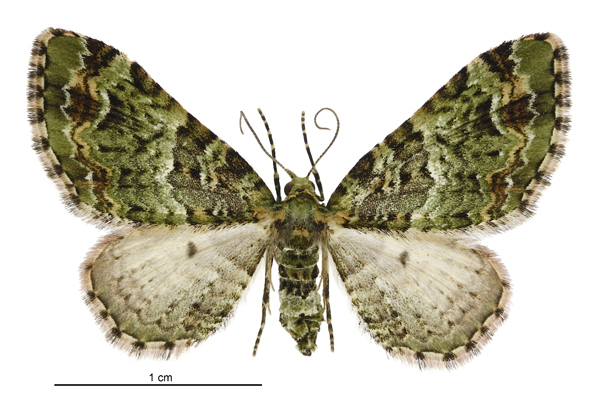
Pasiphila bilineolata
Pasiphila bilineolata is a moth in the family Geometridae. It is endemic to New Zealand and can be found in the North and South Islands. The species inhabits native forest and shrubland and the larvae feed on Hebe species. Adults are on the wing commonly from August to January but have been observed most months of the year and are attracted to light.
From the article Pasiphila bilineolata on Wikipedia (CC BY-SA), quoted section by section
Description
Walker described the species as follows:
Female. Greenish cinereous. Palpi obliquely ascending, as long as the breadth of the head. Thorax with two black points on each side. Abdomen slightly crested, with a broad blackish band near the base. Wings rather broad, with several brown denticulated lives, some of which, and especially in the fore wings, are clouded or pointed with black; submarginal line whitish, zigzag; marginal points black, elongated. Fore wings slightly acute, with a fawn coloured tinge at the base, and with a black discal point. Hind wings reddish cinereous. Length of the body 4 lines; of the wings 12 lines. The forewings are bright green with numerous wavy darker lines. The hindwings are grey, slightly tinged with reddish. Adults are on wing from September to May.
Range & habitat
This species is endemic to New Zealand. This species has been observed in the North and South Islands.
Wikipedia: “Distribution”
What it does
This species is on the wing mainly from August to January but observations have also been recorded in February, April, May and June. This species is attracted to light.
Wikipedia: “Behaviour”
Listen
Looking for field recordings…
Where it lives
Recorded sightings
—
geo-referenced records in GBIF, from museums, herbaria and field observers.
Drag the globe to turn it. Dots are where records exist, not a range map; darker means more records.
In the stacks
Searching the stacks…
Every page naming Pasiphila bilineolata in the Biodiversity Heritage Library →
This page is assembled live from iNaturalist, GBIF, Wikipedia, the Source Library and the Internet Archive. It is not yet part of the hand-edited codex. iNaturalist taxon 394643.