- Animals
- ›Arthropods
- ›Hexapods
- ›Insects
- ›Winged and Once-winged Insects
- ›Beetles
- ›Water, Rove, Scarab, Long-horned, Leaf, and Snout Beetles
- ›Cucujiform Beetles
- ›Darkling Beetles and Allies
- ›False Blister Beetles
- ›Oedemerinae
- ›Asclerini
- ›Parisopalpus
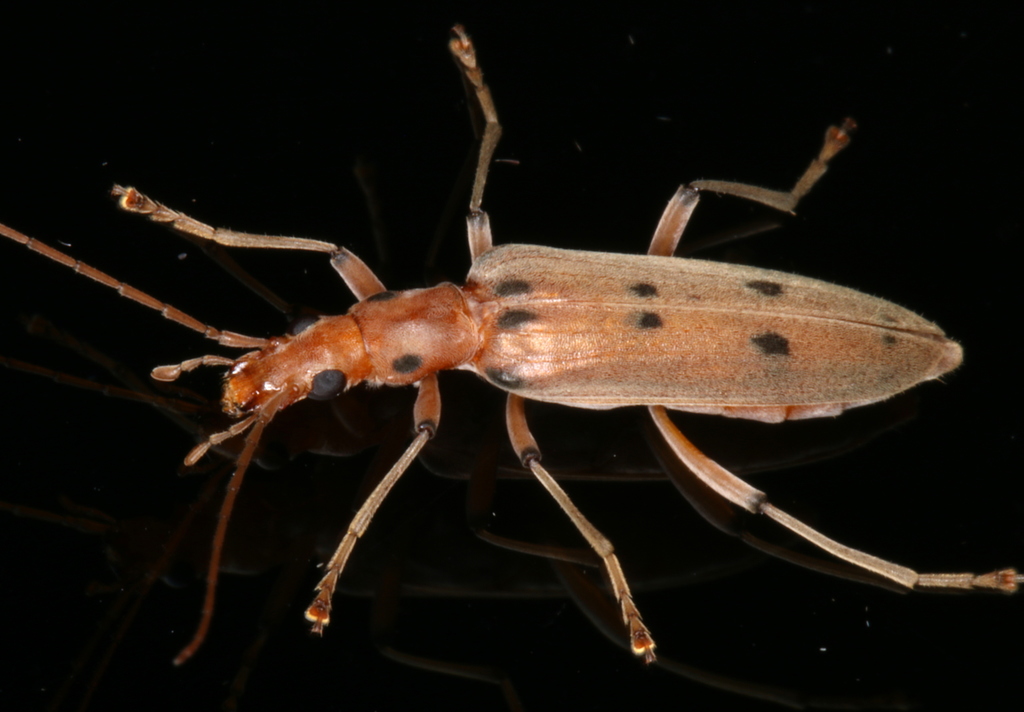
Spotted lax beetle
Parisopalpus nigronotatus
Parisopalpus nigronotatus, known by its common name, the spotted lax beetle, is a species of false blister beetles. It was first identified by Carl Henrik Boheman in 1858, under the name Nacerdes nigronotata. Native to eastern Australia, the species was introduced to New Zealand in 1931.
From the article Parisopalpus nigronotatus on Wikipedia (CC BY-SA), quoted section by section
Description
Parisopalpus nigronotatus is generally coloured brick-red, with dark spots found on the beetle's body and legs. The species is densely covered with pale hair. The beetle is typically between 8.7 and 12.2 mm in length. Parisopalpus nigronotatus can be told apart from other species of Parisopalpus by the presence of at least two dark spots on the beetle's body.
Range & habitat
Parisopalpus nigronotatus is found in eastern Australia, south-eastern Australia and Tasmania. It was introduced to New Zealand in 1931, and is found in Nelson and the North Island. The species has been intercepted by biosecurity in Chile.
Wikipedia: “Distribution”
What it does
The beetles lay their eggs in mangroves. Grubs of the species are typically found in rotting wood, and as adults the beetles feed on nectar and pollen, and are attracted to light. The beetles secrete a toxic substance as a defense, which causes skin blisters in humans if touched.
== References ==
Wikipedia: “Behaviour”
Listen
Looking for field recordings…
Where it lives
Recorded sightings
—
geo-referenced records in GBIF, from museums, herbaria and field observers.
Drag the globe to turn it. Dots are where records exist, not a range map; darker means more records.
In the stacks
Searching the stacks…
Every page naming Parisopalpus nigronotatus in the Biodiversity Heritage Library →
This page is assembled live from iNaturalist, GBIF, Wikipedia, the Source Library and the Internet Archive. It is not yet part of the hand-edited codex. iNaturalist taxon 394571.