- Animals
- ›Arthropods
- ›Hexapods
- ›Insects
- ›Winged and Once-winged Insects
- ›Butterflies and Moths
- ›Curved-horn Moths
- ›Timber Moths
- ›Hierodoris
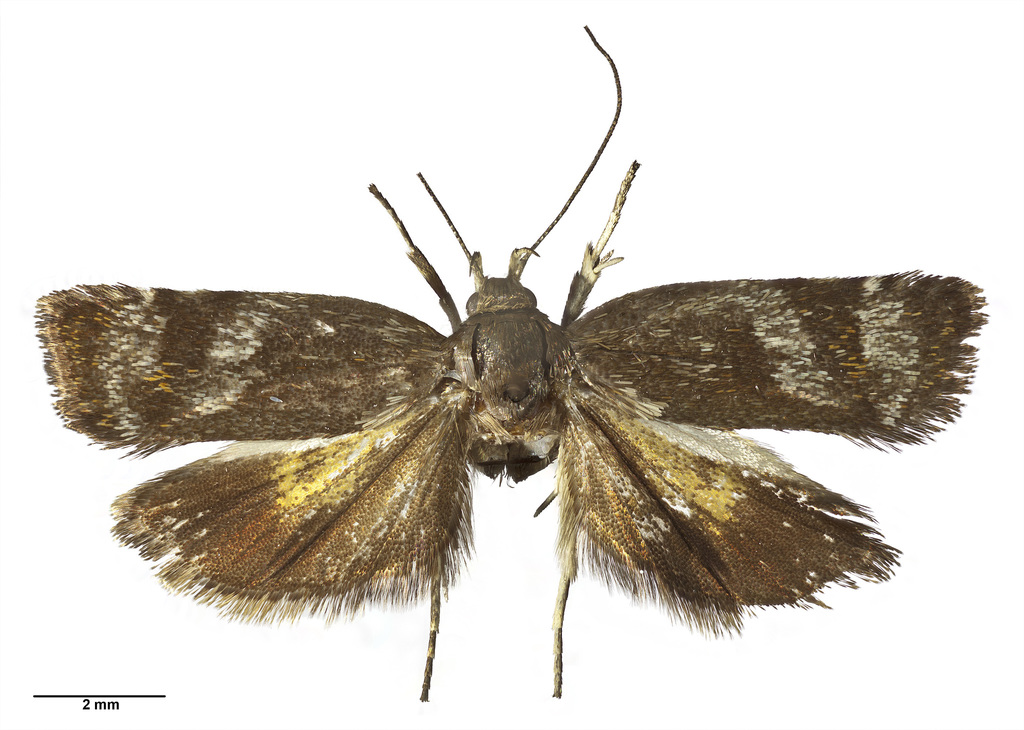
Hierodoris bilineata
Hierodoris bilineata is a species of moth in the family Oecophoridae. It is endemic to New Zealand. This species is classified as "At Risk, Naturally Uncommon" by the Department of Conservation. It is possible that this species gives birth to live young rather than lay eggs as is the norm.
From the article Hierodoris bilineata on Wikipedia (CC BY-SA), quoted section by section
Description
Salmon describes the species as follows:
The expansion of the wings is 15mm. The forewings are somewhat rectangular in shape, on the distal half, with the costa strongly arched to the base; dark brown in colour with a cloudy blackish spot at the centre and another at two-thirds; between these two spots from the costa almost to the dorsum runs a broad band of whitish scales superimposed upon the ground of dark-brown; beyond the distal blackish spot is a second similar whitish line; these two lines are inclined toward one another and may be joined by a thin line above the dorsum giving the appearance of a broad U-shaped band. There is a small tuft of whitish scales basally scattered over the entire forewings and impart a pleasing bronzy reflection to them. Hind wings are dark-brown with the costa broadly white basally, narrowing towards the apex, and shaded with bright orange-yellow from the base almost to the centre. Cilia of the fore-wings dark brown, of the hind wings ochreous-brown shaded with dark-brown at the base. Head and thorax heavily scaled; patagia small, dark brown. Body entirely dark-brown above with transverse intersegmental bands of bright-orange across the abdomen; below it is profusely shaded with whitish scales. …
Range & habitat
This species is endemic to New Zealand. It is likely that H. bilineata is found only at the Three Kings Islands. Along with its type locality of Great Island, it has also been collected from South West Island.
Wikipedia: “Distribution”
What it does
Little is known of the biology of this species. It has been hypothesised, as a result of the discovery of a larva in the oviduct of a female moth during dissection, that this species gives birth to live young rather than laying eggs. The adults of this species are on the wing in April and May.
Wikipedia: “Biology and behaviour”
Listen
Looking for field recordings…
Where it lives
Recorded sightings
—
geo-referenced records in GBIF, from museums, herbaria and field observers.
Drag the globe to turn it. Dots are where records exist, not a range map; darker means more records.
In the stacks
Searching the stacks…
Every page naming Hierodoris bilineata in the Biodiversity Heritage Library →
This page is assembled live from iNaturalist, GBIF, Wikipedia, the Source Library and the Internet Archive. It is not yet part of the hand-edited codex. iNaturalist taxon 390501.