- Animals
- ›Arthropods
- ›Hexapods
- ›Insects
- ›Winged and Once-winged Insects
- ›Butterflies and Moths
- ›Tortricid Leafroller Moths and Allies
- ›Tortricid Leafroller Moths
- ›Tortricine Leafroller Moths
- ›Archipini
- ›Epalxiphora
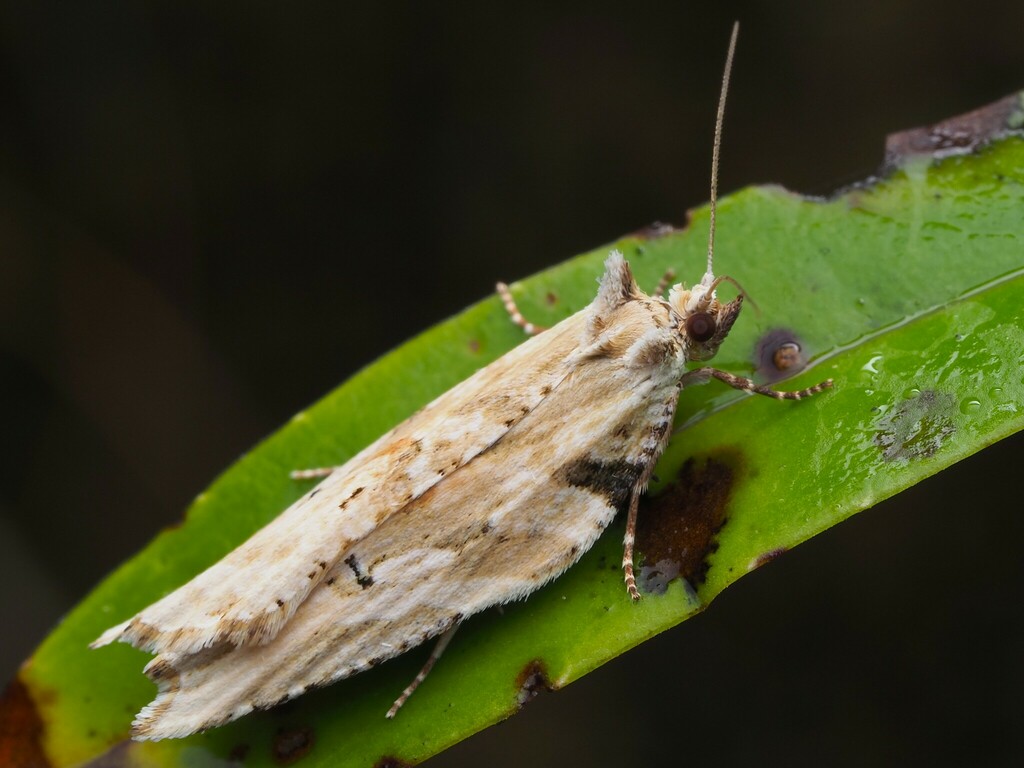
Sharp-Tipped Bell Moth
Epalxiphora axenana
Epalxiphora axenana, the brindled bell or sharp-tipped bell moth, is a species of moth of the family Tortricidae. It was first described by Edward Meyrick in 1881. It is endemic to New Zealand and is found throughout the North Island and in the South Island districts of Nelson, Buller and Westland. This species is strongly sexually dimorphic and has unusually shaped forewings which can assist with identification. Adults are variable in appearance. This species inhabits native forest with larvae feeding on a range of native shrubs as well as citrus species. Adults are on the wing throughout the year but are most frequently observed during New Zealand summer months. They are nocturnal and are attracted to light.
From the article Epalxiphora axenana on Wikipedia (CC BY-SA), quoted section by section
Description
The larvae of this species are semi transparent green in colour, with no appreciable markings other than on their head which is yellowish with brown mottling or stripes. Adults are strongly sexually dimorphic. Hudson described the adults of this species in detail. He states:
The expansion of the wings of the male varies from slightly over 3⁄4 inch to 1+1⁄8 inches; of the female from slightly under 1 inch to 1+1⁄4 inches. The fore-wings in the male have the apex slightly hooked and the termen strongly bowed; the general colour varies from pale ochreous-brown to dull purplish-grey; the costa is broadly shaded with dark brown, darkest near the middle and usually enclosing an oval paler patch; in the purplish varieties there is often a large reddish patch just below the costa; there is nearly always a narrow pale brown or yellowish patch on the apex and usually a number of dark brownish marks on the dorsum. …
Range & habitat
This species is endemic to New Zealand. This species was regarded as being endemic to the North Island but since the mid-1980s it has been present in the South Island, likely transported on horticultural plants or garden shrubs. It can now be found in the South Island regions of Nelson, Buller and Westland.
Wikipedia: “Distribution”
What it does
Adult females lay approximately 30 eggs in a circular, semi transparent mass. Each egg is oval in shape and is slightly convex above. Newly hatched larvae do not eat their egg shells but feed on the underside of the leaves of their host plants beneath a few strands of silk. When more mature, the larvae hide between and feed from spun leaves of their host plants. They can be easily alarmed and drop to the ground as a defensive mechanism. E. axenana exist in their larval state for 30 to 32 days. Pupation takes place close to the feeding place of the larva and pupation last between 17 and 29 days. Adults have been observed on the wing throughout the year but are most commonly come across in the summer months of November until February. Hudson states that adult females of this species can be found resting on the upper surface of a leaf of its foodplant when its appearance is suggestive of a small crumpled dead leaf adhering to a green leaf. Adults are nocturnal and are attracted to light.
== References ==
Wikipedia: “Life history and behaviour”
Listen
Looking for field recordings…
Where it lives
Recorded sightings
—
geo-referenced records in GBIF, from museums, herbaria and field observers.
Drag the globe to turn it. Dots are where records exist, not a range map; darker means more records.
In the stacks
Searching the stacks…
Every page naming Epalxiphora axenana in the Biodiversity Heritage Library →
This page is assembled live from iNaturalist, GBIF, Wikipedia, the Source Library and the Internet Archive. It is not yet part of the hand-edited codex. iNaturalist taxon 389032.