- Animals
- ›Arthropods
- ›Hexapods
- ›Insects
- ›Winged and Once-winged Insects
- ›Butterflies and Moths
- ›Gracillarioidea
- ›Roeslerstammiidae
- ›Dolichernis
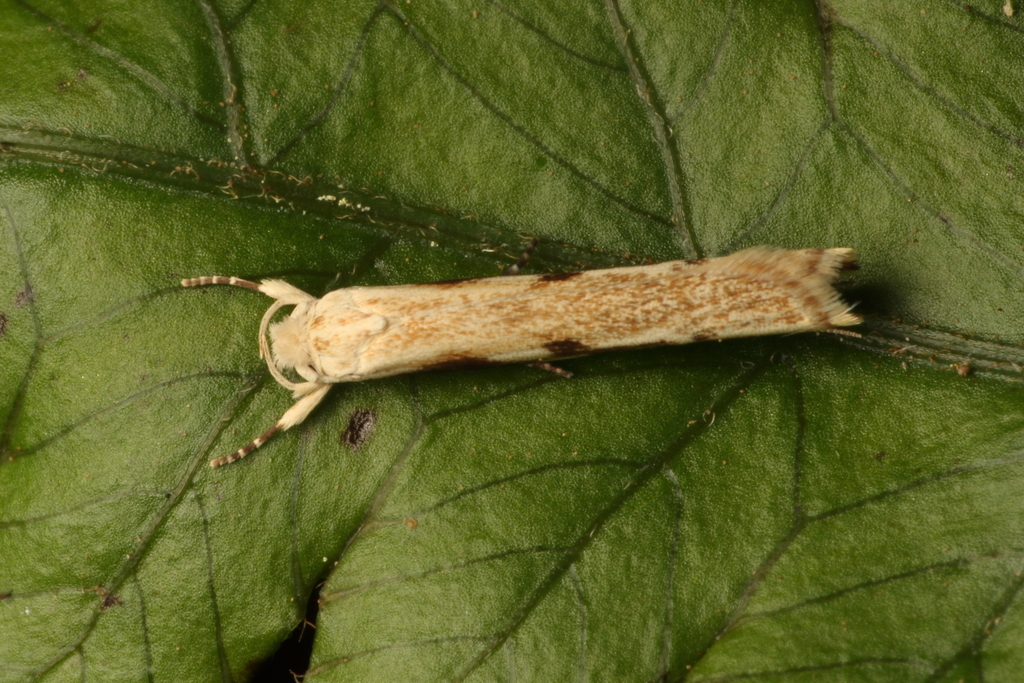
Dolichernis chloroleuca
Dolichernis chloroleuca is a moth of the family Plutellidae. It was first described by Edward Meyrick in 1891. It is endemic to New Zealand and has been observed in the North and South Islands. The species inhabits native forest. The larvae of this species mine the leaves of Aristotelia serrata and Elaeocarpus dentatus. Adults are on the wing from February to March and October to December. They are attracted to light.
From the article Dolichernis chloroleuca on Wikipedia (CC BY-SA), quoted section by section
Description
Meyrick described this species as follows:
♀. 16 mm. Head, palpi, antennae, thorax, abdomen, and legs ochreons-whitish ; anterior and middle legs banded with dark fuscous. Forewings elongate, rather narrow, costa moderately arched, apex tolerably pointed, hindmargin slightly sinuate, oblique ; pale whitish-ochreous, with a few scattered fuscous scales ; a cloudy irregular elongate dark fuscous dot beneath costa near base, two obliquely placed in disc at 1⁄4, four forming a straight oblique series from middle of disc to before middle of inner margin, and two transversely placed in disc above anal angle: cilia ochreous-whitish, with a small black spot at apex. Hindwings and cilia whitish. Hudson pointed out that the species is variable in appearance with some specimens being almost white with the markings nearly obliterated while in others the costal and dorsal portions of the fore-wings are thickly sprinkled with pale brown, or golden-ochreous scales.
Range & habitat
This species is endemic to New Zealand. It has been observed in the North and South Islands.
Wikipedia: “Distribution”
What it does
Adults are on the wing from February to March and October to December. They are attracted to black light. Adults have been observed resting on the upper sides of fern fronds and other foliage, often fully exposed to view. When adults are at rest the wings are rolled around the body; the hind- and intermediate legs are withdrawn and used for standing; the anterior legs are extended and the palpi arched around the head, with their tips almost in contact in front. The antennae are placed backwards close to the body and are almost invisible. In assuming this position the moth resembles to a small, whitish-coloured dead stick. This appearance protects the moth from predators.
Wikipedia: “Behaviour”
Listen
Looking for field recordings…
Where it lives
Recorded sightings
—
geo-referenced records in GBIF, from museums, herbaria and field observers.
Drag the globe to turn it. Dots are where records exist, not a range map; darker means more records.
In the stacks
Searching the stacks…
Every page naming Dolichernis chloroleuca in the Biodiversity Heritage Library →
This page is assembled live from iNaturalist, GBIF, Wikipedia, the Source Library and the Internet Archive. It is not yet part of the hand-edited codex. iNaturalist taxon 388715.