- Animals
- ›Arthropods
- ›Hexapods
- ›Insects
- ›Winged and Once-winged Insects
- ›Ants, Bees, Wasps, and Sawflies
- ›Narrow-waisted Wasps, Ants, and Bees
- ›Ichneumonid and Braconid Wasps
- ›Braconid Wasps
- ›Microgastrinae
- ›Cotesia
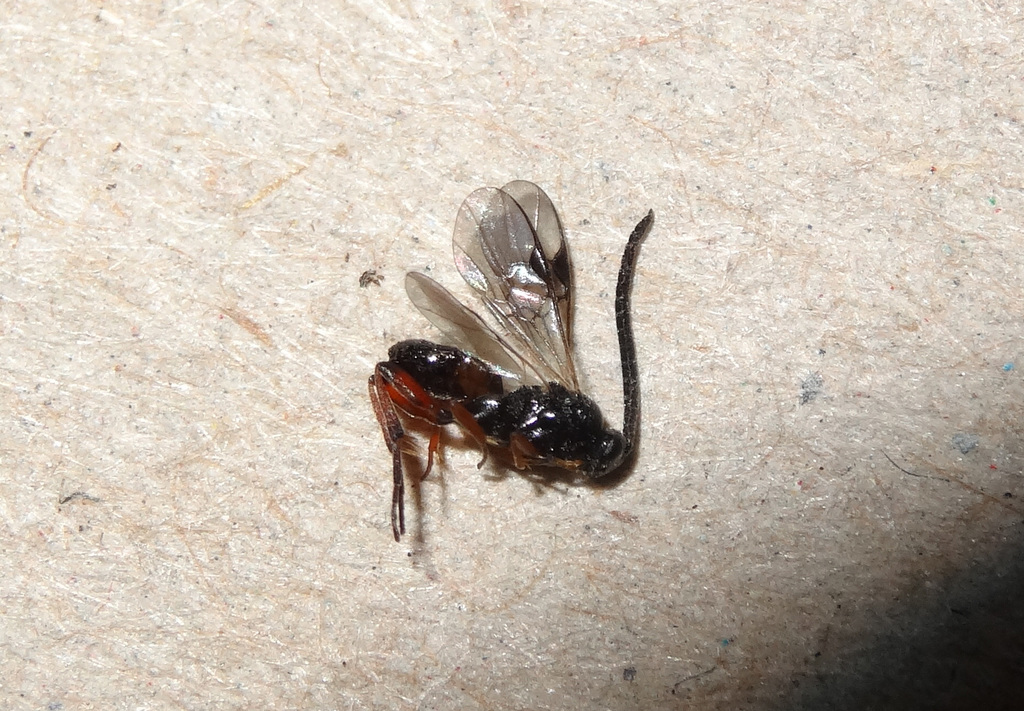
Cotesia rubecula
Cotesia rubecula is a parasitoid wasp from the large wasp family Braconidae.
From the article Cotesia rubecula on Wikipedia (CC BY-SA), quoted section by section
Description
Black in adulthood with a body less than 1/4 of an inch long, C. rubecula has long, extending antenna about the same size as its body.
Range & habitat
Cotesia rubecula is not common, established in only a few areas of the world. Originally native to China, the parasite has been introduced as biological pest control in North America, specifically in New England. The population dies down during winter months with a population bubble in late summer related to the growth of its host species.
Wikipedia: “Distribution and habitat”
What it does
The mating system of C. rubecula is polygynous. Mate-guarding, a process in which a member of a species prevents another member of the same species from mating with their partner, is seen in C. rubecula. Males are attracted to females through pheromones and they induce females to mate through vibrations, to which the female responds by assuming a specific position. When a male who has copulated with a female sees another male trying to court her, he will often adopt the female receptive position. Post-copulatory female mimicry by the male offers an advantage by acting as a mate-guarding mechanism. If a second male arrives soon enough after the female copulates with the first male, the second male may be able to induce a second copulation which will compete with the first one. However, if the first male who copulated with her mimics the female, it distracts the second male long enough that the female becomes unreceptive. Cotesia rubecula parasitizes the cabbage worm caterpillar, generally in the stage of first instar, with the female wasp stinging and laying between 20 and 50 eggs within the host instar. The defense mechanism of the caterpillars can sometimes kill the eggs. If they do not, the caterpillar does not die until the larvae of the wasp emerge. …
Wikipedia: “Reproduction and lifecycle”
Listen
Looking for field recordings…
Where it lives
Recorded sightings
—
geo-referenced records in GBIF, from museums, herbaria and field observers.
Drag the globe to turn it. Dots are where records exist, not a range map; darker means more records.
In the stacks
Searching the stacks…
Every page naming Cotesia rubecula in the Biodiversity Heritage Library →
This page is assembled live from iNaturalist, GBIF, Wikipedia, the Source Library and the Internet Archive. It is not yet part of the hand-edited codex. iNaturalist taxon 387956.