- Animals
- ›Arthropods
- ›Hexapods
- ›Insects
- ›Winged and Once-winged Insects
- ›Butterflies and Moths
- ›Ermine Moths and Allies
- ›Sedge and False Diamondback Moths and Allies
- ›Chrysorthenches
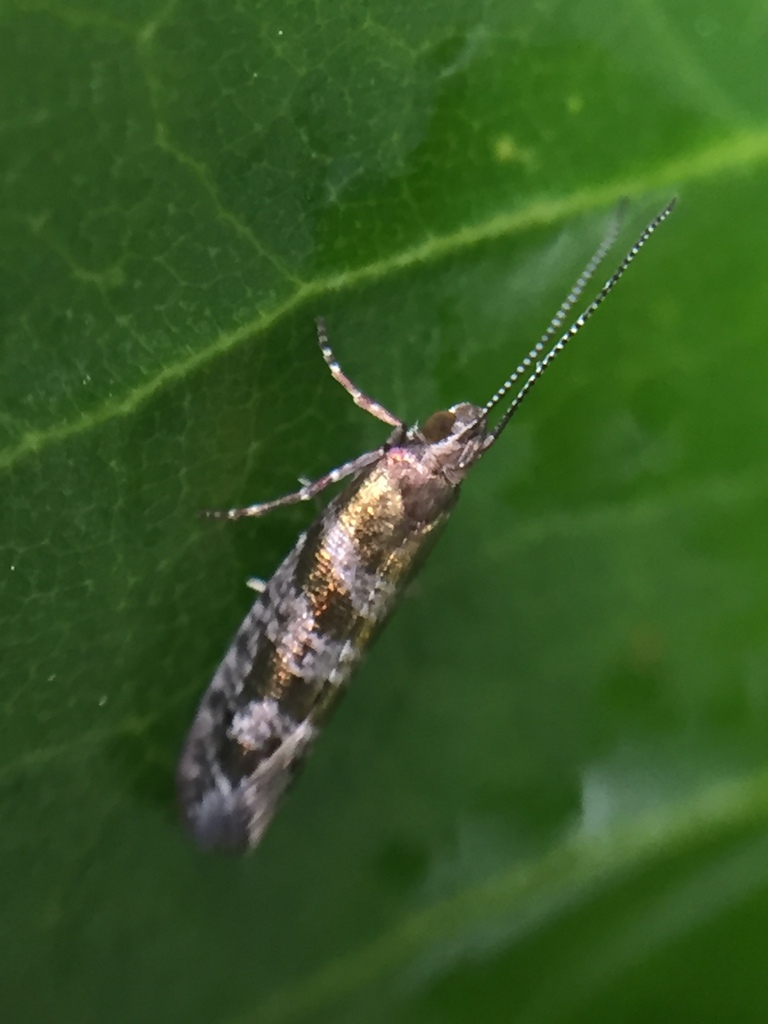
Chrysorthenches drosochalca
Chrysorthenches drosochalca is a species of moth in the family Plutellidae first described by Edward Meyrick in 1905. It is endemic to New Zealand and has been found in the North and South Islands. The larvae are leaf miners of Prumnopitys ferruginea. Adults are on the wing from January to March.
From the article Chrysorthenches drosochalca on Wikipedia (CC BY-SA), quoted section by section
Description
Hudson described the larva and pupa of this species as follows:
The larva ... is about 1⁄4 inch in length, cylindrical tapering at each end with the segmental divisions deeply excised, uniform dark green and shining. The pupa is enclosed in a small oval cocoon fastened to a fern frond. Meyrick described the adults of this species as follows:
♂♀. 11mm. Head and thorax leaden-grey. Palpi dark fuscous, inwardly and towards base white, terminal joint half as long again as second (1+1⁄2). Antennae dark fuscous, ringed with white. Abdomen grey, towards base pale ochreous, apex in ♂ whitish. Fore-wings elongate, costa moderately arched, apex pointed, termen sinuate, rather strongly oblique, rounded beneath; 7 to termen; shining coppery-bronze; four oblique fasciae of white irroration, first slender, second antemedian, broader, third angulated, considerably enlarged towards costa, fourth forming an apical patch extended along termen; a spot on base of costa, an interrupted streak along submedian fold, and a spot above middle of disc purple; a dark fuscous-purple transverse mark in disc at 2⁄3, in third fascia : cilia light grey, above apex spotted basally with purplish. Hind-wings ovate-lanceolate, apex acute, termen sinuate; light grey, darker posteriorly; cilia whitish-grey. This species is variable in size and in the intensity of the ground colour of the forewings. …
Range & habitat
C. drosochalca is endemic to New Zealand. It has been observed in both the North and South Islands.
Wikipedia: “Distribution”
What it does
The larvae feed in January. Adults are on the wing from January until March. The species has been collected by beating Prumnopitys ferruginea. When resting the forewings are closed giving the moth the appearance of a cylinder. Both the larvae and the adult moth appear to overwinter.
Wikipedia: “Behaviour”
Listen
Looking for field recordings…
Where it lives
Recorded sightings
—
geo-referenced records in GBIF, from museums, herbaria and field observers.
Drag the globe to turn it. Dots are where records exist, not a range map; darker means more records.
In the stacks
Searching the stacks…
Every page naming Chrysorthenches drosochalca in the Biodiversity Heritage Library →
This page is assembled live from iNaturalist, GBIF, Wikipedia, the Source Library and the Internet Archive. It is not yet part of the hand-edited codex. iNaturalist taxon 387590.