- Animals
- ›Arthropods
- ›Hexapods
- ›Insects
- ›Winged and Once-winged Insects
- ›Butterflies and Moths
- ›Ermine Moths and Allies
- ›Sedge and False Diamondback Moths and Allies
- ›Chrysorthenches
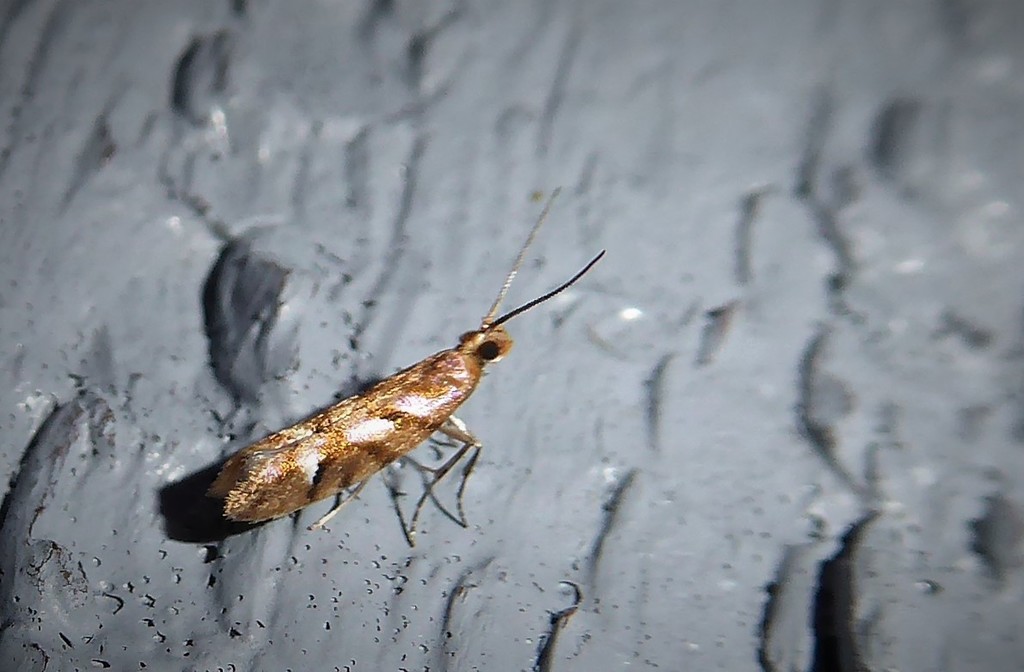
Chrysorthenches virgata
Chrysorthenches virgata is a species of moth in the family Plutellidae. It was first described by Alfred Philpott in 1920. It is endemic to New Zealand and has been found in the North, South and Chatham Islands at altitudes ranging from sea-level up to approximately 1000 m. This species inhabits areas where its larval host plants, Libocedrus bidwillii and Cupressus macrocarpa are common. The larvae feed on the leaves of their hosts from under a silk shelter and pupate in a cocoon of thick silk covered in frass. Adult moths are on the wing from September to February as well as in April and June.
From the article Chrysorthenches virgata on Wikipedia (CC BY-SA), quoted section by section
Description
Dugdale described the larvae of this species as follows:
Final instars with body green, head and pronotum sclerotised, brown. Penultimate abdominal segment with setae LI, L2, L3 on large greyish pinacula. Philpott described the adult female of this species as follows:
♀. 10 mm. Head, palpi, and thorax ochreous. Antennae ochreous on basal fifth, annulated with white and black on remaining portion. Abdomen greyish-white. Legs, anterior pairs fuscous, tarsi obscurely annulated with ochreous, posterior pair ochreous-whitish. Forewings moderate, costa strongly arched, apex round-pointed, termen moderately oblique; bright ochreous with violet and purplish reflections; a brownish fascia from beneath costa near base to dorsum at 1⁄4; a well-defined fascia from costa at 1⁄4 to dorsum at 1⁄2, slightly irregular, brownish mixed with black; a similar fascia from costa at 2⁄5, strongly angled above middle towards termen, thence to dorsum at 2⁄3, where it coalesces with inwardly-oblique fascia from costa at 3⁄4, both these fasciae having black patches at middle; a white patch margining last fascia at middle; a few black scales on central portion of dorsum : cilia ochreous, becoming fuscous round apex. Hindwings and cilia shining white. The larvae can be distinguished from the similar looking larvae of C. argentea as C. virgata larvae lack the zigzag colour pattern. …
Range & habitat
This species is endemic to New Zealand and has been found in the North, South and Chatham Islands. It can be found at altitudes ranging from sea level to approximately 1050 m, the upper altitudinal limit of its host species Libocedrus bidwillii.
Wikipedia: “Distribution”
What it does
The larvae of this species feeds on the leaves of its host under a silk shelter. It pupates within a cocoon of thickly woven silk covered in frass. Adults have been observed from September to February as well as in April and June.
Wikipedia: “Behaviour”
Listen
Looking for field recordings…
Where it lives
Recorded sightings
—
geo-referenced records in GBIF, from museums, herbaria and field observers.
Drag the globe to turn it. Dots are where records exist, not a range map; darker means more records.
In the stacks
Searching the stacks…
Every page naming Chrysorthenches virgata in the Biodiversity Heritage Library →
This page is assembled live from iNaturalist, GBIF, Wikipedia, the Source Library and the Internet Archive. It is not yet part of the hand-edited codex. iNaturalist taxon 387585.