- Animals
- ›Arthropods
- ›Hexapods
- ›Insects
- ›Winged and Once-winged Insects
- ›Beetles
- ›Water, Rove, Scarab, Long-horned, Leaf, and Snout Beetles
- ›Cucujiform Beetles
- ›Longhorn Beetles and Allies
- ›Longhorn Beetles
- ›Tooth-necked and Aberrant Longhorn Beetles
- ›Meroscelisini
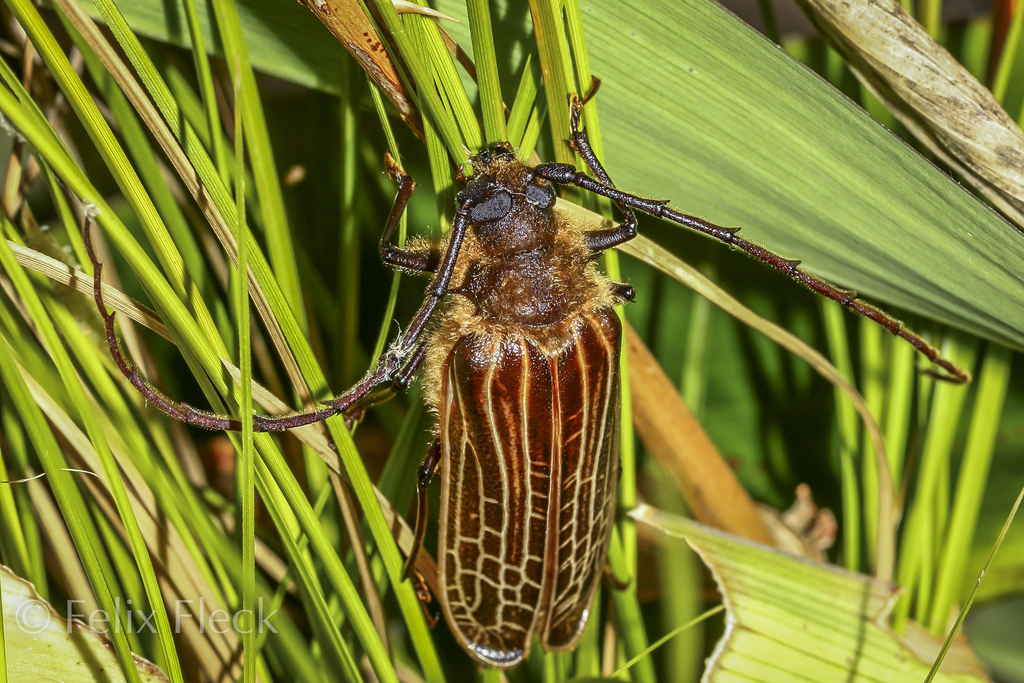
Prionoplus
The huhu beetle (Prionoplus reticularis) is a longhorn beetle endemic to New Zealand. It is a large, visually distinctive species whose adults reach up to five cm (2 in) in length. It is widespread throughout New Zealand, occurring up to 1,400 m (4,600 ft) at altitude. Although the adult is unable to eat, the larva feeds and burrows in the dead wood of trees, almost entirely feeding on gymnosperms such as rimu and Monterey pine. As a larva, it can grow to sizes of 50–70 mm (2.0–2.8 in) and has a cylindrical appearance with a creamy colour. During this stage, in which the insect is high in protein and fat, it is edible and has been described as tasting similar to peanut butter. It has a history of consumption by the Māori, with the larva being consumed either raw or traditionally cooked in a hāngī.
The adult lives for roughly two weeks. It is nocturnal and is strongly attracted to light, such as that produced by human habitation. The female appears to produce olfactory cues to attract the male. During its larval stage, the beetle can potentially take one to two years to reach maturity, although this has been achieved more quickly in laboratory conditions. The intestinal tract of the larva hosts a diverse range of microorganisms that may assist in digestion of wood. Because the larva burrows into logs, New Zealand has to treat logs before exporting them to prevent the beetle spreading to other countries. This is done by fumigating or heating the logs, which is done by government-approved third parties.
1 branches of this genus, most-observed first
See this branch on the Wheel of Life →
Where it lives
Recorded sightings
—
geo-referenced records in GBIF, from museums, herbaria and field observers.
Drag the globe to turn it. Dots are where records exist, not a range map; darker means more records.
In the stacks
Searching the stacks…
Every page naming Prionoplus in the Biodiversity Heritage Library →
This page is assembled live from iNaturalist, GBIF, Wikipedia, the Source Library and the Internet Archive. It is not yet part of the hand-edited codex. iNaturalist taxon 377802.