- Plants
- ›Vascular Plants
- ›flowering plants
- ›Dicots
- ›Gentians, Dogbanes, Madders, and Allies
- ›madder family
- ›Ixoroideae
- ›Gardenieae
- ›Atractocarpus
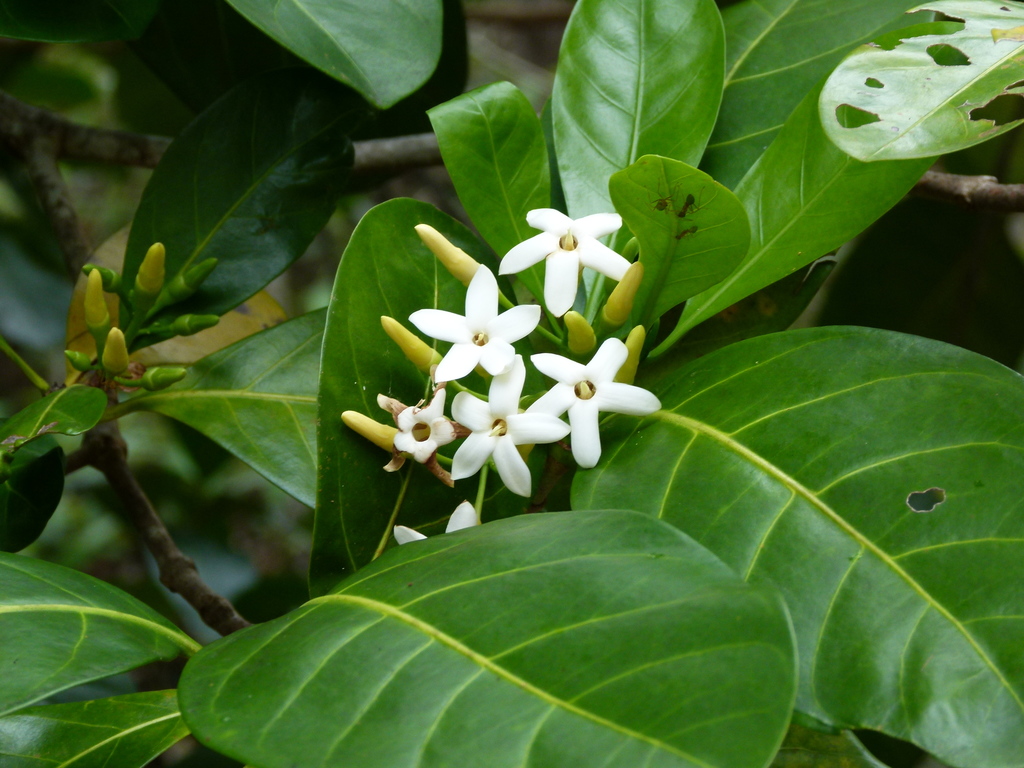
Brown Gardenia
Atractocarpus fitzalanii
Atractocarpus fitzalanii, commonly known as the brown gardenia or yellow mangosteen, is a species of plant in the coffee and madder family Rubiaceae. It is found in coastal parts of tropical Queensland, Australia. The beautifully scented flowers and glossy foliage has seen this plant enter cultivation in gardens of eastern Australia.
From the article Atractocarpus fitzalanii on Wikipedia (CC BY-SA), quoted section by section
Description
The brown gardenia is a woody shrub or small tree usually growing up to 3 m (9.8 ft) wide and 8 m (26 ft) high, although it may reach up to 20 m (66 ft) on occasions, and it has a smooth grey trunk up to 35 cm (14 in) diameter. The large leaves are obovate to oval-shaped and may be up to 20 cm (7.9 in) long by 10 cm (3.9 in) wide, held on petioles up to 3 cm (1.2 in) long. They are glossy dark green above, dull grey-green below, and have an opposite arrangement. The lateral veins number 6–7 pairs and subtend an angle of 50°–70° to the midrib. The new growth is a bright lime green in colour. This species is dioecious, meaning that male and female flowers are borne on separate plants. The inflorescences are panicles produced either terminally or in the leaf axils; male inflorescences have 15–30 flowers while female ones have up to 15 flowers. The fragrant white flowers measure about 3 cm (1.2 in) in diameter with a corolla tube about 1.5 cm (0.6 in) long. The globose fruit is a drupe, yellow-brown in colour and measuring up to 10 cm (3.9 in) long by 9 cm (3.5 in) wide, usually produced singly or rarely in a cluster of 3–4. In the subspecies tenuipes they are paler, measure up to 3.8 cm (1.5 in) long by 3.5 cm (1.4 in) wide, and produced in clusters of 3–7. The calyx is persistent at the apex of the fruit in both subspecies.
Phenology. …
Range & habitat
A. f. subsp. fitzalanii is widespread in rainforest, monsoon forest, swamp forest, mangrove forest, and riparian forest from just south of Cooktown to just south of Mackay, at altitudes from sea level to around 1,200 m (3,900 ft). A. f. subsp. tenuipes is found at higher altitudes from 500 to 1,500 m (1,600 to 4,900 ft) and has a more restricted range than its parent, from near Cape Tribulation to the southern Atherton Tableland. Although the weed potential has not been studied in Australia, weed management personal of Noosa Integrated Catchment Association have found it regularly growing in bushland areas outside of its natural range distribution. Birds are known to disperse the fruit outside of cultivation giving this species a risk as a potential weed in non-native areas such as Hawaii.
Wikipedia: “Distribution and habitat”
What it does
Moths visit the flowers soon after opening. The fruits are eaten by a variety of birds and animals, including the cassowary (Casuarius casuarius).
Wikipedia: “Ecology”
How it is grown
Its bushy foliage, flowers and edible fruit allow it to sometimes be used in horticultural gardens. It is suited to a shady position with good drainage in gardens, or moderately to brightly lit indoor spaces. In the city of Cairns for example, more than 280 of these have been planted as street trees.
Wikipedia: “Cultivation”
In human culture
The genus name Atractocarpus is derived from the Ancient Greek terms átraktos meaning 'spindle' and karpós 'fruit', and refers to the spindle-shaped fruit of the type species. The species epithet fitzalanii was given in honour of the collector. The subspecies name tenuipes is from the Latin tenuipes meaning 'slender legged', a reference to the slender pedicels displayed by the group.
Wikipedia: “Etymology”
Where it lives
Recorded sightings
—
geo-referenced records in GBIF, from museums, herbaria and field observers.
Drag the globe to turn it. Dots are where records exist, not a range map; darker means more records.
In the stacks
Searching the stacks…
Every page naming Atractocarpus fitzalanii in the Biodiversity Heritage Library →
This page is assembled live from iNaturalist, GBIF, Wikipedia, the Source Library and the Internet Archive. It is not yet part of the hand-edited codex. iNaturalist taxon 370077.