- Plants
- ›Vascular Plants
- ›flowering plants
- ›Dicots
- ›myrtles, evening primroses, and allies
- ›myrtle family
- ›Myrtoideae
- ›Syzygieae
- ›Syzygium
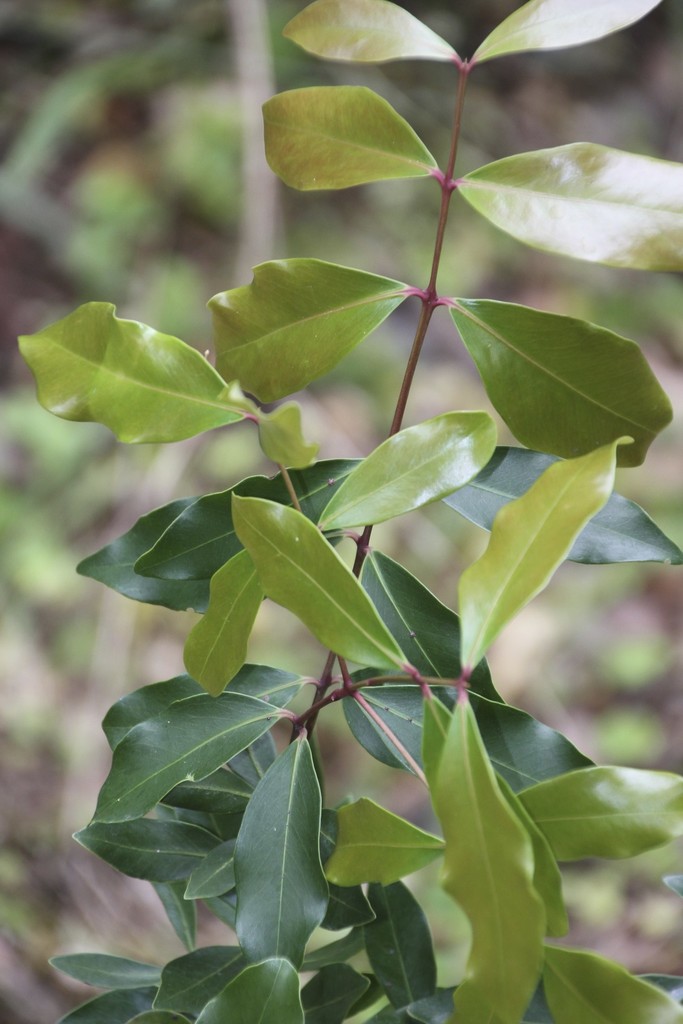
Syzygium hemilamprum
Syzygium hemilamprum, commonly known as the broad-leaved lilly pilly, blush satinash, cassowary gum, Eungella gum, and treated as Acmena hemilampra in New South Wales and Queensland, is a species of flowering plant in the family Myrtaceae and is native to New South Wales, Queensland and the Northern Territory. It is a rainforest tree with broadly lance-shaped to elliptic leaves, panicles of white flowers and more or less spherical white fruit.
From the article Syzygium hemilamprum on Wikipedia (CC BY-SA), quoted section by section
Description
Syzygium hemilamprum is a tree that typically grows to a height of 35 m (115 ft) with a diameter at breast height of up to 120 cm (47 in). The trunk is flanged or buttressed in larger trees, and has fissured and flaky reddish-brown bark. The leaves are arranged in opposite pairs, broadly lance-shaped to elliptic, 39–131 mm (1.5–5.2 in) long and 18–60 mm (0.71–2.36 in) wide on a petiole 2–10 mm (0.079–0.394 in) long. The leaves are glossy and more or less glabrous on the upper surface and paler below. The flowers are arranged in panicles on the ends of branchlets, each flower on a pedicel 2.5–5 mm (0.098–0.197 in) long. The sepals are joined at the base forming a tube about 1.5–4 mm (0.059–0.157 in) in diameter, the sepal lobes small and inconspicuous. The petals are more or less circular, 1–1.5 mm (0.039–0.059 in) long and the stamens 0.5–2.5 mm (0.020–0.098 in) long. Flowering occurs from October to November and the fruit is white and more less spherical, 11–17 mm (0.43–0.67 in) in diameter.
Range & habitat
Often seen on sand by the sea in littoral rainforests, it reaches its best development in the red/brown volcanic soils, such as around the Mount Warning caldera. The natural range of distribution is from Yamba to Cape York Peninsula in the far north eastern tip of Australia. Removal of the flesh from the seed is advised to assist seed germination. Germination is slow, taking up to 80 days. However, cuttings strike well.
Wikipedia: “Distribution and habitat”
Where it lives
Recorded sightings
—
geo-referenced records in GBIF, from museums, herbaria and field observers.
Drag the globe to turn it. Dots are where records exist, not a range map; darker means more records.
In the stacks
Searching the stacks…
Every page naming Syzygium hemilamprum in the Biodiversity Heritage Library →
This page is assembled live from iNaturalist, GBIF, Wikipedia, the Source Library and the Internet Archive. It is not yet part of the hand-edited codex. iNaturalist taxon 369796.