- Plants
- ›Vascular Plants
- ›flowering plants
- ›Dicots
- ›Legumes, Milkworts, and Allies
- ›Legumes
- ›Faboideae
- ›Phaseoleae
- ›Glycininae
- ›Glycine
Glycine Pea
Glycine tabacina
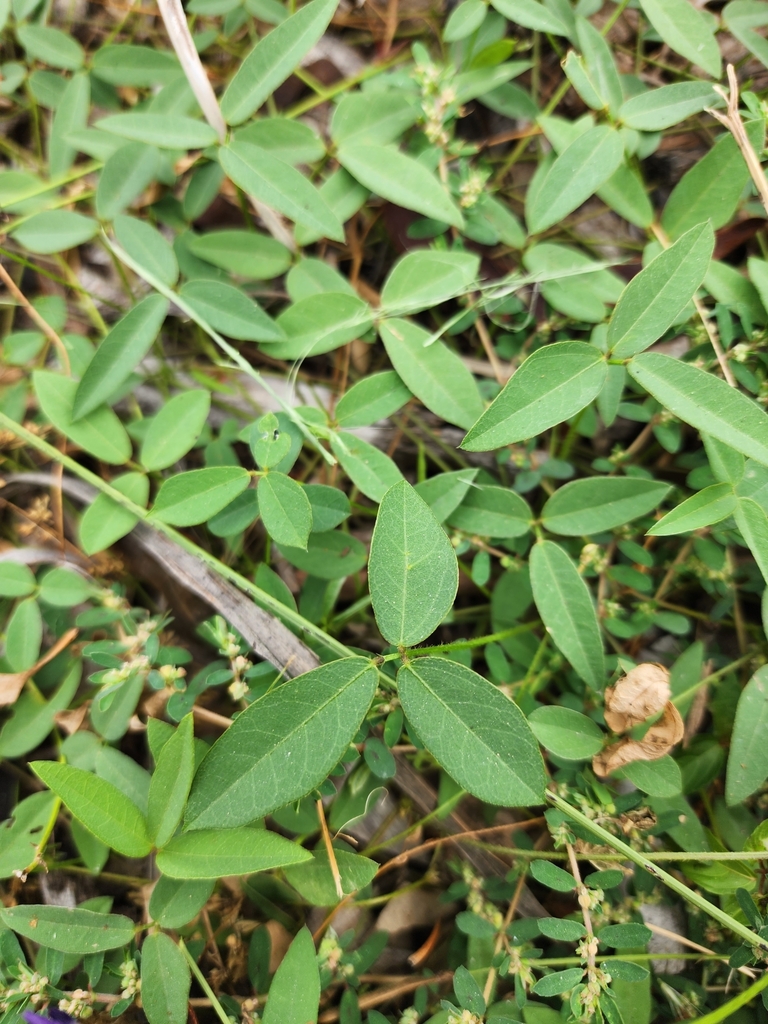
Glycine tabacina, commonly known as variable glycine, is a scrambling plant in the bean family found in Australia. It grows in areas of high rainfall, ranging to semi-arid areas. The leaves are in threes, 7 cm long by 2 cm wide. Bluish to purple flowers form on racemes in the warmer months. The bean pod is up to 3 cm long. The habitat is among grasses, often in open country.
From the article Glycine tabacina on Wikipedia (CC BY-SA), quoted section by section
Description
There are twenty-six perennial species found of Glycine. The length of the leaflet stalks identifies it, since it has a lengthy stalk. The pea-shaped flower varies in colour from purple to mauve which blossoms throughout Spring to Autumn seasons. Once mature, their pods become black in colour, with the seeds [usually 4 – 8] inside are red to brown. The stems are typically slender and can reach to 1m in length, either trailing or creeping and often twining. The stems are often covered in stiff, straight hairs, emerging from a thickened root system. The leaves are usually tri-foliolate pinnate, and the rachis may vary in length between 5 and 45 mm, with pubescence comparable to the stem. The leaflets appear generally narrow with straight, stiff hairs [strigose] beneath the leaves, although they can also be sparsely strigose or glabrous [without straight stiff hairs] above. The apical portion of this species is generally broader or longer than that of the lateral portion of this species. Lower leaves are typically broad, oval to elliptic shape (10-15 x 8–14 mm), obtuse to truncate, acute, tapering at the base, and often noticeably net-veined underneath. Upper leaflets are normally elliptic-lanceolate to slightly linear (7-50 x 3–7 mm), sharp to blunt and apiculate, abruptly sharp to curved at the base, and on the petiolules, they are covered in coarse, long hairs. …
Wikipedia: “Morphology”
Range & habitat
Glycine tabacina is native in Australia. However, can also be located in China, Pacific Islands, Papua New Guinea, Indonesia, Philippines and Taiwan. In Australia, Glycine tabacina are mostly located in New South Wales, Queensland, Victoria and Western Australia. Within Eastern Australia, Glycine tabacina are frequently and largely scattered and found in cosmopolitan areas. Typically, Glycine tabacina grow within grasses in wide forest lands and woodland areas. It can also be found in dense forests and rainforest riverbeds, though it is uncommon near ocean shores. Glycine tabacina thrives in moist soils, loamy clay soils, and does not require shade. The pH level that is best for Glycine tabacina growth can vary from acidic to alkaline. After a fire, this plant has the ability to re-sprout from the root and regenerates extensively from seed. There have been no toxic elements that have been discovered yet. This is a nectar plant for butterflies as well as a food plant for certain caterpillar groups.
Wikipedia: “Distribution and habitat”
In medicine
Glycine tabacina, a legume plant, is a well-known natural medicine and Chinese herbal medicine. The roots were used in traditional medicine to treat osteoporosis, nephritis, rheumatism, and menopausal syndrome. Glycine tabacina is often used as an herbal tea in Taiwan and is one of the origins of the folk medicine, I – TiaoGung. Nevertheless, some phytochemical and pharmacological research on this plant have been reported. The extract was shown to have anti-inflammatory, anti-arthritic [6], antioxidant, and antidiabetic properties in vitro. A study conducted by Yanbei Tu in 2019, in which they examined the anti-arthritic impact of ethanol extract from Glycine tabacina on a collagen-induced arthritis mouse model. The mouse model orally received Glycine tabacina extract powder [1.11g, 2.22g, 4.44g] daily beginning from day zero and extended for 30 days. The extent of arthritis was determined by measuring the width of paws, arthritis index levels, X – rays, histopathological changes and swelling size. Physical examination on mouse models, swelling on paws and arthritis index revealed that orally administering Glycine tabacina extract substantially reduced arthritic symptoms in collagen – induced arthritis mouse models. …
Wikipedia: “Medicinal use”
Where it lives
Recorded sightings
—
geo-referenced records in GBIF, from museums, herbaria and field observers.
Drag the globe to turn it. Dots are where records exist, not a range map; darker means more records.
In the stacks
Searching the stacks…
Every page naming Glycine tabacina in the Biodiversity Heritage Library →
This page is assembled live from iNaturalist, GBIF, Wikipedia, the Source Library and the Internet Archive. It is not yet part of the hand-edited codex. iNaturalist taxon 369513.