- Plants
- ›Vascular Plants
- ›flowering plants
- ›Dicots
- ›Legumes, Milkworts, and Allies
- ›Legumes
- ›Acacias, Mimosas, Mesquites, and Allies
- ›Acacia
- ›Juliflorae
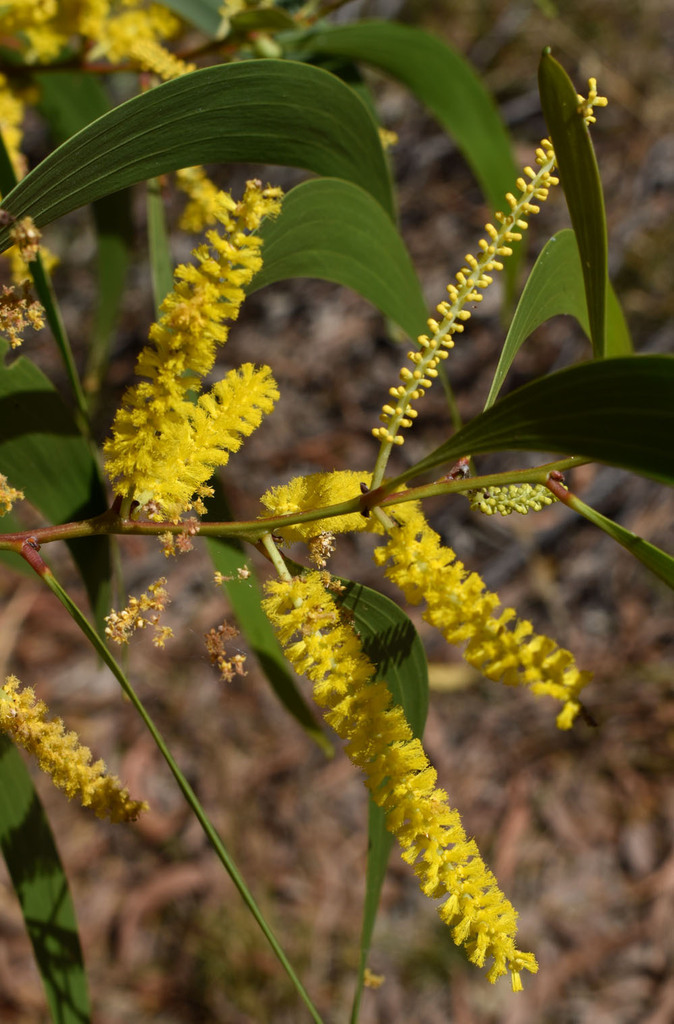
north coast wattle
Acacia leptocarpa
Acacia leptocarpa, commonly known as slender-fruited wattle, mangarr mangal, malakmalak, matngala or wagiman in Australian Aboriginal languages, is a species of flowering plant in the family Fabaceae and is endemic to northern Australia. It is a tree, rarely a shrub, with dark grey to almost black bark, narrowly elliptic, sickle-shaped, shortened phyllodes, spikes heads of yellow to golden yellow flowers and curved, curled or twisted pods constricted between and raised over the seeds.
From the article Acacia leptocarpa on Wikipedia (CC BY-SA), quoted section by section
Description
Acacia leptocarpa is a tree that typically grows to a height of up to 15 m (49 ft), rarely a shrub to 4 m (13 ft), and has dark grey to almost black, 'ironbark' type bark and glabrous branchlets with lenticels. The phyllodes are narrowly elliptic, markedly sickle-shaped, shortened at both ends, mostly 110–200 mm (4.3–7.9 in) long and 10–35 mm (0.39–1.38 in) wide, thinly leathery with three prominent veins and a conspicuous gland near the base of the phyllode. The flowers are yellow to golden yellow and borne in spikes 35–95 mm (1.4–3.7 in) long. Flowering occurs from May to October, and the pods are curved, coiled or twisted, 80–150 mm (3.1–5.9 in) long, 2–35 mm (0.079–1.378 in) wide, thinly leathery to papery, glabrous and slightly or variably constricted between, and raised over the seeds. The seeds are 3–4 mm (0.12–0.16 in) long and dark brown with a massive, yellow-orange aril that is longer than the seed. Acacia leptocarpa resembles A. cowleana and A. elachantha but has glabrous and thinner phyllodes and longer, more curved pods. It is thought to be allied with A. tropica and A. cretata. The seed pods appear very similar to those of A. gardneri.
Range & habitat
This species of wattle is mostly found in open forest, occasionally in monsoon forest and rainforest margins from Carlton Hill Station in the Kimberley region of Western Australia and eastwards across the Top End of the Northern Territory including its offshore islands, to Cape York Peninsula and south to southern Central Queensland where it is found along the margins of watercourses and swampy areas growing in sandy or rocky soils occasionally around laterite in open Eucalyptus or Melaleuca woodland.
Wikipedia: “Distribution and habitat”
Where it lives
Recorded sightings
—
geo-referenced records in GBIF, from museums, herbaria and field observers.
Drag the globe to turn it. Dots are where records exist, not a range map; darker means more records.
In the stacks
Searching the stacks…
Every page naming Acacia leptocarpa in the Biodiversity Heritage Library →
This page is assembled live from iNaturalist, GBIF, Wikipedia, the Source Library and the Internet Archive. It is not yet part of the hand-edited codex. iNaturalist taxon 369342.