- Animals
- ›Arthropods
- ›Hexapods
- ›Insects
- ›Winged and Once-winged Insects
- ›Butterflies and Moths
- ›Owlet Moths and Allies
- ›Cutworm Moths and Allies
- ›Heliothinae
- ›Helicoverpa
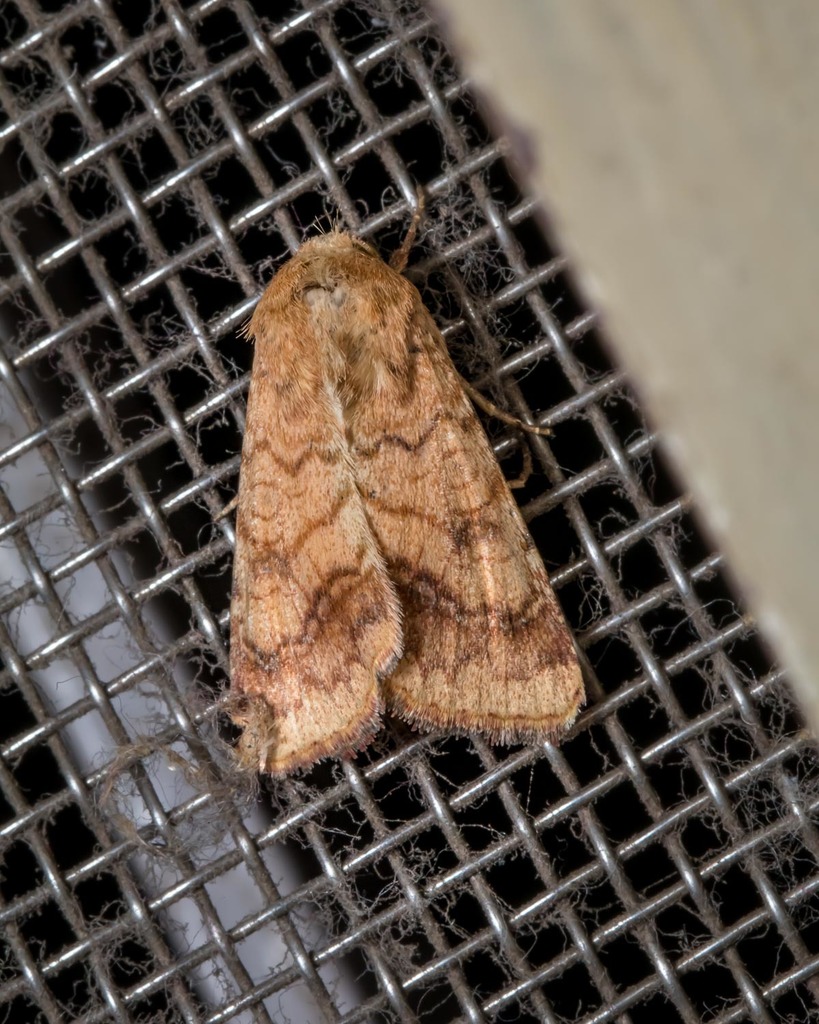
Cape Gooseberry Budworm
Helicoverpa assulta
Helicoverpa assulta, the oriental tobacco budworm, is a moth of the family Noctuidae. H. assulta adults are migratory and are found all over the Old World Tropics including Asia, Africa, and Australia.
This species has a brown coloured pattern on their forewings while their hindwings are yellowish orange and have a brown margin which has a pale mark. The wingspan is about 25 millimetres (0.98 in). H. assulta is closely related to Helicoverpa armigera and Helicoverpa zea.
From the article Helicoverpa assulta on Wikipedia (CC BY-SA), quoted section by section
Range & habitat
H. assulta is distributed across three continents: Asia, Africa and Australia. In Asia, populations of H. assulta are specifically found in China, Korea, Thailand, and Japan. Environmental conditions, like temperature and geographic locality, can impact the fecundity of the moth.
Wikipedia: “Geographic range”
At the table
H. assulta is a pest of red peppers (Capsicum frutescens ), tobacco (Nicotiatna tabacum), tomato, and onion. They prefer to eat red peppers over tobacco, but are still considered a pest to both. In order to develop and survive successfully, the moth must both have access to nutrient rich food, and be able to digest and uptake the nutrients.
Capsaicin. H. assulta is one of very few insects that can successfully feed on and damage plants, such as hot peppers, containing capsaicin. Studies show that long-term dietary exposure to capsaicin stimulates larger larvae. Furthermore, its unique tolerance to capsaicin may have allowed H. assulta to expand its host range.
Larvae. Hatching larvae feed on tender or new leaves near the site of oviposition. When it goes through instar, larvae feed on the fruit and flowers of the host, and can infest the host over the course of their development. Newly hatched larvae exhibit a great preference for tender tobacco leaves, followed by pepper and tomato leaves. The success of H. assulta is significantly dependent on its larval diet. Larvae that fed on tobacco had a significantly greater fecundity than those that fed on red peppers. The sex ratio differs slightly depending on the type of food the larvae feed on. Larvae who feed on mainly tobacco have a higher female ratio compared to those which feed on mainly pepper. The H. …
Wikipedia: “Food resources”
Listen
Looking for field recordings…
Where it lives
Recorded sightings
—
geo-referenced records in GBIF, from museums, herbaria and field observers.
Drag the globe to turn it. Dots are where records exist, not a range map; darker means more records.
In the stacks
Searching the stacks…
Every page naming Helicoverpa assulta in the Biodiversity Heritage Library →
This page is assembled live from iNaturalist, GBIF, Wikipedia, the Source Library and the Internet Archive. It is not yet part of the hand-edited codex. iNaturalist taxon 368830.