On eBird ↗
Casqued Cacique
Live sightings near you, the range map, bar charts of when it is seen, and Macaulay Library photos and recordings.
Casqued Cacique
Cacicus oseryi
The casqued cacique (Cacicus oseryi) is a species of bird in the family Icteridae, the oropendolas, New World orioles, and New World blackbirds. It is found in Brazil, Colombia, Ecuador, Peru, and possibly Bolivia.
From the article Casqued cacique on Wikipedia (CC BY-SA), quoted section by section
Description
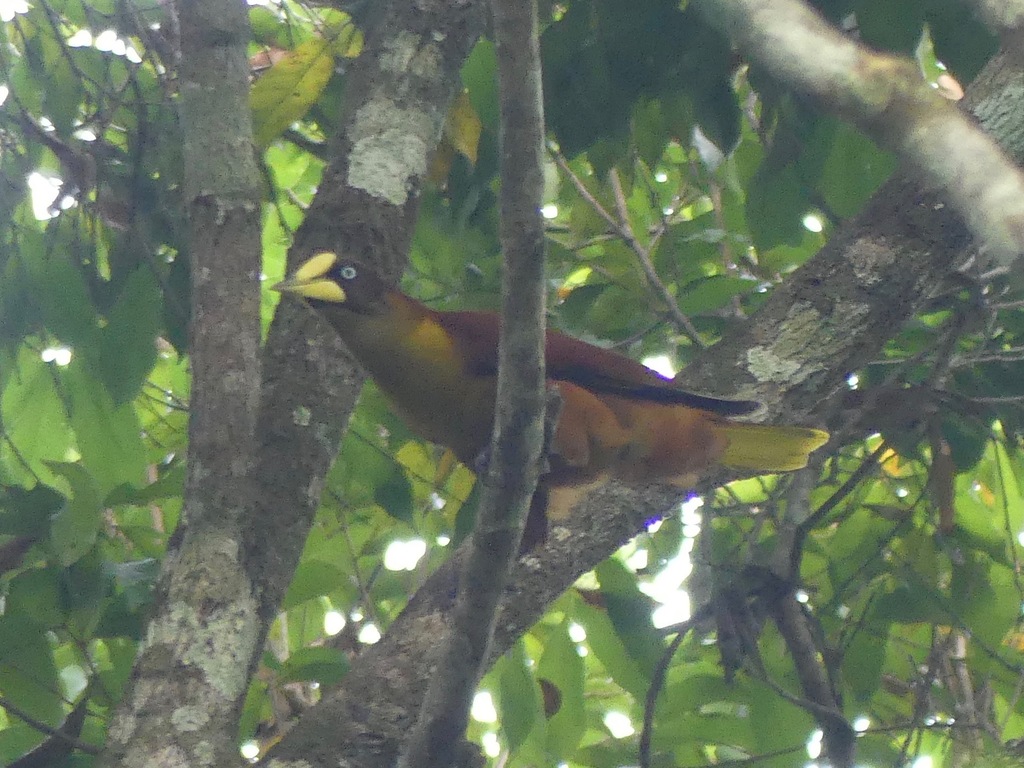
Male casqued caciques average 37 cm (15 in) long and 188 g (6.6 oz). Females average 29 cm (11 in) long and 101 g (3.6 oz). Males have a prominent casque and females a smaller one. The casque's color is usually yellowish gray to olivaceous gray, sometimes ivory-colored with a greenish tinge and a dark gray tip, and sometimes entirely dark gray. The sexes have the same plumage. Adults are mostly rich chestnut. Their tail is mostly dusky olive with bright yellow outer feathers. Their wing's flight feathers have yellow edges. Their throat is grayish olive and their upper breast and the side of their neck are yellowish olive. They have a pale blue iris and black legs and feet. Their bill is variable but usually has a dark gray maxilla and a yellow-green mandible with a dark gray tip. Juveniles are like adults but have dark eyes.
Range & habitat
The casqued cacique is a bird of the extreme western Amazon Basin. Its range includes extreme southern Amazonas Department in far southern Colombia and the three eastern Ecuadorean provinces of Sucumbíos, Orellana, and Pastaza. Its range continues south through the eastern half of Peru and extends east from Peru very slightly into the far western parts of Brazil's Amazonas and Acre states. Though most sources include northern Bolivia in the species' range, the South American Classification Committee has only unconfirmed records there. The casqued cacique inhabits terra firme and várzea forest. It appears to breed primarily in várzea and use the drier terra firme for foraging and in the non-breeding season. In elevation it is found below about 300 m (1,000 ft) in Colombia and Ecuador, below 1,000 m (3,300 ft) in Peru, and below 400 m (1,300 ft) in Brazil.
Wikipedia: “Distribution and habitat”
What it does
The casqued cacique's diet is known to include fruits and is assumed to also include arthropods, small vertebrates, and nectar. It has been observed foraging with flocks of yellow-rumped caciques (C. cela). It forages mostly in the forest interior.
Wikipedia: “Feeding”
Listen
Looking for field recordings…
Where it lives
Recorded sightings
—
geo-referenced records in GBIF, from museums, herbaria and field observers.
Drag the globe to turn it. Dots are where records exist, not a range map; darker means more records.
In the stacks
Searching the stacks…
Every page naming Cacicus oseryi in the Biodiversity Heritage Library →
This page is assembled live from iNaturalist, GBIF, Wikipedia, the Source Library and the Internet Archive. It is not yet part of the hand-edited codex. iNaturalist taxon 367696.