On eBird ↗
Black-crowned Pitta
Live sightings near you, the range map, bar charts of when it is seen, and Macaulay Library photos and recordings.
Black-crowned Pitta
Erythropitta ussheri
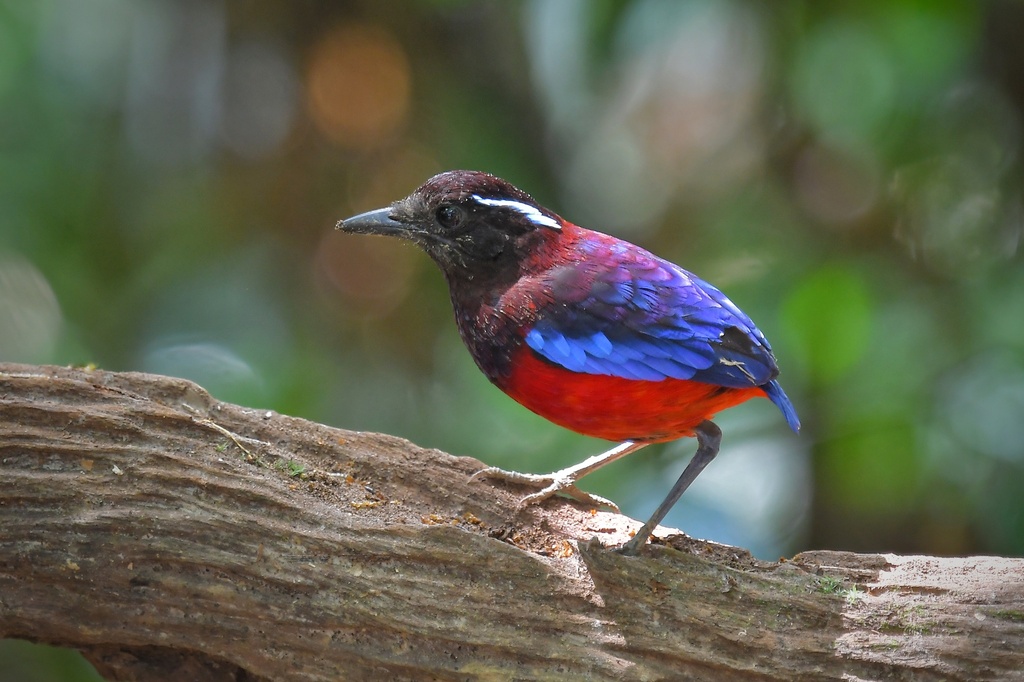
The black-crowned pitta (Erythropitta ussheri), also known as the black-headed pitta, black-and-crimson pitta, black-and-scarlet pitta or black-crowned garnet pitta, is a brightly coloured, ground-dwelling, bird species in the pitta family. It is endemic to the Southeast Asian island of Borneo. It was described by John Gould in 1877, with the type locality recorded as the Lawas River.
From the article Black-crowned pitta on Wikipedia (CC BY-SA), quoted section by section
Description
The birds grow to a length of 13–15.5 cm (5.1–6.1 in) and a weight of 50–64 g (1.8–2.3 oz). An adult pitta is distinctively marked with a black head and breast contrasting with a crimson belly and prominent, pale blue, narrow raised stripes extending back from the eyes. The upperparts are dark purple-blue with an iridescent azure patch on the bend of the wing. The tip of the bill is bright red to orange. Nestlings are yellow with coral-red gapes and bill tips. Juveniles are uniformly dark brown until they begin to acquire adult plumage.
Range & habitat
The pitta has only been recorded from the Malaysian state of Sabah in northern Borneo, where it occupies lowland tropical rainforests from sea level up to about 300 m, above which it is replaced by the blue-banded pitta. It prefers dark and damp places, especially ravines beneath dense cover. In prime habitat, such as the primary forest of the Danum Valley Conservation Area, recorded population densities are 21–22 pairs per square kilometre. It can also be found in areas that have been selectively logged as well as in overgrown rubber and Albizia plantations.
Wikipedia: “Distribution and habitat”
What it does
The pitta consumes a variety of largely invertebrate prey. Its diet includes spiders, ants, cockroaches, beetles and snails.
Wikipedia: “Feeding”
Listen
Looking for field recordings…
Where it lives
Recorded sightings
—
geo-referenced records in GBIF, from museums, herbaria and field observers.
Drag the globe to turn it. Dots are where records exist, not a range map; darker means more records.
In the stacks
Searching the stacks…
Every page naming Erythropitta ussheri in the Biodiversity Heritage Library →
This page is assembled live from iNaturalist, GBIF, Wikipedia, the Source Library and the Internet Archive. It is not yet part of the hand-edited codex. iNaturalist taxon 367595.