- Plants
- ›Vascular Plants
- ›flowering plants
- ›monocots
- ›Agaves, Orchids, Irises, and Allies
- ›Orchids
- ›Lower Epidendroid Orchids
- ›Malaxideae
- ›Malaxidinae
- ›Hammarbya
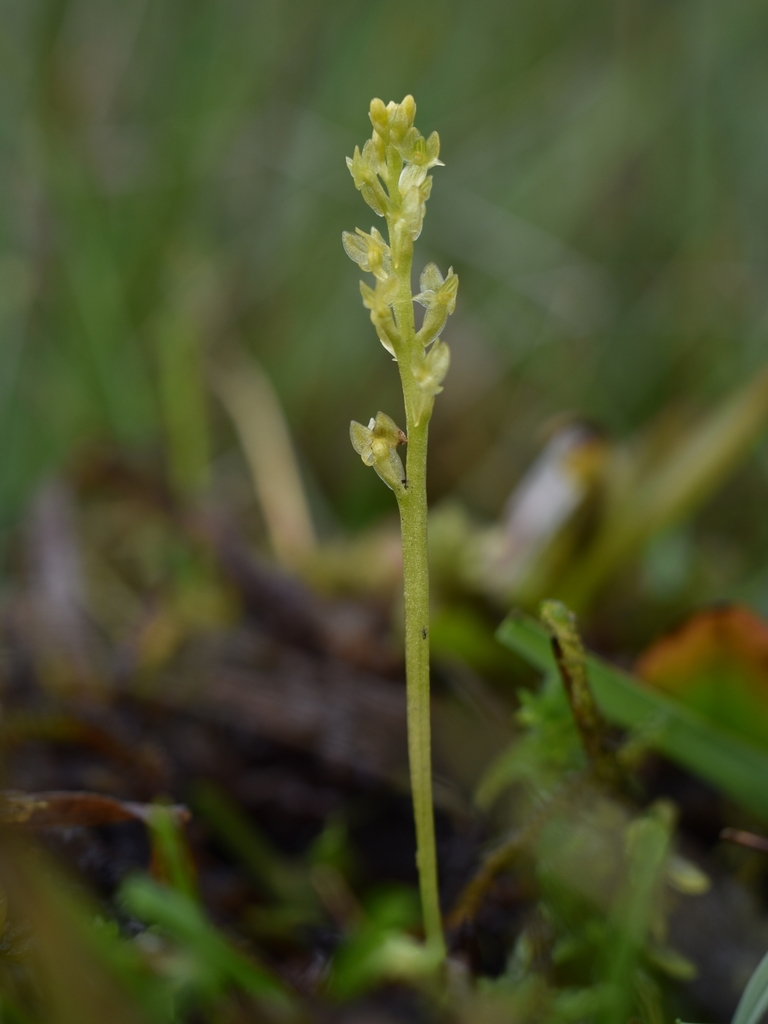
bog adder's-mouth orchid
Hammarbya paludosa
Hammarbya is a genus in the orchid family (Orchidaceae) containing the single species Hammarbya paludosa, commonly known as the bog orchid, bog adder's-mouth or bog adder's-mouth orchid. It is known for being the only epiphytic orchid native to northern North America and for being the only orchid to produce plantlets on the tips of its leaves. It is also called Malaxis paludosa by some authorities who included it within the closely related genus Malaxis.
A small, short-lived perennial, H. paludosa flowers every one or two years for about a month at the end of summer and is pollinated by fungus gnats and other small flies. Like many orchids, it requires a fungal associate to germinate, and mature plants continue to obtain some of their nutrients from the fungal partner. The species is widely distributed across the Circumboreal Region in Europe, Asia, and North America, where it grows primarily in bogs. Many populations are small and geographically isolated, and the total number of plants is in decline due to habitat loss and degradation. Although assessed as a Least-concern species by the IUCN, H. paludosa is considered threatened or endangered through much of its range.
From the article Hammarbya on Wikipedia (CC BY-SA), quoted section by section
Range & habitat
Hammarbya paludosa has a circumboreal distribution, occurring through the northern parts of Europe, Asia, and North America. Despite its extensive range, there are large gaps in its known range, which can be explained both by its rarity in some areas and by the difficulty in detecting populations. Whether the fragmented populations represent relicts of a once-wider distribution or result from long-distance dispersal events remains unknown. In Europe, the largest numbers of this plant occur in Scandinavia, the Netherlands, Belgium, the Baltic states, and northwestern Russia. Scattered populations are present as far west as France and the British Isles and as far south as the Italian Alps and Romania. It is now considered extirpated in Bulgaria. Near the southern edges of its range in Europe, the plant occurs at higher altitudes, up to 1,500 metres (4,900 ft). In Ireland, about 30 known populations are scattered around the coast; in Great Britain, the plant is common in the Scottish Highlands, the Lake District, and North and Mid Wales but has become uncommon in England due to the draining of peatlands. Around 60 populations persist in the New Forest and 15 in the Dorset Heaths. In Russia, the distribution of H. paludosa spreads eastward to Siberia and the Russian Far East, including the Sakhalin and Kuril Islands. There are also ten known populations in Japan. …
Wikipedia: “Distribution”
What it does
Whether H. paludosa is self-compatible is unknown, though a 1984 study in Minnesota showed that pollinated flowers produced fruit, while plants that had been bagged to prevent pollination by insects did not. It is expected that the flowers are pollinated by small flies, including fungus gnats. Indeed, the 1984 pollination study in Minnesota identified a male fungus gnat of the species Phronia digitata with two H. paludosa pollen sacs attached to its thorax and also noted that mosquitoes, despite collecting nectar from the flowers, were too large to come into contact with the flower's reproductive parts. A 1995 study in France identified Sciara thomae as a pollinator. In a majority of plants observed in the Minnesota study, the pollen sacs had been removed.
Wikipedia: “Pollination”
In human culture
A 2014 study in western Russia found that plants remain vegetative for their first three years and flower intermittently during the following three to five years, with gaps of one or two years between flowering events. The pseudobulb lives only one to two years (rarely up to five years). Occasionally, plants spread vegetatively, with up to five renewal buds producing multiple new pseudobulbs. The short lifespan of the pseudobulb has led researchers to suggest that the plants overall may be short-lived.
Hammarbya paludosa reproduces sexually, through pollination, and asexually, by producing small buds called gemmae along its leaf margins that drop off and develop into new plants. It is the only species of orchid known to reproduce in this way. The relative importance of vegetative and sexual reproduction remains unknown. Flowering occurs from July to late August across the plant's entire range, and fruiting occurs from August to September. The flowers at the base of the inflorescence open first and remain open for the entire blooming period, approximately 4–5 weeks. In contrast, the flowers near the top of the inflorescence only bloom for a few days. After flowering, the lip wilts, but the sepals and lateral petals remain green, possibly to increase the photosynthetic capacity of the plant. The proportion of plants setting fruit has varied across studies, between 0% and 90%. …
Wikipedia: “Life history”
Where it lives
Recorded sightings
—
geo-referenced records in GBIF, from museums, herbaria and field observers.
Drag the globe to turn it. Dots are where records exist, not a range map; darker means more records.
In the stacks
Searching the stacks…
Every page naming Hammarbya paludosa in the Biodiversity Heritage Library →
This page is assembled live from iNaturalist, GBIF, Wikipedia, the Source Library and the Internet Archive. It is not yet part of the hand-edited codex. iNaturalist taxon 366367.