- Plants
- ›Vascular Plants
- ›flowering plants
- ›monocots
- ›grasses, sedges, cattails, and allies
- ›grasses
- ›Pooideae
- ›Poeae
- ›fescues and ryegrasses
- ›Festuca
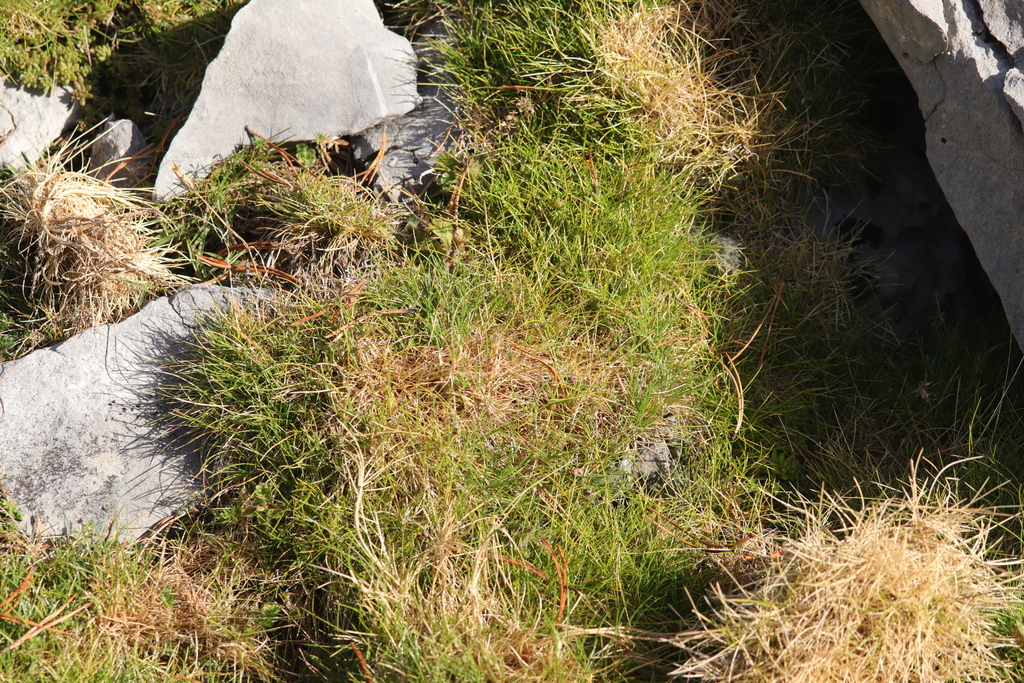
Spiky Fescue
Festuca gautieri
Festuca gautieri, commonly known as spiky fescue or bearskin fescue, is a species of flowering plant in the grass family, Poaceae, native to the Pyrenees. It is a commonly cultivated evergreen or semi-evergreen herbaceous perennial, and, as a native to European alpine areas, it is a small, low-growing Festuca suitable for rock gardens. It is first described in 1890.
From the article Festuca gautieri on Wikipedia (CC BY-SA), quoted section by section
Description
The bearskin fescue is a persistent, overwintering green grass with about 20 to 50 centimeters high and bare stalks, which have a diameter of 0.9 to 1.7 millimeters. It has dense horst-like growth with very thin, bristly to rush-shaped, folded leaves that are closed tubularly to one-third to three-quarters of their length. The leaf blades carry five to seven vascular bundles. The ligules are membranous, slightly fringed and about 0.5 to 1 millimeter long. The yellow-green inflorescence is a panicle that reaches a length of about 4.5 to 7 centimetres. The panicle branches are hairy and each carry an elongated, flattened spikelet that grows to about 9 to 11 millimetres in length. The glumae are unkempt and shorter than the spikelets, the lower one is single-veined, the upper one is three-veined and 4.9 to 5.8 millimetres long. The five-veined lemmas reach a length of 6 to 7.3 millimetres. The flowering season lasts from June to July. The chromosome count is 2n = 14 or 28.
Range & habitat
The bearskin fescue is widespread in the southwest of Europe above all in the Pyrenees. Its range extends from northern Morocco to eastern and north-eastern Spain and south-western France. It needs permeable, but moisture-storing soils in a semi-shade location.
Wikipedia: “Distribution and habitat”
Where it lives
Recorded sightings
—
geo-referenced records in GBIF, from museums, herbaria and field observers.
Drag the globe to turn it. Dots are where records exist, not a range map; darker means more records.
In the stacks
Searching the stacks…
Every page naming Festuca gautieri in the Biodiversity Heritage Library →
This page is assembled live from iNaturalist, GBIF, Wikipedia, the Source Library and the Internet Archive. It is not yet part of the hand-edited codex. iNaturalist taxon 363726.