- Animals
- ›Arthropods
- ›Hexapods
- ›Insects
- ›Winged and Once-winged Insects
- ›True Bugs, Hoppers, Aphids, and allies
- ›True Bugs
- ›Pentatomomorph Bugs
- ›Seed Bugs and Allies
- ›Seed Bugs
- ›Lygaeinae
- ›Lygaeus
- ›Lygaeus equestris
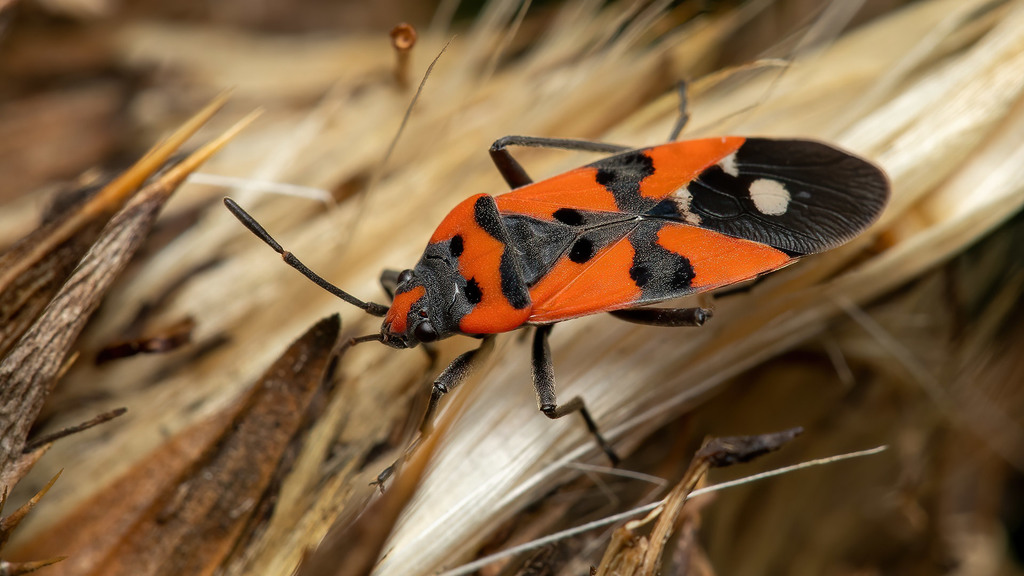
Black-and-Red Bug
Lygaeus equestris
Lygaeus equestris, common name Black-and-Red-bug, is a species of ground bugs belonging to the family Lygaeidae, subfamily Lygaeinae.
From the article Lygaeus equestris on Wikipedia (CC BY-SA), quoted section by section
Description
These bugs can reach about 11 to 12 millimetres (0.43 to 0.47 in) in length. They have a characteristic red-black pattern, fully developed wings and long, powerful legs. The hemelytra have two transverse bands that reach the margin and a round white spot on the membrane. Scutellum is without bristles but with tiny hairs. The black band close to the eye is wider than the same. This species is very difficult to differentiate from Lygaeus simulans, that has a scutellum with long bristles, antennae with angulous tubercles and a larger red area on the head. The red-black pattern has a deterrent effect and serves to protect the insect (Müllerian mimicry or Batesian mimicry). By storing the toxic ingredients of their food plants, they are unpalatable to potential predators.
Range & habitat
It is mainly present in Albania, Austria, Belgium, Bosnia, Bulgaria, Brazil, Croatia, Czech Republic, Denmark, Finland, France, Germany, Gibraltar, Greece, Hungary, Italy, Montenegro, North Macedonia, Poland, Portugal, Romania, Russia, Serbia, Slovakia, Slovenia, Spain, Sweden and Switzerland. It inhabits lawns, forests clearings and scrubs, generally in warm calcareous areas.
Wikipedia: “Distribution and habitat”
Listen
Looking for field recordings…
Where it lives
Recorded sightings
—
geo-referenced records in GBIF, from museums, herbaria and field observers.
Drag the globe to turn it. Dots are where records exist, not a range map; darker means more records.
In the stacks
Searching the stacks…
Every page naming Lygaeus equestris in the Biodiversity Heritage Library →
This page is assembled live from iNaturalist, GBIF, Wikipedia, the Source Library and the Internet Archive. It is not yet part of the hand-edited codex. iNaturalist taxon 362835.