- Animals
- ›Arthropods
- ›Hexapods
- ›Insects
- ›Winged and Once-winged Insects
- ›Butterflies and Moths
- ›Butterflies
- ›Gossamer-winged Butterflies
- ›Blues
- ›Typical Blues
- ›Polyommatina
- ›Polyommatus
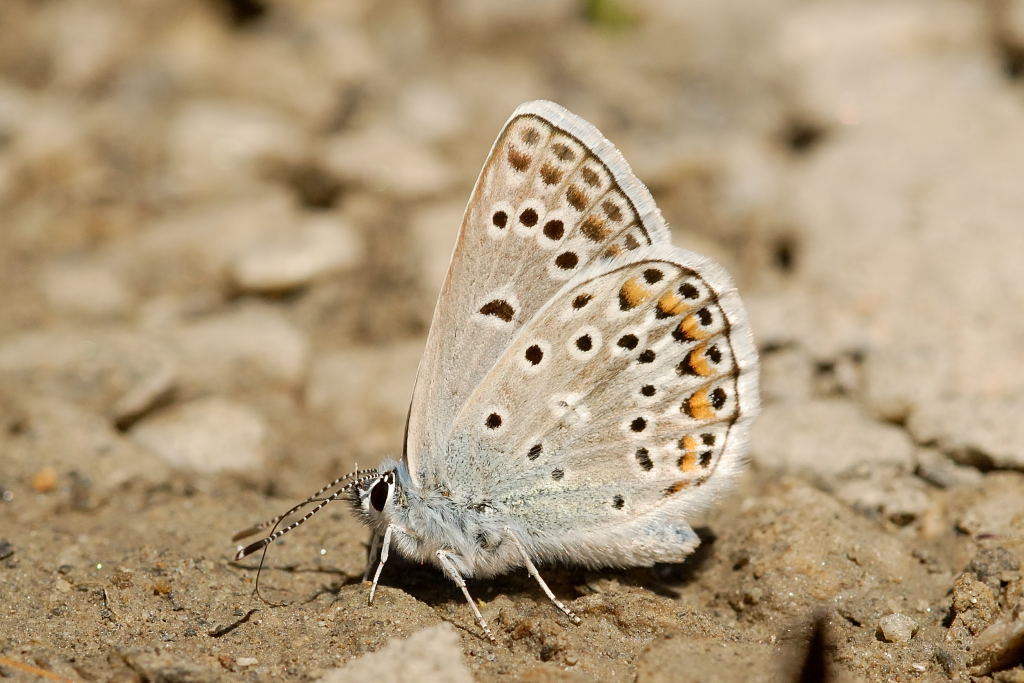
Escher's blue
Polyommatus escheri
Polyommatus escheri, Escher's blue, is a butterfly of the family Lycaenidae. It is found in Southern Europe and Morocco.
From the article Polyommatus escheri on Wikipedia (CC BY-SA), quoted section by section
Description
L. escheri Hbn. (81 a, b). male and female above similar to icarus, but much larger; the underside more prominently spotted, with more numerous ocelli, but the forewing beneath always without basal ocelli; the ground-colour of the underside in the male more shaded with grey and in the female sometimes darkened to a chocolate-brown; moreover, the discal row of ocelli of the hindwing is more proximal, standing nearer the discocellular spot than in icarus. Southern Europe, from Spain to the Balkan Peninsula, northwards extending into the Alps. Females with the upperside strongly dusted with blue are ab. subapennina Tur. — dalmatica Spey. (81 b) is the form from Dalmatia; the male is lighter blue, more similar in colour to hylas than to icarus; the black margin, which is very narrow in escheri is here broader, and the hindwing above bears very weak traces of dark spots at the margin. If these spots are especially distinct, we have ab. punctulata Wheel. — Egg of the usual flattened from, pure white, with small projections at the corners of the meshes of the minute network. Larva until April on Astragalus and Plantago. The butterflies commence to fly at the end of June, occurring in mountain valleys, singly but not rarely; they have a rather clumsy flight and frequent specially the beds of brooks. The length of the forewings is 17–19 mm.
Wikipedia: “Description in Seitz”
Listen
Looking for field recordings…
Where it lives
Recorded sightings
—
geo-referenced records in GBIF, from museums, herbaria and field observers.
Drag the globe to turn it. Dots are where records exist, not a range map; darker means more records.
In the stacks
Searching the stacks…
Every page naming Polyommatus escheri in the Biodiversity Heritage Library →
This page is assembled live from iNaturalist, GBIF, Wikipedia, the Source Library and the Internet Archive. It is not yet part of the hand-edited codex. iNaturalist taxon 362084.