- Animals
- ›Arthropods
- ›Hexapods
- ›Insects
- ›Winged and Once-winged Insects
- ›Butterflies and Moths
- ›Butterflies
- ›Brush-footed Butterflies
- ›Milkweed Butterflies
- ›Tiger and Crow Butterflies
- ›Tiger Butterflies
- ›Tirumala
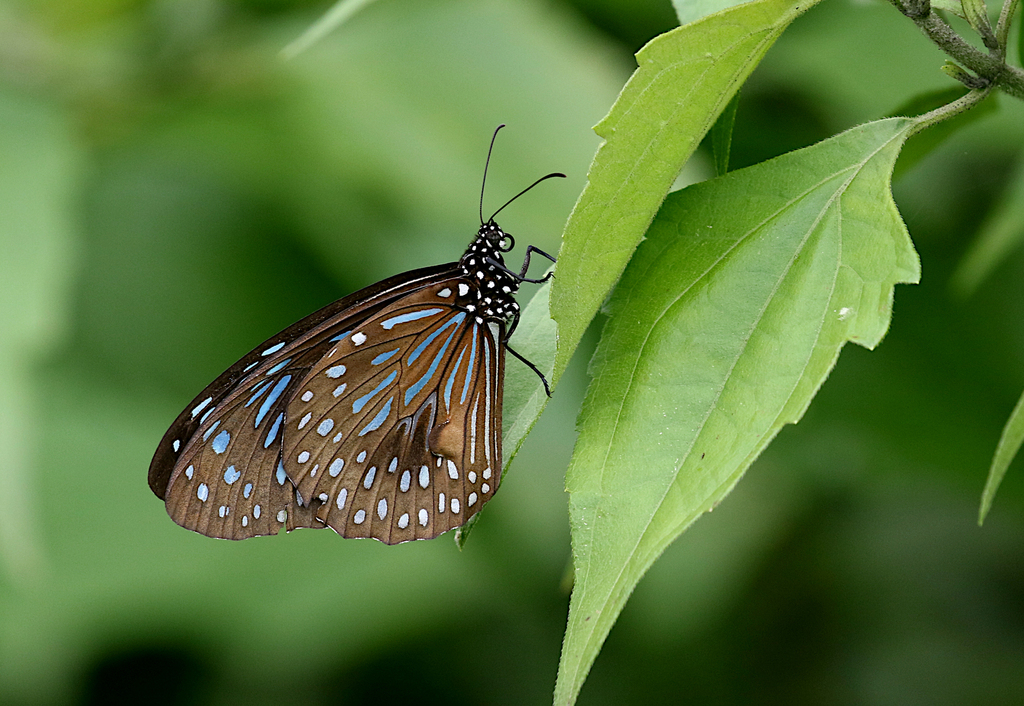
Dark Blue Tiger
Tirumala septentrionis
Tirumala septentrionis, the dark blue tiger, is a danaid butterfly found in the Indian subcontinent and Southeast Asia.
From the article Tirumala septentrionis on Wikipedia (CC BY-SA), quoted section by section
Description
Tirumala septentrionis has a wingspan from 80–115 mm. The species closely resembles Tirumala limniace, but is sufficiently distinct to be easily recognized, even on the wing. Wings on any butterfly can show strong variations and genetics. For instance, the Dark Blue Tiger butterfly has a large wingspan because of the environment it grew up in, causing it to fly at large distances. Large sized wings were found in a low latitude area as well. Compared to T. limniace, its upperside is darker and the semihyaline markings are narrower, more distinct, and of a bluer tint. In the forewing, in interspace 1 the two streaks are narrower, never coalescent, and the upper streak forms an oval detached spot; the short streaks above vein 5 are outwardly never truncate, always acute. In the hindwing, the two streaks of the discoidal cell united at base are wide apart at their apices, with the lower streak never formed into a hook. On the underside, this species is generally darker, the apex of the forewing and the whole of the ground colour of the hindwing not being of the conspicuous golden brown that they are in T. limniace.
Range & habitat
The Himalayas from Simla to Sikkim, into Assam, Myanmar, Cambodia and Southeast Asia; Odisha; West Bengal, southern India, the Western Ghats and Nilgiris; Sri Lanka.
Wikipedia: “Distribution”
What it does
Caterpillar is similar to that of T. limniace (see Journal of the Bombay Natural History Society x, 1896, p. 240). It is said by MacKinnon and de Nicéville to feed on Vallaris dichotoma (Journal of the Bombay Natural History Society xi, 1807, p. 212). Other species include Cosmostigma racemosa, Heterostemma brownii and Cocculus species.
Wikipedia: “Life cycle”
Listen
Looking for field recordings…
Where it lives
Recorded sightings
—
geo-referenced records in GBIF, from museums, herbaria and field observers.
Drag the globe to turn it. Dots are where records exist, not a range map; darker means more records.
In the stacks
Searching the stacks…
Every page naming Tirumala septentrionis in the Biodiversity Heritage Library →
This page is assembled live from iNaturalist, GBIF, Wikipedia, the Source Library and the Internet Archive. It is not yet part of the hand-edited codex. iNaturalist taxon 358953.