- Plants
- ›Vascular Plants
- ›flowering plants
- ›Dicots
- ›Sunflowers, Bellflowers, Fanflowers, and Allies
- ›Sunflowers, Daisies, Asters, and Allies
- ›Asteroideae
- ›stinkworts and allies
- ›Inulinae
- ›Telekia
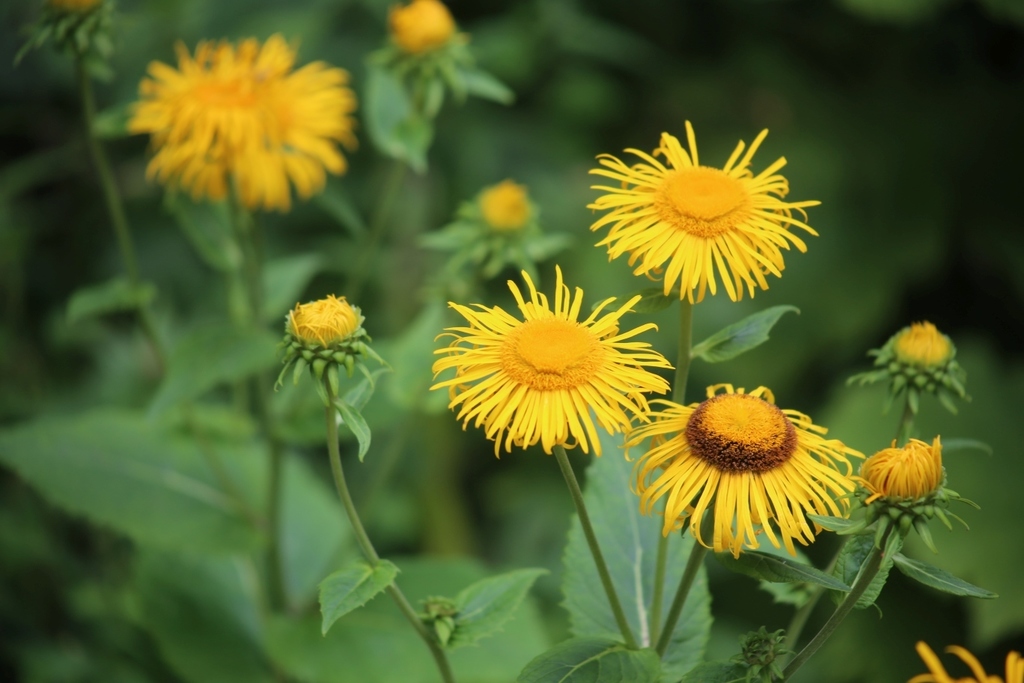
Yellow Oxeye
Telekia speciosa
Telekia speciosa, also known as the heart-leaved oxeye or yellow oxeye, is a species of flowering plant within the family Asteraceae.
From the article Telekia speciosa on Wikipedia (CC BY-SA), quoted section by section
Description
Telekia speciosa is a herbaceous perennial, which can grow up to 2 metres tall. Leaves are green, triangular, doubly-serrate and long-petioled. Plant leaves can range from 10 to 40 cm long. The leaves are also glabrous on their surface and possess hairs on the undersides. Younger ovate stem leaves are sessile. Plants will bloom from early summer to early autumn. Flowers are hosted on slender stems. Flowers appear daisy-like with ragged yellow petals.
Range & habitat
This species is native to much of Europe, where it can be found in: Albania, Bulgaria, the Czech Republic, Greece, Hungary, Romania, Turkey, Ukraine, Slovakia, Bulgaria and North Macedonia. It is also native to the Baltic states, North and South Caucasus and Central and Northwest European Russia.
Wikipedia: “Native range”
What it does
The flowers of Telekia speciosa are used by a large variety of pollinating insects including various species of bee, butterfly and hoverfly. Butterflies such as the European peacock (Aglais io), the common swallowtail (Papilio machaon), the green-veined white (Pieris napi) and the high brown fritillary (Argynnis adippe) have been recorded to feed from the flower of T. speciosa. Bee species such as the bumblebee (Bombus semenoviellus) also pollinate the flowers of T. speciosa. The seeds of T. speciosa are consumed by seed eating birds such as goldfinch (Carduelis carduelis) and other finch species. Telekia speciosa is the food plant of the aphid species Uroleucon telekiae, which is monophagous and feeds from no other plant species.
The fungi Golovinomyces inulae, which causes powdery mildew and Coleosporium telekiae, which causes rust can both infect T. speciosa.
Wikipedia: “Ecology”
Where it lives
Recorded sightings
—
geo-referenced records in GBIF, from museums, herbaria and field observers.
Drag the globe to turn it. Dots are where records exist, not a range map; darker means more records.
In the stacks
Searching the stacks…
Every page naming Telekia speciosa in the Biodiversity Heritage Library →
This page is assembled live from iNaturalist, GBIF, Wikipedia, the Source Library and the Internet Archive. It is not yet part of the hand-edited codex. iNaturalist taxon 358060.