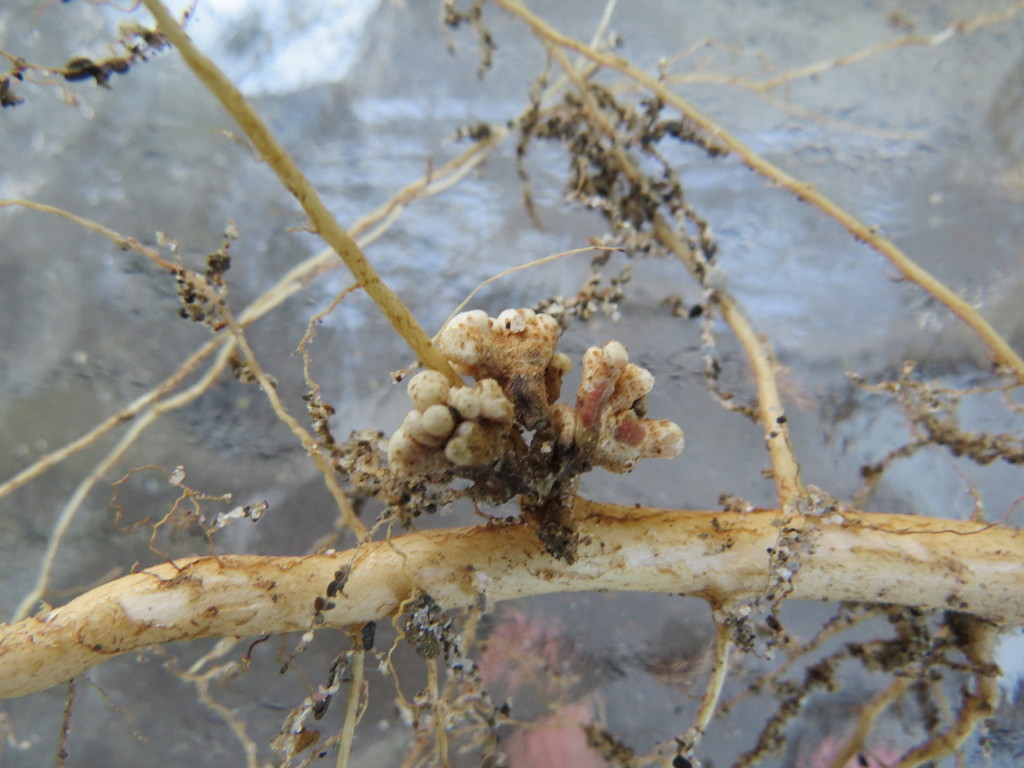
Rhizobium leguminosarum
Rhizobium leguminosarum is a Gram-negative soil bacterium in the genus Rhizobium that forms mutualistic, nitrogen-fixing symbioses with legumes. Compatible strains colonise the roots of various host plants and induce the formation of root nodules, within which the bacteria differentiate into bacteroids and convert atmospheric nitrogen into ammonium compounds that can be used by the plant. In return, the plant supplies the bacteria with carbon compounds.
Different symbiotic groups have characteristic host ranges: strains of symbiovar viciae nodulate legumes including peas, vetches and lentils, whereas symbiovar trifolii is associated with clovers. R. leguminosarum, particularly strains of symbiovar viciae, has been widely used as a model for studying root-nodule formation, bacteroid metabolism and symbiotic nitrogen fixation. Its genome has also been extensively studied, including the complete sequencing of the widely used strain 3841.
From the article Rhizobium leguminosarum on Wikipedia (CC BY-SA), quoted section by section
Description
Rhizobium leguminosarum is a Gram-negative, motile, rod-shaped, aerobic bacterium.
Wikipedia: “Morphology”
What it does
The symbiosis between R. leguminosarum and its host plants involves an exchange of chemical signals. Compounds released by legume roots, particularly flavonoids and other phenolic compounds, are detected by rhizobial regulatory proteins such as NodD, which activate bacterial nod genes. These genes direct the production of Nod factors, signalling molecules whose precise chemical structure is an important determinant of host specificity. In susceptible legumes, Nod-factor signalling causes changes including root hair deformation and curling. The bacteria enter through structures known as infection threads and are delivered into developing root nodules, where they differentiate into bacteroids capable of nitrogen fixation. Within the nodule, the plant supplies the bacteroids with carbon compounds, while the bacteria reduce atmospheric nitrogen to forms that can be assimilated by the plant. Nitrogenase is sensitive to oxygen, although the bacteroids require oxygen for respiration; leghemoglobin produced in the nodule helps maintain a low free-oxygen concentration while delivering oxygen to the bacteroids.
Wikipedia: “Symbiosis and nitrogen fixation”
At the table
R. leguminosarum is widely used in the inoculation of legume seeds. The sv. trifolii strain U204 is commercially used to inoculate white and red clover in particular, but better strains for this purpose are being developed. Research has been carried out into the role that R. leguminosarum could play in promoting growth of canola and lettuce.
Wikipedia: “Uses”
Where it lives
Recorded sightings
—
geo-referenced records in GBIF, from museums, herbaria and field observers.
Drag the globe to turn it. Dots are where records exist, not a range map; darker means more records.
In the stacks
Searching the stacks…
Every page naming Rhizobium leguminosarum in the Biodiversity Heritage Library →
This page is assembled live from iNaturalist, GBIF, Wikipedia, the Source Library and the Internet Archive. It is not yet part of the hand-edited codex. iNaturalist taxon 356505.