- Animals
- ›Arthropods
- ›Hexapods
- ›Insects
- ›Winged and Once-winged Insects
- ›Butterflies and Moths
- ›Clearwing moths
- ›Clearwing Moths
- ›Sesiinae
- ›Sesiini
- ›Sesia
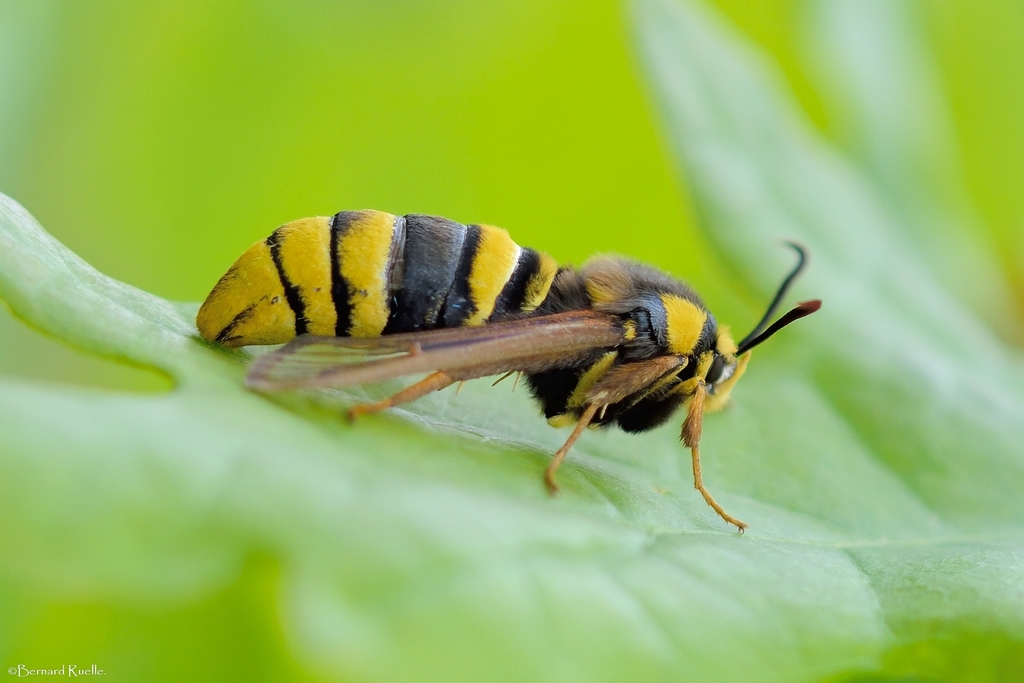
Hornet Moth
Sesia apiformis
The hornet moth or hornet clearwing (Sesia apiformis) is a large moth native to Europe and the Middle East and has been introduced to North America. Its protective coloration is an example of Batesian mimicry, as its similarity to a hornet makes it unappealing to predators. The hornet moth has been linked to the large dieback of poplar trees across Europe because its larvae bore into the trunk of the tree before re-emerging as adults.
From the article Hornet moth on Wikipedia (CC BY-SA), quoted section by section
Range & habitat
Sesia apiformis is found across mainland Europe, Great Britain, and in parts of the Middle East. It has also recently been introduced to America and Canada.
Wikipedia: “Geographic range”
At the table
Larvae feed on host trees of several poplar species including Populus tremula and Populus nigra as well as Salix caprea. The moth also prefers to feed around trees surrounded by heavy vegetation. It was found that trees near this heavy vegetation suffered from a lot more infestation than those without the basal vegetation.
Wikipedia: “Food resources”
Listen
Looking for field recordings…
Where it lives
Recorded sightings
—
geo-referenced records in GBIF, from museums, herbaria and field observers.
Drag the globe to turn it. Dots are where records exist, not a range map; darker means more records.
In the stacks
Searching the stacks…
Every page naming Sesia apiformis in the Biodiversity Heritage Library →
This page is assembled live from iNaturalist, GBIF, Wikipedia, the Source Library and the Internet Archive. It is not yet part of the hand-edited codex. iNaturalist taxon 354819.