- Plants
- ›Vascular Plants
- ›flowering plants
- ›Dicots
- ›Sunflowers, Bellflowers, Fanflowers, and Allies
- ›Sunflowers, Daisies, Asters, and Allies
- ›Asteroideae
- ›paper daisies
- ›cudweeds, everlastings, and pussytoes
- ›Helichrysum
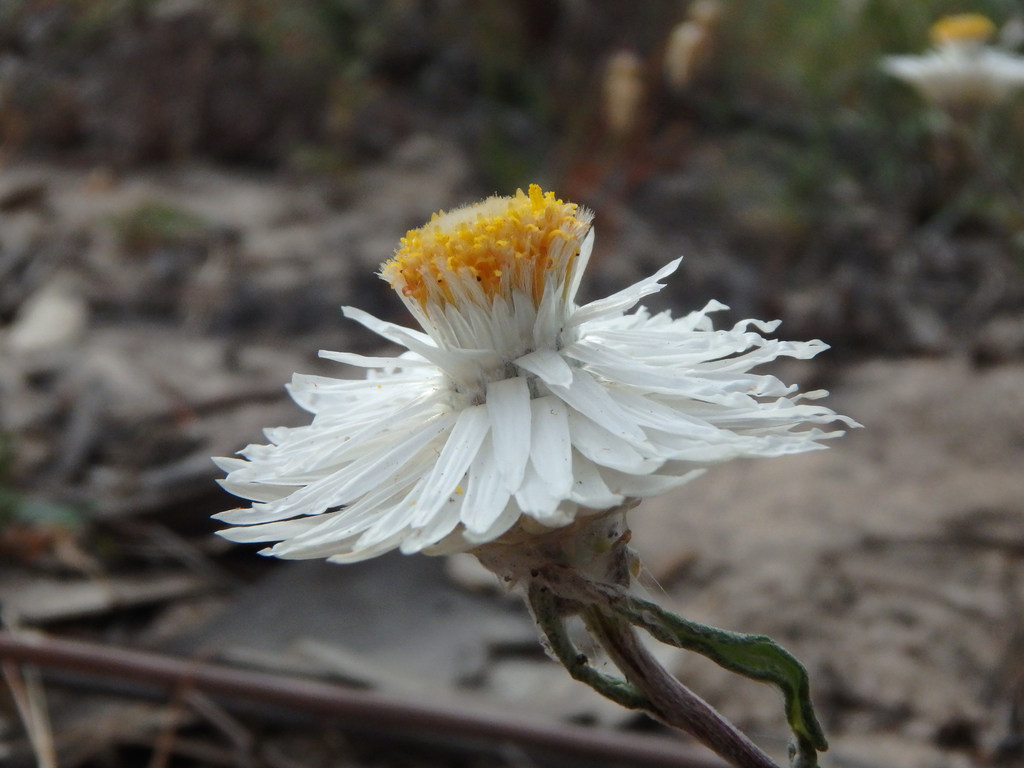
Satin Everlasting
Helichrysum leucopsideum
Helichrysum leucopsideum, commonly known as satin everlasting, is a perennial herb in the family Asteraceae. It is native to southern Australia. It produces terminal flower heads, mainly between spring and early summer. The white bracts spread out or become reflexed with age.
From the article Helichrysum leucopsideum on Wikipedia (CC BY-SA), quoted section by section
Description
Helichrysum leucopsideum is an upright, spreading perennial herb 15–50 cm (5.9–19.7 in) high, stems with occasional or thickly woolly glandular hairs. The leaves are narrowly oblong to linear, 1.5–5 cm (0.59–1.97 in) long, 1–10 mm (0.039–0.394 in) wide, blunt to acute and ending with a sharp point. The upper surface green, rough, hairless or with a few scattered glandular hairs. The lower surface grey or white, densely woolly and the margins rolled under or wavy. The flower heads are mostly single or 2-3 in corymbs, 2–3.5 cm (0.79–1.38 in) in diameter and the bracts are arranged in rows of about 10, white, sometimes pinkish in bud, wooly toward the base, folding back toward the stem as the flower matures, florets are yellow and numerous. Flowering occurs mostly in spring and summer and the fruit is cypsela 2–3 mm (0.079–0.118 in) long, smooth, brown and bristly.
Range & habitat
Satin everlasting grows in a variety of habitats including sand, open forests, coastal scrub to sub-alpine locations in Western Australia, South Australia, Victoria, Tasmania and New South Wales.
== References ==
Wikipedia: “Distribution and habitat”
Where it lives
Recorded sightings
—
geo-referenced records in GBIF, from museums, herbaria and field observers.
Drag the globe to turn it. Dots are where records exist, not a range map; darker means more records.
In the stacks
Searching the stacks…
Every page naming Helichrysum leucopsideum in the Biodiversity Heritage Library →
This page is assembled live from iNaturalist, GBIF, Wikipedia, the Source Library and the Internet Archive. It is not yet part of the hand-edited codex. iNaturalist taxon 353939.