- Plants
- ›Vascular Plants
- ›flowering plants
- ›Dicots
- ›carrots, ivies, and allies
- ›cheesewood family
- ›Pittosporum
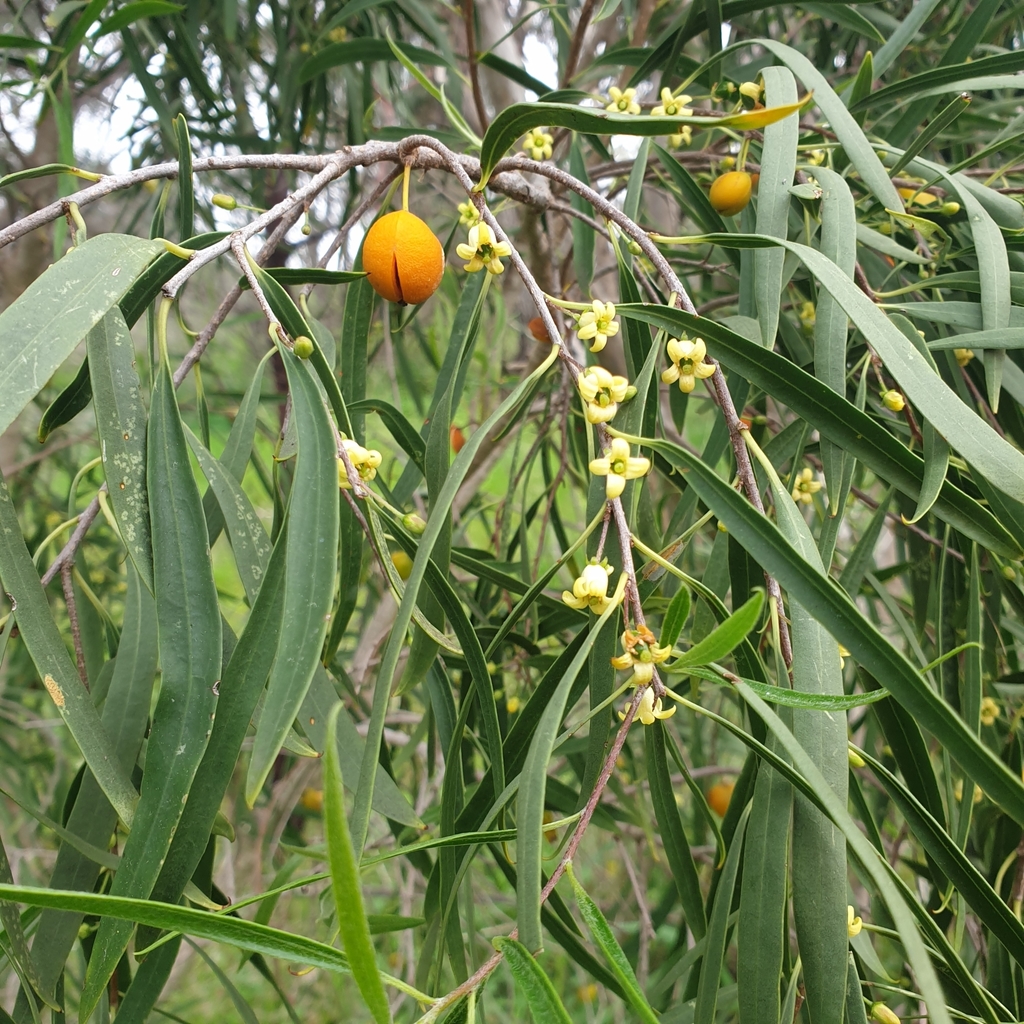
Native apricot
Pittosporum angustifolium
Pittosporum angustifolium (formerly Pittosporum phillyreoides) is a shrub or small tree growing in inland Australia. A slow growing plant, usually seen between two and six metres high, though exceptional specimens may exceed ten metres. Common names include Weeping Pittosporum, Butterbush, Cattle Bush, Native Apricot, Gumbi Gumbi, Cumby Cumby, Meemeei and Berrigan. It is drought and frost resistant. It can survive in areas with rainfall as low as 150 mm per year. A resilient desert species, individuals may...
From the article Pittosporum angustifolium on Wikipedia (CC BY-SA), quoted section by section
Description
Pittosporum angustifolium weeping shrub or tree up to about 10 m (33 ft) high. It has thick fissured, fibrous or flaky bark. Its leaves are arranged alternately, oblong, linear or narrowly elliptic, curved, 50–90 mm (2.0–3.5 in) long and 6–11 mm (0.24–0.43 in) wide on a petiole 5–14 mm (0.20–0.55 in) long. The flowers are dioecious, arranged singly or in small groups in leaf axils, or in clusters on the ends of branches, each flower on a pedicel 5–12 mm (0.20–0.47 in) long. Male flowers are in groups of four, with a small pistil and stamens 5.5–6.0 mm (0.22–0.24 in) long. Female flowers have an ovary about 5 mm (0.20 in) long with a short style. Flowering mostly occurs from winter to spring, and the fruit is an oval to spherical, yellowish capsule 8–14 mm (0.31–0.55 in) in diameter containing sticky, reddish-brown seeds 4–5 mm (0.16–0.20 in) long.
Range & habitat
Pittosporum angustifolium is a widespread plant found in all states of Australia apart from Tasmania and in the Northern Territory, mostly in inland Australia. It is found in mallee communities, on alluvial flats and ridges, as well as in dry woodland and on loamy, clay or sandy soils, however it is never common.
It is drought- and frost-resistant. It can survive in areas with rainfall as low as 150 mm (5.9 in) per year. A resilient desert species, individuals may live for over a hundred years.
Wikipedia: “Distribution and habitat”
At the table
Pittosporum angustifolium is used as an ornamental plant in the garden, prized for its weeping habit and orange fruit.
Traditional/cultural use. Indigenous Australians used parts of the plant in various ways as medicine. Uses varied from place to place and people to people. Some ate or chewed the gum that oozed from branches, while others ground seeds into flour for food. Most commonly, the leaves, seed or wood were steeped in hot water and made into a poultice or a tea for medicinal uses, such as to relieve digestive issues, internal pain and cramping, combat chronic fatigue, induce lactation, treat colds, muscle sprains, eczema and other sources of itching. Despite being known as "native apricot", the bitter fruit is rarely considered a food source.
Medical/therapeutic use. Ongoing scientific research is being carried out internationally, and has begun to identify medically relevant biochemistry present in P. angustifolium, including anti microbial and antibacterial, antioxidant, antifungal, anti inflammatory, and galactogogue compounds. …
Wikipedia: “Uses”
Where it lives
Recorded sightings
—
geo-referenced records in GBIF, from museums, herbaria and field observers.
Drag the globe to turn it. Dots are where records exist, not a range map; darker means more records.
In the stacks
Searching the stacks…
Every page naming Pittosporum angustifolium in the Biodiversity Heritage Library →
This page is assembled live from iNaturalist, GBIF, Wikipedia, the Source Library and the Internet Archive. It is not yet part of the hand-edited codex. iNaturalist taxon 349255.