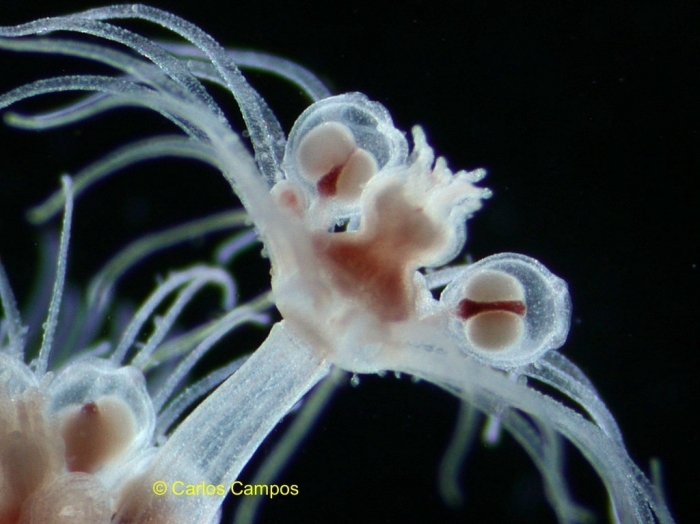
tubular sponge hydroid
Zyzzyzus warreni
Zyzzyzus warreni, the tubular sponge hydroid, is a species of hydroid cnidarian. It is a member of the family Tubulariidae. These animals usually grow embedded in sponges.
From the article Zyzzyzus warreni on Wikipedia (CC BY-SA), quoted section by section
Description
Zyzzyzus warreni grows to about 1.5 cm (0.6 in) tall. It has a fat stem and a daisy-like polyp with sparse tentacles surrounding a group of reproductive sporosacs which in turn surround the pink and white oral tentacles. The body of the hydranths (feeding individuals) as well as the gonophores (reproductive polyps) are pinky red, while the tentacles are transparent white.
Range & habitat
This species is found around the South African coast from Saldanha Bay to KwaZulu-Natal as well as off the Cape Verde Islands, Trinidad and Bermuda. It is also known from Brazil, Colombia, the Netherlands Antilles, Puerto Rico and Japan. It occurs in various habitats where the sponges on which it feeds live, including rocky shores, quiet coastal waters, bays and on mangrove roots. It is known from the subtidal to at least 30 m (100 ft) underwater.
Wikipedia: “Distribution and habitat”
What it does
At breeding time, female gonophores contain one to four actinulae (mobile tentaculate larvae), and these are released into the water column in a series of pulsations over the course of a few minutes. They can not actively swim but are attracted towards suitable species of sponge on which to settle, and may be attracted by the presence of chemical cues emitted by the sponge. They can settle within ten minutes on favourable substrates and can survive for about three days if no suitable substrate can be found. When settled, they quickly undergo metamorphosis and the new polyps that form develop tentacles and start feeding in about two days.
== References ==
Wikipedia: “Ecology”
Where it lives
Recorded sightings
—
geo-referenced records in GBIF, from museums, herbaria and field observers.
Drag the globe to turn it. Dots are where records exist, not a range map; darker means more records.
In the stacks
Searching the stacks…
Every page naming Zyzzyzus warreni in the Biodiversity Heritage Library →
This page is assembled live from iNaturalist, GBIF, Wikipedia, the Source Library and the Internet Archive. It is not yet part of the hand-edited codex. iNaturalist taxon 347778.