- Animals
- ›Arthropods
- ›Hexapods
- ›Insects
- ›Winged and Once-winged Insects
- ›Ants, Bees, Wasps, and Sawflies
- ›Narrow-waisted Wasps, Ants, and Bees
- ›Ants, Bees, and Stinging Wasps
- ›Formicoidea
- ›Ants
- ›Myrmicine Ants
- ›Crematogastrini
- ›Leptothorax
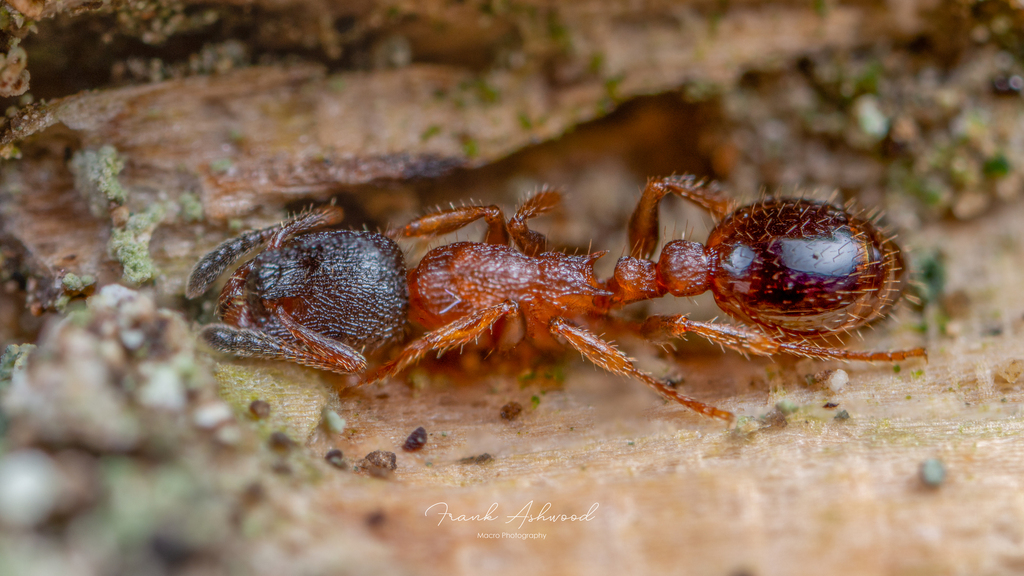
Leptothorax acervorum
Leptothorax acervorum is a small brown to yellow ant in the subfamily Myrmicinae. It was first described by Johan Christian Fabricius in 1793. L. acervorum is vastly distributed across the globe, most commonly found in the coniferous forests of Central, Western and Northern Europe. The morphology of L. acervorum is extremely similar to that of other Leptothorax ants. The difference arises in the two-toned appearance of L. acervorum, with the head and metasoma being darker than the mesosoma segment of the body, and hair across its body. Following Bergmann's rule—unusually, for ectothermic animals—body size increases with latitude.
From the article Leptothorax acervorum on Wikipedia (CC BY-SA), quoted section by section
Description
Leptothorax acervorum is a small red ant Similar to other ants, L. acercorum displays geniculate (elbowed) antennae, metapleural glands, and a constriction of the second abdominal segment. The exoskeleton provides a protecting casing of the body, which can be divided into 3 segments: the head, mesosoma, and metasoma. The head contains eyes that detect acute movement, three small ocelli to detect light and polarization, and two mandibles. Attached to the head are two antennae. All six legs are attached to the mesosoma. The metasoma houses vital internal organs. "The pedicel of the metasoma is two-segmented," which is unique for the Subfamily Myrmicinae. The head and abdomen are dark, thereby giving the ant a two-toned appearance. Individual ants are small, with workers measuring around 3 millimetres (0.12 in) in length and queens being only 10% larger. Colonies are small compared to those of other ants—they have anywhere from a few dozen to a few hundred workers and one to several queens.
Workers. The workers have reddish to brownish yellow body colour with the head, antennal club and dorsal surface being darker. The petiole nodes and femora are frequently infuscate. They have a total of 11 segments in antennae. The head is longitudinally striated, and smooth and the average length is usually 3.7–4.5 mm.
Queen. The queen is similar in appearance to the worker. …
Wikipedia: “Morphology”
Range & habitat
Leptothorax acervorum are commonly found in dry coniferous forests, where they nest in small rotting branches, tree stumps, and under bark. However, colonies that inhabit the periphery of its range are patchily distributed. Patchy distribution is positively correlated with an increase in latitude because, in the case that a queen leaves its colony due to a resource deficit, there is a low possibility that it will find and thereby compete with another one. The ideal environment for this species consists of temperate or subtropical biomes, in which resources are readily available for survival and success of the colony.
Wikipedia: “Habitat”
What it does
Leptothorax acervorum is a model organism to investigate the social structure of multiple-queen colonies. Leptothorax acervorum is a facultatively polygynous ant, meaning that colonies with one or more than one queen occur, and these colonies acquire extra queens by adoption—thus polygyny is secondary. Electrophoretic allozyme analysis showed that cohabiting queens are close relatives. This reinforces the assumption that the queens in L. acervorum colonies form mother-daughter-sister groups, which arise from adopting newly mated queens into their natal nests. Newly eclosed queens mate with unrelated males near the natal nest and then return to it, where they are readopted. Other queens disperse to mating aggregations, mate, and then leave the aggregations to establish new colonies elsewhere. Matings near the nest may occur because L. acervorum queens 'call' males through the use of pheromones.
Oophagy. An important behavior noticed in L. acervorum was the eating of reproductive eggs by queens. On average, approximately 69% of eggs eaten were intact. Also in observed colonies, the proportions of eggs eaten out of all eggs laid were 25%, 93%, 125% (i.e. more eggs were eaten than laid in that period) and 64%. This oophagy had a major impact on the colony's output of eggs. The queens appeared to exhibit no discrimination when targeting eggs. …
Wikipedia: “Queen behavior”
Listen
Looking for field recordings…
Where it lives
Recorded sightings
—
geo-referenced records in GBIF, from museums, herbaria and field observers.
Drag the globe to turn it. Dots are where records exist, not a range map; darker means more records.
In the stacks
Searching the stacks…
Every page naming Leptothorax acervorum in the Biodiversity Heritage Library →
This page is assembled live from iNaturalist, GBIF, Wikipedia, the Source Library and the Internet Archive. It is not yet part of the hand-edited codex. iNaturalist taxon 347536.