- Animals
- ›Arthropods
- ›Hexapods
- ›Insects
- ›Winged and Once-winged Insects
- ›Ants, Bees, Wasps, and Sawflies
- ›Narrow-waisted Wasps, Ants, and Bees
- ›Ants, Bees, and Stinging Wasps
- ›Formicoidea
- ›Ants
- ›Ponerine Ants
- ›Typical Ponerine Ants
- ›Ponera
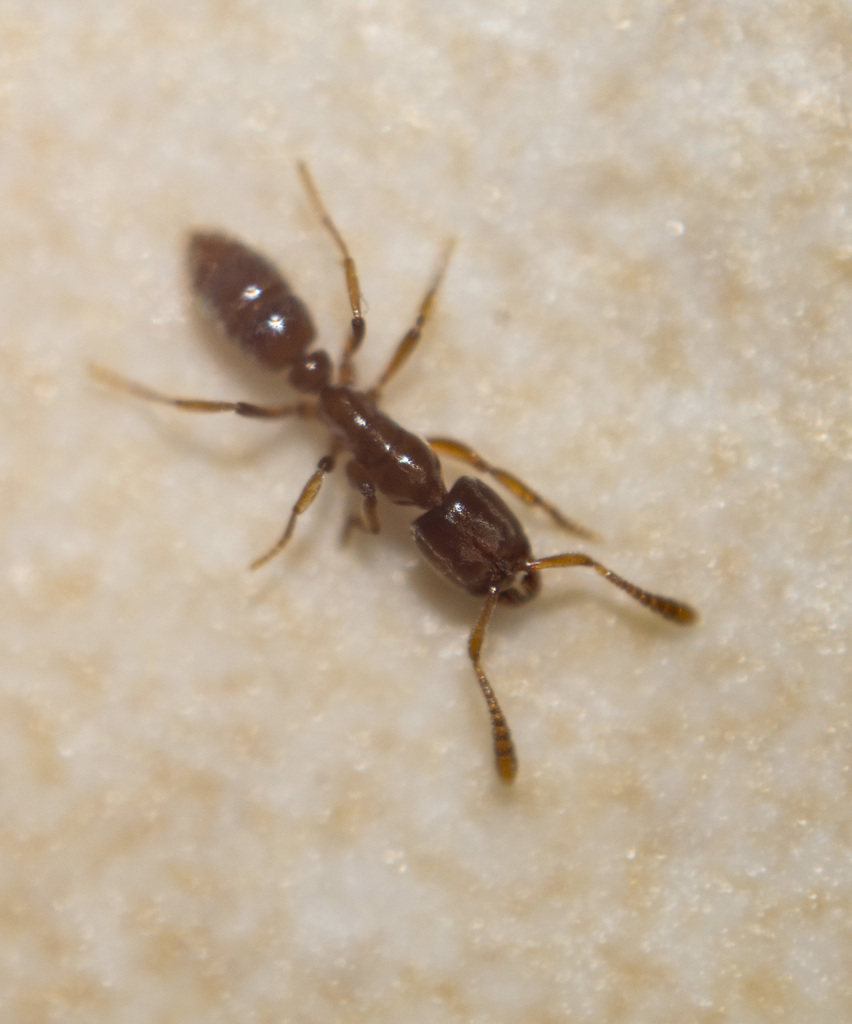
Ponera testacea
Ponera testacea is a species of ant native to Europe and some areas of the north African coast. The species was previously regarded as a variety of Ponera coarctata, being raised to species status in 2003. It is 1 of 7 species of Ponera known in the Palearctic region and 1 of 3 in Europe.
From the article Ponera testacea on Wikipedia (CC BY-SA), quoted section by section
Description
P. testacea is very similar to P. coarctata, with the primary identifying difference being the size and shape of the petiole. In P. testacea the petiole is shorter and thicker when seen in profile, typically not extending above the height of the gaster and thorax. The sides of the petiole are also parallel sided, instead of slightly tapering as seen in its sister species. P. testcea is also smaller than its sister species on average, and are typically of a lighter colouration than P. coarctata. Workers were measured at 2.5-3.0mm in length with thick decumbent hairs cover the full body. Female alates were measured at 3.0mm on average in length, sharing the thick decumbent hairs of the workers.
Range & habitat
P. testacea is distributed across most of Europe, excluding Scandinavia, the Baltics, Belarus, Ireland and Iceland. Its range extends east to the Caucus region and Southern Russia. The specie's most eastern presence is located in Turkmenistan, and its most southern records are from Tunisia and Morocco. Unlike its sister species, P. testacea prefers a more xerothermic (warmer and drier) habitat, avoiding humid and/or shaded sites which P. coarctata would prefer.
Wikipedia: “Distribution and habitat”
Listen
Looking for field recordings…
Where it lives
Recorded sightings
—
geo-referenced records in GBIF, from museums, herbaria and field observers.
Drag the globe to turn it. Dots are where records exist, not a range map; darker means more records.
In the stacks
Searching the stacks…
Every page naming Ponera testacea in the Biodiversity Heritage Library →
This page is assembled live from iNaturalist, GBIF, Wikipedia, the Source Library and the Internet Archive. It is not yet part of the hand-edited codex. iNaturalist taxon 347519.