- Animals
- ›Arthropods
- ›Hexapods
- ›Insects
- ›Winged and Once-winged Insects
- ›Ants, Bees, Wasps, and Sawflies
- ›Narrow-waisted Wasps, Ants, and Bees
- ›Ants, Bees, and Stinging Wasps
- ›Formicoidea
- ›Ants
- ›Formicine Ants
- ›Formicini
- ›Formica
- ›Formica fusca
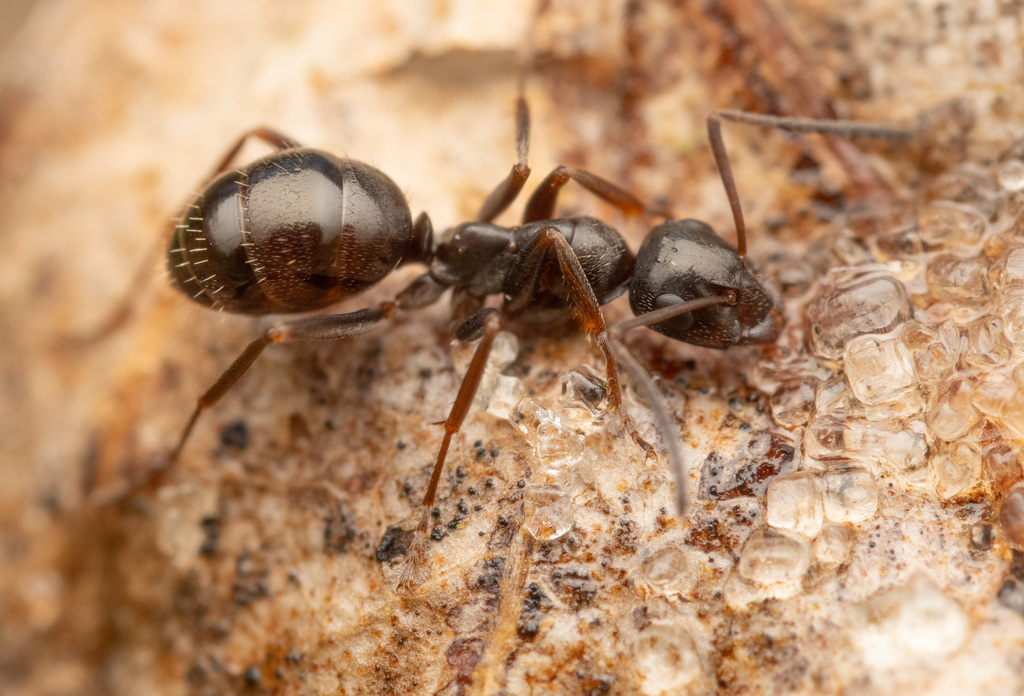
Black Bog Ant
Formica picea
Formica picea, sometimes called Black Bog Ant, is a species of ant belonging to the family Formicidae. It is black and shiny. and have a high resistance to cold winter temperatures and to flooding. It has even been observed to escape below the water surface by climbing down Sphagnum stems. In areas with milder winters, it inhabits bogs, but in colder areas and at higher elevations it can also inhabit grassland on mineral soils.
Formica picea very closely resembles the species Formica candida, but among the characters that have been shown to differ on average, noticeable ones are that F. picea has a proportionally longer head and longer antennal scapes than F. candida. However, recent molecular investigation of specimens collected across northern Eurasia have revealed three different genetic clusters within the populations of Formica picea and Formica candida. The westernmost cluster, along with one sample from Tibet, correspond to Formica picea. A small cluster from Kyrgyzstan correspond to Formica candida, while a third eastern cluster could represent a third unnamed taxon. The difference between Formica picea and Formica candida was smaller than between either of them and the third unnamed taxon. Formica picea did not form a clearly separate genetic group, and it remains uncertain whether F. picea and F. candida are distinct species.
Listen
Looking for field recordings…
Where it lives
Recorded sightings
—
geo-referenced records in GBIF, from museums, herbaria and field observers.
Drag the globe to turn it. Dots are where records exist, not a range map; darker means more records.
In the stacks
Searching the stacks…
Every page naming Formica picea in the Biodiversity Heritage Library →
This page is assembled live from iNaturalist, GBIF, Wikipedia, the Source Library and the Internet Archive. It is not yet part of the hand-edited codex. iNaturalist taxon 347461.