- Plants
- ›Vascular Plants
- ›flowering plants
- ›Dicots
- ›Heathers, Balsams, Primroses, and Allies
- ›Lecythis Family
- ›Barringtonia
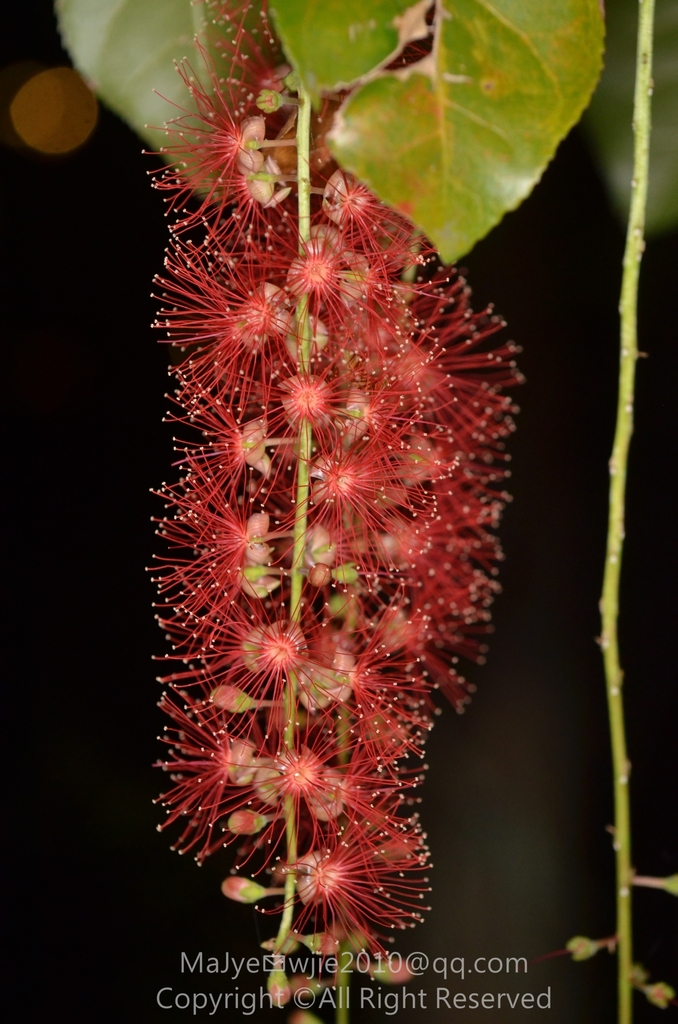
Indian Putat
Barringtonia acutangula
Barringtonia acutangula is a species of plant in the family Lecythidaceae native to coastal areas from Afghanistan east to mainland Southeast Asia and south to northern Australia. It has a conservation status of least concern, and it has culinary and medicinal uses in parts of Asia. Common names include freshwater mangrove, itchytree and mango-pine.
From the article Barringtonia acutangula on Wikipedia (CC BY-SA), quoted section by section
Description
This plant is a tree that grows to about 8–15 meters high. Its leaves are thick, smooth and oval in shape, about 8–12 centimeters long and 4–5 cm wide, with reddish petioles about 0.5–1.0 cm long. The plant has drooping raceme of up to 50 cm long, with numerous large, white flowers. Its fruit is oval-shaped and about 3 cm long, with one seed inside.
Range & habitat
It is native to the following regions as defined in the World Geographical Scheme for Recording Plant Distributions:
Western Asia: – Afghanistan Indian Subcontinent: – Assam, Bangladesh, India, Nepal, Pakistan, Sri Lanka Indo-China: – Cambodia, Laos, Myanmar, Thailand, Vietnam Malesia: – Borneo, Jawa, Lesser Sunda Islands, Malaya, Philippines, Sulawesi, Sumatera Papuasia: – New Guinea Australia: – Northern Territory, Queensland, Western Australia
Wikipedia: “Distribution”
At the table
The young leaves of this plant are consumed as food, such as in Vietnam where they are eaten fresh with other vegetables, meat and shrimp.
Wikipedia: “Food”
In medicine
Research on this plant has reported a number of medicinal uses, including antitumor (seed extract), antibiotic, inhibition of growth of Helicobacter pylori, and antifungal activity. The 1889 book 'The Useful Native Plants of Australia' records that "In India an extract or juice is obtained from the leaves of this tree which, when mixed with oil, is used in native [sic.] practice for eruptions of the skin. The kernels powdered and prepared with sago and butter, are used in diarrhoea; mixed with milk they produce vomiting (Treasury of Botany). The root is bitter, and is said to be similar to Cinchona, but also cooling and aperient. (Drury)."
Wikipedia: “Medicinal”
Where it lives
Recorded sightings
—
geo-referenced records in GBIF, from museums, herbaria and field observers.
Drag the globe to turn it. Dots are where records exist, not a range map; darker means more records.
In the stacks
Searching the stacks…
Every page naming Barringtonia acutangula in the Biodiversity Heritage Library →
This page is assembled live from iNaturalist, GBIF, Wikipedia, the Source Library and the Internet Archive. It is not yet part of the hand-edited codex. iNaturalist taxon 345950.