- Animals
- ›Arthropods
- ›Hexapods
- ›Insects
- ›Winged and Once-winged Insects
- ›Butterflies and Moths
- ›Geometrid and Swallowtail Moths
- ›Geometer Moths
- ›Ennominae
- ›Alsophilini
- ›Alsophila
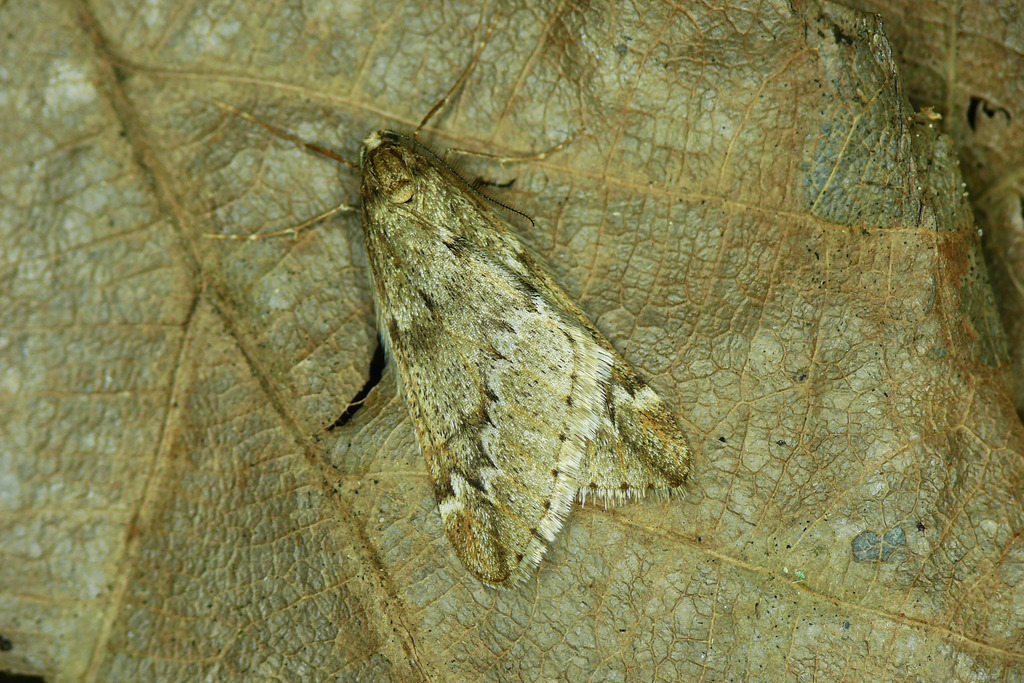
March Moth
Alsophila aescularia
Alsophila aescularia, the March moth, is a species of moth of the family Geometridae. It is found throughout Europe and can be a pest of fruit trees.
From the article Alsophila aescularia on Wikipedia (CC BY-SA), quoted section by section
Description
The wingspan is 25–35 mm. The colour of the forewings varies between pale brownish and grayish brown. There is a well-defined usually dark brown central band. The lines are sharply toothed and on the opposite side to the band they are whitish. A prominent black dot is present on the hind wings. Darkened specimens are rare. In these the lines are extinguished or the butterfly is completely black. The females have no wings and are eight to ten millimeters long. The abdomen is brownish grey, the abdominal hair tuft is about two millimeters wide and thus narrower than the abdomen, which represents a differentiator against Alsophila aceraria. The palps are very short, the sensors are slightly toothed. The proboscis is stunted. The tibiae of the hind legs have four spurs that are very short in females. The adults are active in March and April.
Larva The bright pale-green larva reaches a length of about 26 mm. It is characterized by a very smooth skin and a flat head. There is a dark green dorsal line and yellowish-white lateral lines. In contrast to other geometrid caterpillars, they have an additional rudimentary abdominal leg pair in the fifth segment. Long, spider's-web like strings hang from oak trees in the southern hemisphere. …
Range & habitat
It is a well-known species distributed throughout the western Palearctic region except northern Europe, Corsica, Malta, Albania, and the Greek Islands. A few isolated populations live outside of Europe in northern and eastern Turkey, Caucasus, Transcaucasus, and Turkmenistan. Alsophila aescularia has also been reported to exist in the Hyrcanian relic temperate deciduous forests of Iran along the northern slopes of Alborz Mountain Range, called the Caspian Forest.
Wikipedia: “Distribution”
Listen
Looking for field recordings…
Where it lives
Recorded sightings
—
geo-referenced records in GBIF, from museums, herbaria and field observers.
Drag the globe to turn it. Dots are where records exist, not a range map; darker means more records.
In the stacks
Searching the stacks…
Every page naming Alsophila aescularia in the Biodiversity Heritage Library →
This page is assembled live from iNaturalist, GBIF, Wikipedia, the Source Library and the Internet Archive. It is not yet part of the hand-edited codex. iNaturalist taxon 345611.