- Animals
- ›Arthropods
- ›Hexapods
- ›Insects
- ›Winged and Once-winged Insects
- ›Butterflies and Moths
- ›Owlet Moths and Allies
- ›Underwing, Tiger, Tussock, and Allied Moths
- ›Erebinae
- ›Poaphilini
- ›Dysgonia
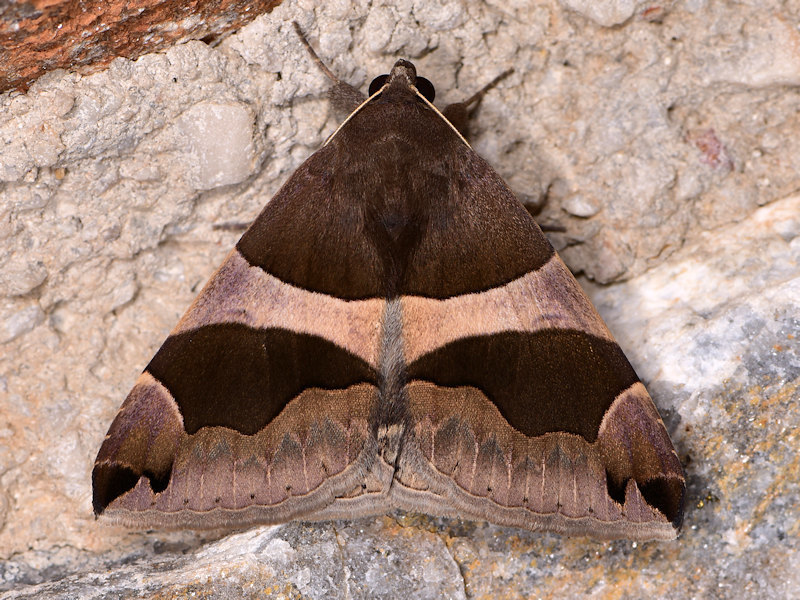
Jigsaw
Dysgonia torrida
Dysgonia torrida, commonly known as the jigsaw, is a species of moth in the family Erebidae. The species was first described by Achille Guenée in 1852. It is found from the tropical and subtropical areas of Africa to Spain, southern Italy, Greece, Syria, Israel, Iran, Uzbekistan towards India, Sri Lanka and Myanmar.
From the article Dysgonia torrida on Wikipedia (CC BY-SA), quoted section by section
Description
This species has a wingspan of 45–50 mm. Colors highly variable. Body red-brown. Antemedial line of the forewing being erect and having broad, white and slightly suffused band beyond it. Postmedial line angled also between veins 3 and 4 and sinuous towards inner margin. Apical streak broken up into two spots. Hindwings with a white medial band and outer margin greyish at center.
What it does
There are multiple generations per year. In Europe adults are on wing from May to June and September. The larvae feed on Zea mays (Poaceae), Ricinus communis and Acalypha wilkesiana (Euphorbiaceae)
Wikipedia: “Ecology”
Listen
Looking for field recordings…
Where it lives
Recorded sightings
—
geo-referenced records in GBIF, from museums, herbaria and field observers.
Drag the globe to turn it. Dots are where records exist, not a range map; darker means more records.
In the stacks
Searching the stacks…
Every page naming Dysgonia torrida in the Biodiversity Heritage Library →
This page is assembled live from iNaturalist, GBIF, Wikipedia, the Source Library and the Internet Archive. It is not yet part of the hand-edited codex. iNaturalist taxon 344822.