- Animals
- ›Arthropods
- ›Hexapods
- ›Insects
- ›Winged and Once-winged Insects
- ›Butterflies and Moths
- ›Butterflies
- ›Brush-footed Butterflies
- ›Emperors
- ›Apatura
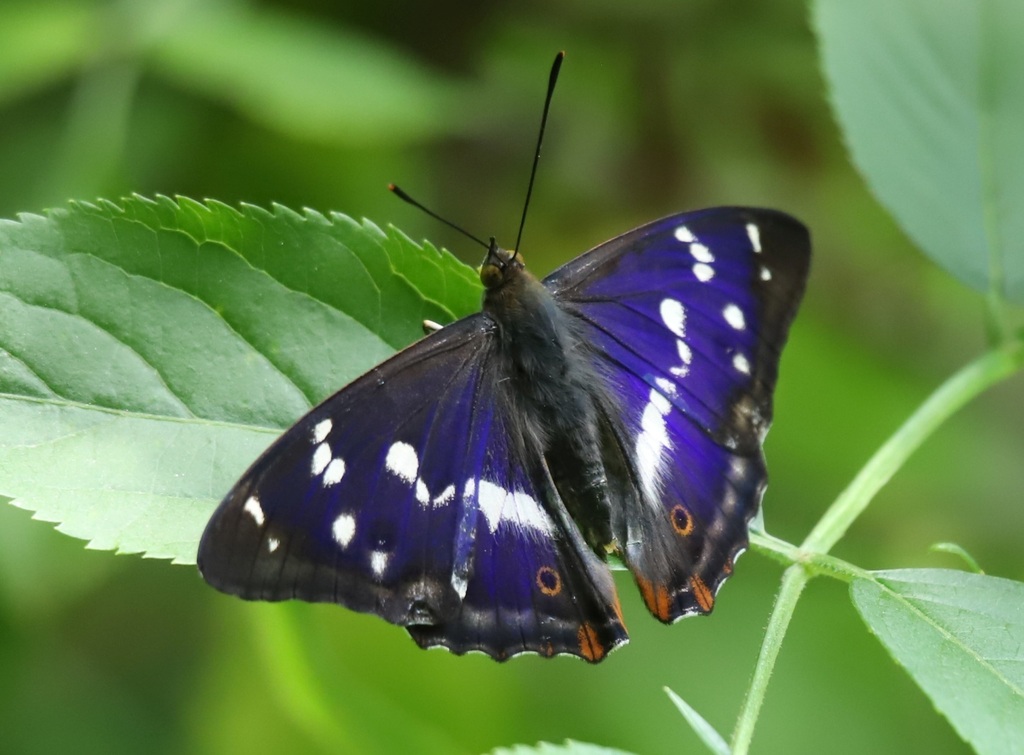
Purple Emperor
Apatura iris
Apatura iris, the purple emperor, is a Palearctic butterfly of the family Nymphalidae.
From the article Apatura iris on Wikipedia (CC BY-SA), quoted section by section
Description
Adults have dark brown wings with white bands and spots, and a small orange ring on each of the hindwings. Males have a wingspan of 70–80 millimetres (2.8–3.1 in), and have a purple-blue sheen caused by iridescence that the slightly larger (80–92 mm) females lack. The larvae (caterpillars) are green with white and yellow markings, and have two large "horns" at the anterior end and a smaller one at the posterior.
Range & habitat
Apatura iris is widely distributed in dense, broadleaved woodlands throughout Europe including southern Britain, and across the Palearctic to central and western China. Different subspecies are found across the region (see below).
British Isles. In Victorian times this species was regarded as being common in southern England, as far north as the river Humber, but since then it has experienced a sharp decline in both range and numbers. This decline started in the first part of the twentieth century (it was noted by South, for example, writing in 1921) and by the 1960s it was relatively scarce, being confined to old broadleaved woodlands in a few counties in south-east England. Heslop et al. ascribed the decline to habitat fragmentation and loss, starting before the First World War but accelerated by the increased demand for timber during that war, causing old woodlands to be clear felled to make way for commercial forestry crops, especially softwoods. This rendered large parts of its former habitat unsuitable, and it died out in those areas. This process continued after the Second World War for the same reason. …
Wikipedia: “Distribution”
What it does
They lay eggs in late summer on the upperside of sallow leaves, preferring the broad-leaved sallow, Salix caprea, but they will also use the narrow-leaved sallow, Salix atrocinerea, and various species of poplar. (Poplar is a more common food plant in continental Europe than in the British Isles.) After hatching, the larvae will lie along the midrib of the leaf where they are well camouflaged, and feed only at night. During the winter they hibernate in the forks of sallow branches, where they change colour from green to brown to match their surroundings. (The larvae are variously stated to be reach 35–40 mm long when fully fed or 55–56 mm; it is hard to give definitive measurements, given that they lack a rigid structure.) The following June they form a pale green chrysalis, 30–35 mm long and 12–15 mm in width, resembling a leaf shoot. The adults usually emerge in July, flying well into August.
Wikipedia: “Life cycle”
In human culture
A specimen of Apatura iris plays a key role in solving a murder mystery in Robert W. Chambers' 1897 short story, "The Purple Emperor." The species is also mentioned in Tolkien's The Hobbit, in chapter 8, "Flies and Spiders". Compton Mackenzie mentions decline in numbers and them feeding on carcass in The Darkening Green.
Wikipedia: “Cultural reference”
Listen
Looking for field recordings…
Where it lives
Recorded sightings
—
geo-referenced records in GBIF, from museums, herbaria and field observers.
Drag the globe to turn it. Dots are where records exist, not a range map; darker means more records.
In the stacks
Searching the stacks…
Every page naming Apatura iris in the Biodiversity Heritage Library →
This page is assembled live from iNaturalist, GBIF, Wikipedia, the Source Library and the Internet Archive. It is not yet part of the hand-edited codex. iNaturalist taxon 343324.