- Plants
- ›Vascular Plants
- ›flowering plants
- ›monocots
- ›grasses, sedges, cattails, and allies
- ›bulrushes, cattails, and allies
- ›Typha
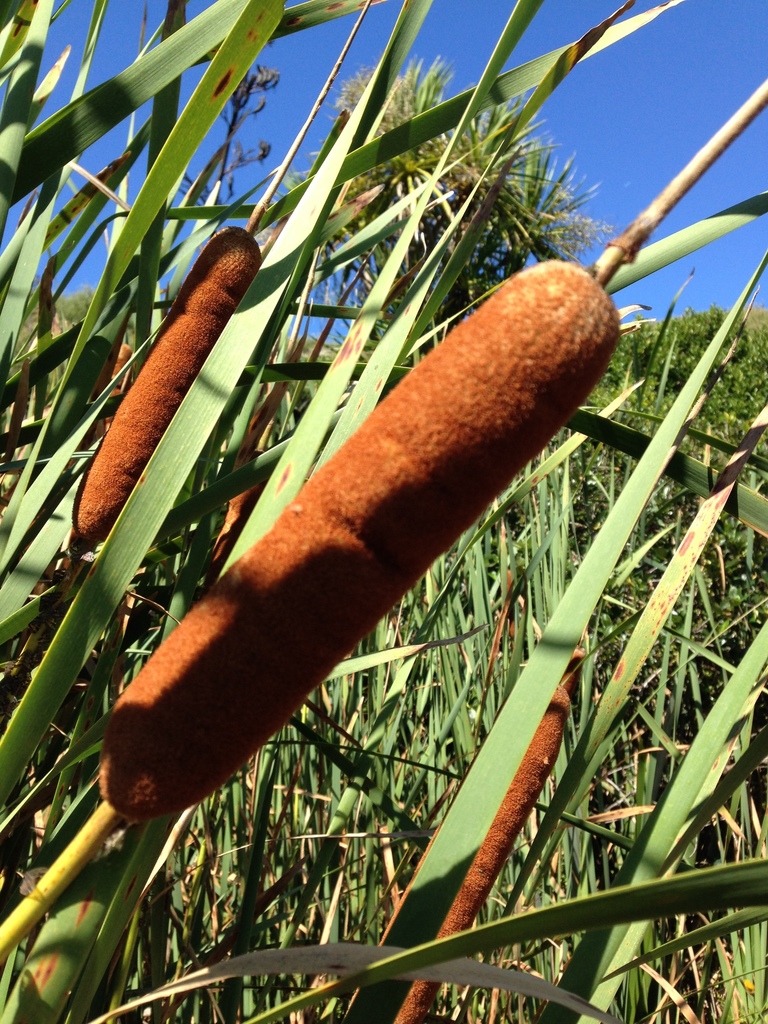
Oriental Cattail
Typha orientalis
Typha orientalis, commonly known as bulrush, bullrush, cumbungi in Australia, or raupō in New Zealand, is a perennial herbaceous plant in the genus Typha. It can be found in Australia (all 6 states plus Northern Territory and Norfolk Island), New Zealand including the Chatham Islands and the Kermadec Islands), Malaysia, Indonesia, Japan, Korea, Mongolia, Myanmar, Philippines, China and the Russian Far East (Sakhalin and Primorye).
From the article Typha orientalis on Wikipedia (CC BY-SA), quoted section by section
Description
Typha orientalis is a perennial herb which grows up to 3 m (9.8 ft) in height and has a rhizome of up to 40 mm (1.6 in) in diameter. The long, sausage-like flower spikes are between 300–500 mm (12–20 in) in length.
Range & habitat
The species is found across East Asia, Southeast Asia, Australia and New Zealand. The plant was introduced to the Chatham Islands of New Zealand by Māori.
Wikipedia: “Distribution”
At the table
Known as raupō in New Zealand, the plant was quite useful to Māori. The rhizomes were cooked and eaten, while the pollen was collected and baked into cakes known as pungapunga. The leaves were used for roofs and walls and occasionally for canoe sails, as well as a material for making kites. Many of the first shelters constructed for European settlers in the 19th century were made from raupō.
Wikipedia: “Uses”
In human culture
The species epithet orientalis refers to the species being found in East Asia. The plant's Māori name, raupō, is a word used in different Polynesian languages to describe bulrushes.
Wikipedia: “Etymology”
Where it lives
Recorded sightings
—
geo-referenced records in GBIF, from museums, herbaria and field observers.
Drag the globe to turn it. Dots are where records exist, not a range map; darker means more records.
In the stacks
Searching the stacks…
Every page naming Typha orientalis in the Biodiversity Heritage Library →
This page is assembled live from iNaturalist, GBIF, Wikipedia, the Source Library and the Internet Archive. It is not yet part of the hand-edited codex. iNaturalist taxon 341639.