cucumberbush
Thilachium africanum
Thilachium africanum is a species of flowering plant in the family Capparaceae. This shrub or small tree is native to Eswatini, Kenya, KwaZulu-Natal, Madagascar, Malawi, Mozambique, the Northern Provinces, Tanzania, and Zimbabwe.
From the article Thilachium africanum on Wikipedia (CC BY-SA), quoted section by section
Description
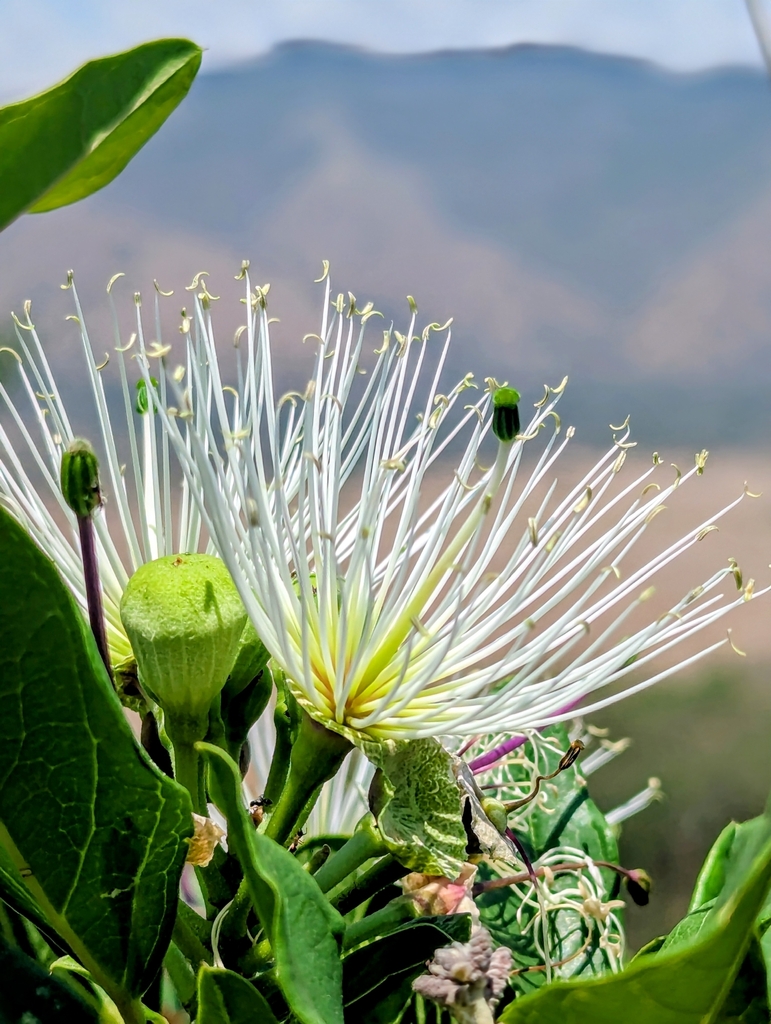
The species grows up to 7 meters tall with tuberous roots; branches are brown or grey and lenticellate. Leaves: simple or 3-foliate; leaflets obovate to elliptic in outline and with a leathery surface, the leaflets are about 3-9 cm long and 1-5 cm wide, apex is obtuse to rounded while base is cuneate to rounded. Inflorescence is terminal or axillary raceme like, white and green with spreading and wavy stamens. Fruit is cucumber like in shape, ellipsoid and up to 6 cm long and contains numerous seeds.
Range & habitat
Occurs in deciduous forests, opens woodland and riverine forests of Eastern Africa and in thickets.
Wikipedia: “Distribution”
At the table
Extracts of the species are used in preparations to ease pain, bark extracts are used to treat snake bites and diarrhoea among the Samburu people of Kenya. The tuberous roots are boiled and then drained a few times to reduce toxicity.
== References ==
Wikipedia: “Uses”
Where it lives
Recorded sightings
—
geo-referenced records in GBIF, from museums, herbaria and field observers.
Drag the globe to turn it. Dots are where records exist, not a range map; darker means more records.
In the stacks
Searching the stacks…
Every page naming Thilachium africanum in the Biodiversity Heritage Library →
This page is assembled live from iNaturalist, GBIF, Wikipedia, the Source Library and the Internet Archive. It is not yet part of the hand-edited codex. iNaturalist taxon 340231.