- Plants
- ›Vascular Plants
- ›flowering plants
- ›Dicots
- ›Legumes, Milkworts, and Allies
- ›Legumes
- ›Acacias, Mimosas, Mesquites, and Allies
- ›Mimoseae
- ›Newtonia
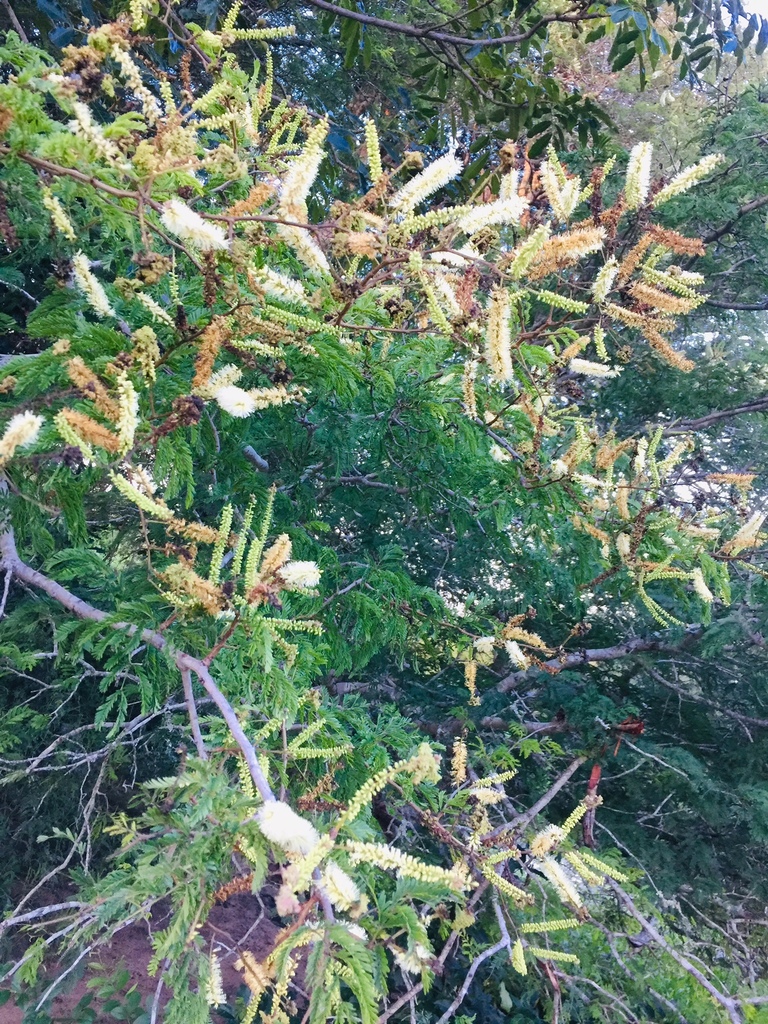
lowveld newtonia
Newtonia hildebrandtii
Newtonia hildebrandtii, the Lebombo wattle (Afrikaans: Lebombowattel, Zulu: Umfomothi), is a medium-sized tree native to eastern Africa. It is a protected tree in South Africa.
From the article Newtonia hildebrandtii on Wikipedia (CC BY-SA), quoted section by section
Description
Newtonia hildebrandtii is a medium-sized tree growing to a height of about 25 m (80 ft). The trunk is usually rough, and the small branchlets and twigs are puberulous (densely covered with very short soft hairs) when young. The leaves are bi-pinnate and up to 8 cm (3 in) long, each leaf having four to seven pairs of pinnae, and each pinna having six to nineteen pairs of leaflets. There is usually a gland between each pair of pinnae. The leaflets are linear or oblong and up to 11 by 3 mm (0.43 by 0.12 in) long, with the underside often having raised lateral nerves. The inflorescence is a spike up to 8 cm (3 in) long composed of whitish or creamy flowers, which are followed by flattened pods up to 30 cm (12 in) long.
Range & habitat
This tree is found in eastern Africa, its range extending from Kenya and Tanzania, through Malawi, Zimbabwe and Zambia, to Mozambique, Eswatini and KwaZulu-Natal in South Africa. Generally a tree of riverside forests, it also grows in sandy areas with a high water table, at altitudes of up to about 1,100 m (3,600 ft); these include the Southern African Sand Forest.
Wikipedia: “Distribution and habitat”
At the table
The timber of Newtonia hildebrandtii is used for building construction and for making poles and implements, and for carving. The wood burns well and makes good-quality charcoal. Products from the tree are also used in traditional medicine; an extract of the roots is used against worms, and an extract from the bark has been shown to have antimicrobial activity against a range of pathogens.
Wikipedia: “Uses”
Where it lives
Recorded sightings
—
geo-referenced records in GBIF, from museums, herbaria and field observers.
Drag the globe to turn it. Dots are where records exist, not a range map; darker means more records.
In the stacks
Searching the stacks…
Every page naming Newtonia hildebrandtii in the Biodiversity Heritage Library →
This page is assembled live from iNaturalist, GBIF, Wikipedia, the Source Library and the Internet Archive. It is not yet part of the hand-edited codex. iNaturalist taxon 340163.