- Plants
- ›Vascular Plants
- ›flowering plants
- ›monocots
- ›Agaves, Orchids, Irises, and Allies
- ›agave and allies
- ›cabbage tree subfamily
- ›Cordyline
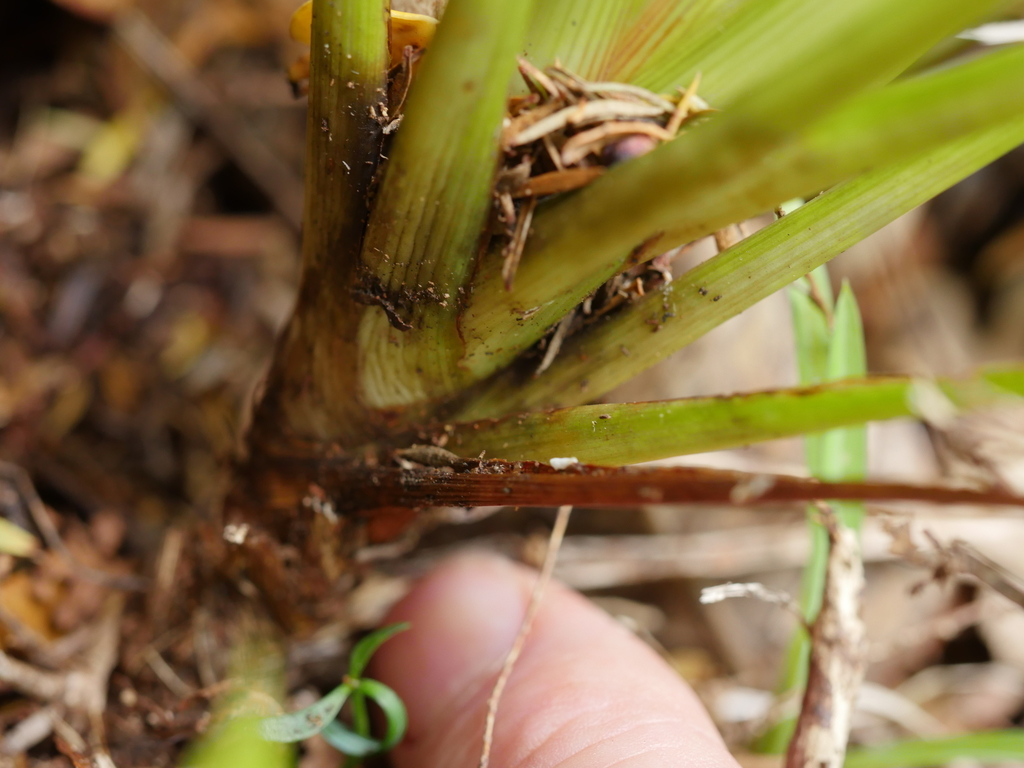
dwarf cabbage tree
Cordyline pumilio
Cordyline pumilio, commonly known as the dwarf cabbage tree, pygmy cabbage tree or by its Māori names tī koraha or tī rauriki, is a narrow-leaved monocot shrub endemic to the North Island of New Zealand. It usually grows up to 1 metre (3.3 feet) tall, although rare examples of 2 metres tall have been reported. It has long leaves and can easily be mistaken for a grass or a sedge. C. pumilio grows in the north of the North Island from North Cape at 34°S to Kawhia and Ōpōtiki at about 38°S, generally under light forest and scrub. It was cultivated by Māori as a source of carbohydrate and used as a relish to sweeten less palatable foods.
From the article Cordyline pumilio on Wikipedia (CC BY-SA), quoted section by section
Description
Cordyline pumilio is a plant rarely exceeding 2 metres (6.6 feet) tall. It is a very narrow-leaved species, and does not develop into the large tree-like form of C. australis. It often flowers while its short stem is leafy to the ground. In older plants the bare part of stem is up to 1 metre (3.3 feet) long and 1.5 cm (less than an inch) wide, and not usually very erect. The leaves are 30 cm to 1 metre (1–3 ft) long and 1 to 2 cm (up to an inch) wide, and may narrow above the base into a channelled petiole. The midrib is prominent abaxially, or at least proximally and the leaf margins are slightly recurved. The flower spike or panicle appears in November or December and is up to 60 by 30 cm (1.97 by 0.98 ft), very open with slender axes, branched to the second order, with small white or bluish-white flowers irregularly scattered along the branches. The bracts are often small and inconspicuous. The tepals are narrow, recurved and have three nerves. The stigma is short and trifid.
In human culture
Cordyline pumilio was cultivated by Māori in the Waikato district and elsewhere all over New Zealand. Young seedlings were carefully selected and planted out, and after perhaps three years the roots were dug up, stacked in small piles, and dried in the sun. As they dried, the fibrous roots were burned off, and then the roots were scraped and baked slowly in an umu or hāngī, requiring twelve to eighteen hours to cook. The cooked roots were chewed, or pounded and washed and squeezed to extract the sugar, which was eaten with fern root as a relish. Māori ranked the taste of the plant above tī kōuka (C. australis) and the other native species, but below tī pore (Cordyline fruticosa) which they brought with them from tropical Polynesia.
Wikipedia: “Cultural use”
Where it lives
Recorded sightings
—
geo-referenced records in GBIF, from museums, herbaria and field observers.
Drag the globe to turn it. Dots are where records exist, not a range map; darker means more records.
In the stacks
Searching the stacks…
Every page naming Cordyline pumilio in the Biodiversity Heritage Library →
This page is assembled live from iNaturalist, GBIF, Wikipedia, the Source Library and the Internet Archive. It is not yet part of the hand-edited codex. iNaturalist taxon 339967.