- Plants
- ›Vascular Plants
- ›flowering plants
- ›monocots
- ›grasses, sedges, cattails, and allies
- ›Rushes and Allies
- ›Luzula
- ›Luzula
- ›Anthelaea
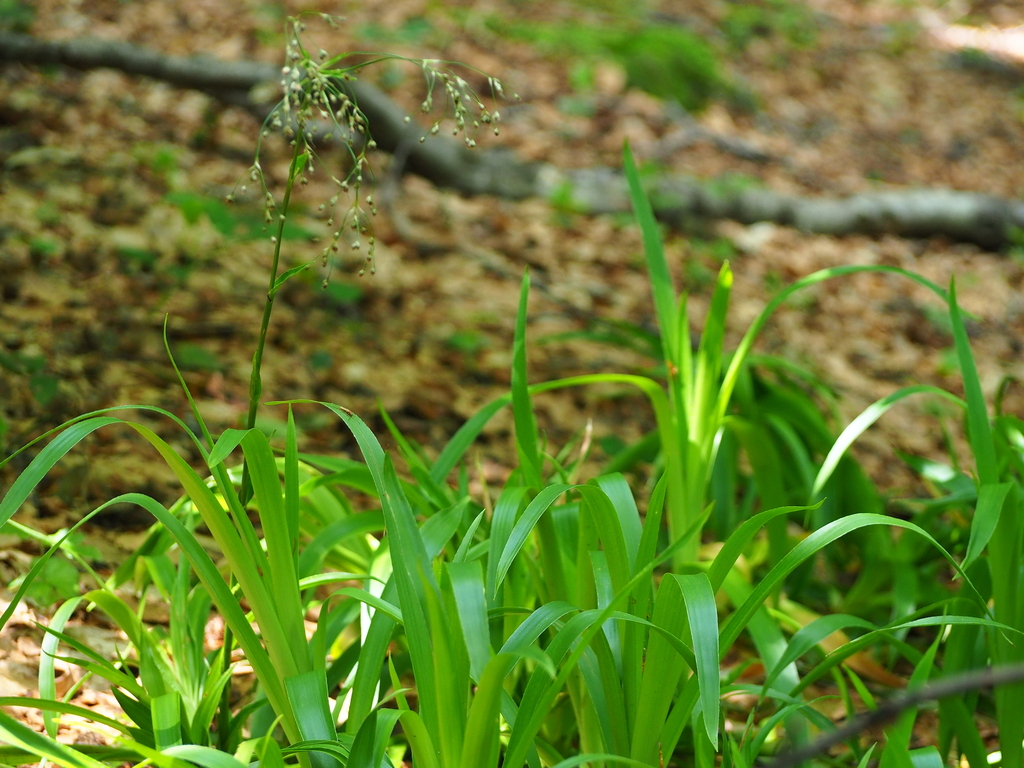
Great Woodrush
Luzula sylvatica
Luzula sylvatica, commonly known as greater wood-rush or great wood-rush, is a perennial flowering plant in the rush family Juncaceae.
From the article Luzula sylvatica on Wikipedia (CC BY-SA), quoted section by section
Description
Luzula sylvatica is the largest woodrush, with stems 30–80 centimetres (12–31 in) high. It forms clumps of bright green leaves which are glossy, flat, linear, about 10–30 centimetres (3.9–11.8 in) in length and 1 centimetre (0.39 in) wide; its leaves remain green or at least greenish throughout winter. The leaves can also help to differentiate the plant from similar-looking plants in the closely related genus Juncus, as scattered white hairs can be found along the leaf edges. Its tepals are 3–3.5 millimetres (0.12–0.14 in), with flowers which grow in groups of 3 or 4. It flowers from mid-spring to summer. It produces flowers in open panicles which are very small, chestnut-brown in colour and can be found in dense and lax clusters. It is sometimes stoloniferous. Luzula sylvatica can be pollinated by either wind or insects. L. sylvatica's fruit is a 3-valved capsule containing three oblong seeds. Each seed is indistinctly reticulate, often with a caruncle (a basal or apical appendage); seeds tend to germinate close to their parent plant.
Range & habitat
Luzula sylvatica has a wide distribution, and is native to Europe (the European temperate element of flora ) and southwest Asia—including the British Isles where populations are widespread and stable, apart from a decline in central and south east England. There is one record from Washington state, United States. Usually growing in partial to full shade, Luzula sylvatica tends to grow on acidic soils in damp habitats. It can be found on stream banks and well-drained, open woodland, as well as in open ground and rock ledges and peaty heath moors. Despite its preference for acidic soils, it can tolerate most soil pH levels.
Wikipedia: “Distribution and habitat”
What it does
The leaves of Luzula sylvatica are picked in winter by golden eagles to line their eyries. The flowers and seeds are also the sole food source for the larvae of the Coleophora sylvaticella moth.
Wikipedia: “Ecology”
How it is grown
Luzula sylvatica is commonly used in horticulture—its thick, patch-forming habit (which allows the plant to act as a weed suppressant), hardiness, as well as the ability to grow in shade and damp soils being particular boons; it is commonly used for ground cover and/or as an ornamental grass. The cultivar 'Marginata' has gained the Royal Horticultural Society's Award of Garden Merit.
Wikipedia: “Cultivation”
Where it lives
Recorded sightings
—
geo-referenced records in GBIF, from museums, herbaria and field observers.
Drag the globe to turn it. Dots are where records exist, not a range map; darker means more records.
In the stacks
Searching the stacks…
Every page naming Luzula sylvatica in the Biodiversity Heritage Library →
This page is assembled live from iNaturalist, GBIF, Wikipedia, the Source Library and the Internet Archive. It is not yet part of the hand-edited codex. iNaturalist taxon 338102.