- Animals
- ›Arthropods
- ›Hexapods
- ›Insects
- ›Winged and Once-winged Insects
- ›Ants, Bees, Wasps, and Sawflies
- ›Narrow-waisted Wasps, Ants, and Bees
- ›Ants, Bees, and Stinging Wasps
- ›Bees and Apoid Wasps
- ›Bees
- ›Honey Bees, Bumble Bees, and Allies
- ›Apine Bees
- ›Bombini
- ›Bombus
- ›Thoracobombus
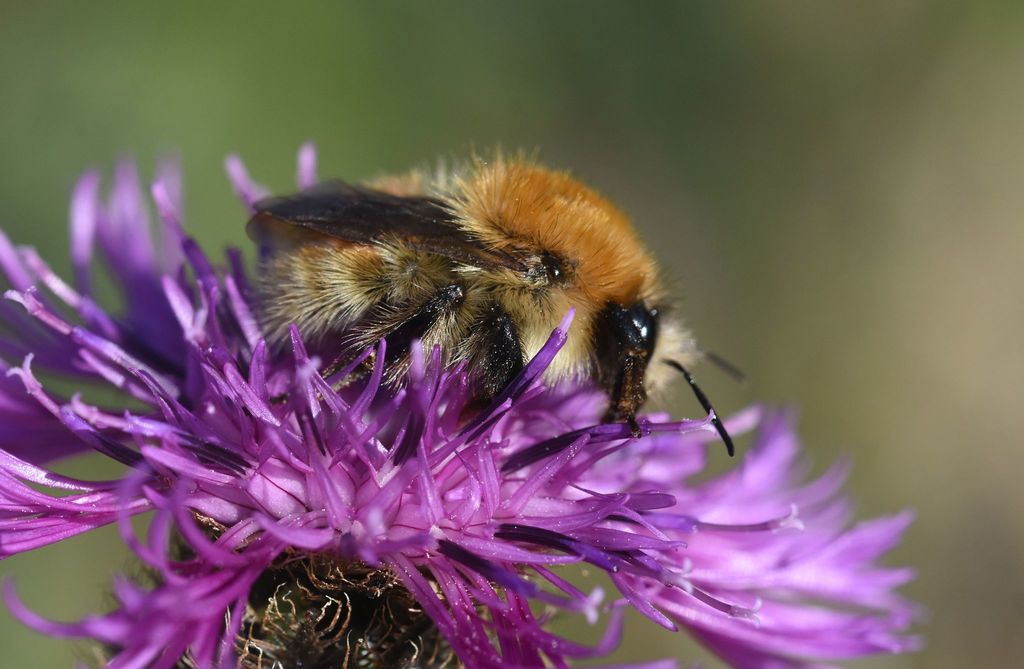
Brown-banded Carder-Bumble bee
Bombus humilis
The brown-banded carder bee (Bombus humilis) is a bumblebee found in most of Europe west of Russia, with the exception of Ireland and Iceland. It is also found in Turkey, on the Tibetan plateau, northern China, eastern and southern Mongolia, and parts of North Korea. In Britain, it is limited to the coast and chalkland areas of southern England, though the species has also been found in the Queen Elizabeth Olympic Park. The brown-banded carder bee is similar in appearance to the moss carder bee. As they share similar habitats, care must be taken to distinguish between the two.
From the article Brown-banded carder bee on Wikipedia (CC BY-SA), quoted section by section
Description
The brown-banded carder bee is medium-sized with a relatively long tongue. The queen is 16–18 mm (0.63–0.71 in) long, the worker 10–15 mm (0.39–0.59 in). The thorax is usually yellow-orange on top, with beige flanks, but may be dark brown. Most of the abdomen is beige, too, although with a somewhat striped effect. Both queens (the reproductive females) and workers usually have a broad, dark brown band (hence the common name) on the upper side of the abdomen, near the front, although it can be missing on some workers. A few black hairs - may only be one or two – are present on the thorax near the wing-bases. Males are similar to queens, but they lack stings and have longer antennae.
Range & habitat
The brown-banded carder bee favours vast grasslands. In Central Asia, it is an alpine species, living at altitudes of 3,000–3,900 m (9,800–12,800 ft). Among the plants visited are Trifolium pratense (red clover), Centaurea (knapweed) and Vicia (vetches).
Wikipedia: “Habitat”
Listen
Looking for field recordings…
Where it lives
Recorded sightings
—
geo-referenced records in GBIF, from museums, herbaria and field observers.
Drag the globe to turn it. Dots are where records exist, not a range map; darker means more records.
In the stacks
Searching the stacks…
Every page naming Bombus humilis in the Biodiversity Heritage Library →
This page is assembled live from iNaturalist, GBIF, Wikipedia, the Source Library and the Internet Archive. It is not yet part of the hand-edited codex. iNaturalist taxon 337776.